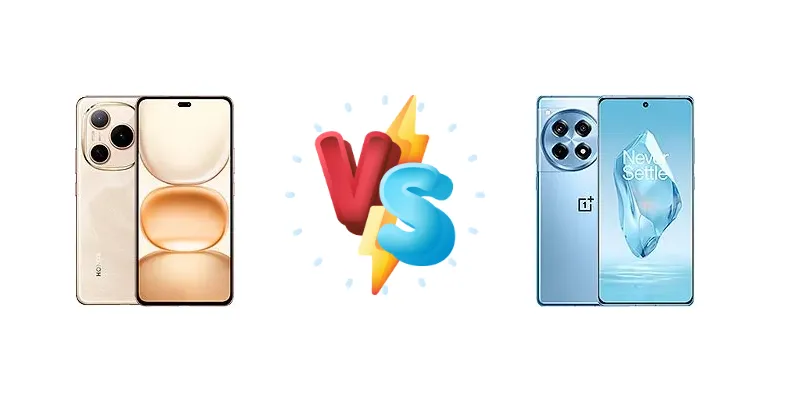
The mid-range smartphone market is fiercely competitive, and the Honor Power and OnePlus 12R represent compelling options for users seeking flagship-level features without the flagship price tag. The Honor Power focuses on providing a solid all-around experience with a focus on efficiency, while the OnePlus 12R prioritizes raw performance with a previous-generation flagship chipset. This comparison will dissect their key differences to help you determine which device best suits your needs.
🏆 Quick Verdict
For the average user prioritizing speed and responsiveness, the OnePlus 12R is the clear winner. Its Snapdragon 8 Gen 2 chipset delivers significantly higher performance than the Honor Power’s Snapdragon 7 Gen 3. However, the Honor Power offers a respectable experience and may appeal to those seeking a more balanced device with potentially better efficiency.
| Network |
|---|
| 2G bands | GSM 850 / 900 / 1800 / 1900 | GSM 850 / 900 / 1800 / 1900 |
| 3G bands | HSDPA 850 / 900 / 1900 / 2100 | HSDPA 850 / 900 / 1700(AWS) / 1900 / 2100 |
| 4G bands | LTE | 1, 2, 3, 4, 5, 7, 8, 12, 17, 18, 19, 20, 26, 28, 32, 38, 39, 40, 41, 66 |
| 5G bands | SA/NSA | 1, 2, 3, 5, 7, 8, 12, 20, 28, 38, 40, 41, 66, 77, 78 SA/NSA |
| Speed | HSPA, LTE, 5G | HSPA, LTE, 5G |
| Technology | GSM / HSPA / LTE / 5G | GSM / CDMA / HSPA / LTE / 5G |
| Launch |
|---|
| Announced | 2025, April 15 | 2024, January 23 |
| Status | Available. Released 2025, April 18 | Available. Released 2024, February 06 |
| Body |
|---|
| Build | - | Glass front (Gorilla Glass Victus 2), aluminum frame, glass back |
| Dimensions | 163.7 x 76.7 x 8 mm (6.44 x 3.02 x 0.31 in) | 163.3 x 75.3 x 8.8 mm (6.43 x 2.96 x 0.35 in) |
| SIM | Nano-SIM + Nano-SIM | · Nano-SIM + Nano-SIM + eSIM (max 2 at a time)· Nano-SIM + Nano-SIM |
| Weight | 209 g (7.37 oz) | 207 g (7.30 oz) |
| Display |
|---|
| Protection | Scratch/drop-resistant glass | Corning Gorilla Glass Victus 2 |
| Resolution | 1224 x 2700 pixels (~437 ppi density) | 1264 x 2780 pixels (~450 ppi density) |
| Size | 6.78 inches, 111.5 cm2 (~88.8% screen-to-body ratio) | 6.78 inches, 111.7 cm2 (~90.9% screen-to-body ratio) |
| Type | AMOLED, 1B colors, 120Hz, HDR, 4000 nits (peak) | LTPO4 AMOLED, 1B colors, 120Hz, HDR10+, Dolby Vision, 1600 nits (HBM), 4500 nits (peak) |
| Platform |
|---|
| CPU | Octa-core (1x2.63 GHz Cortex-A715 & 3x2.4 GHz Cortex-A715 & 4x1.8 GHz Cortex-A510) | Octa-core (1x3.2 GHz Cortex-X3 & 2x2.8 GHz Cortex-A715 & 2x2.8 GHz Cortex-A710 & 3x2.0 GHz Cortex-A510) |
| Chipset | Qualcomm SM7550-AB Snapdragon 7 Gen 3 (4 nm) | Qualcomm SM8550-AB Snapdragon 8 Gen 2 (4 nm) |
| GPU | Adreno 720 | Adreno 740 |
| OS | Android 15, MagicOS 9 | Android 14, up to 3 major Android upgrades, OxygenOS 15 |
| Memory |
|---|
| Card slot | No | No |
| Internal | 256GB 8GB RAM, 256GB 12GB RAM, 512GB 12GB RAM | 128GB 8GB RAM, 256GB 8GB RAM, 256GB 12GB RAM, 256GB 16GB RAM |
| Main Camera |
|---|
| Dual | 50 MP, f/2.0, (wide), 1/1.56", 1.0µm, PDAF, OIS
5 MP, (ultrawide) | - |
| Features | LED flash, HDR, panorama | Laser AF, color spectrum sensor, LED flash, HDR, panorama |
| Triple | - | 50 MP, f/1.8, 24mm (wide), 1/1.56", 1.0µm, multi-directional PDAF, OIS
8 MP, f/2.2, 16mm, 112˚ (ultrawide), 1/4.0", 1.12µm
2 MP (macro) |
| Video | 4K@30fps, 1080p@30fps, gyro-EIS | 4K@30/60fps, 1080p@30/60/120/240fps, gyro-EIS, OIS |
| Selfie camera |
|---|
| Features | - | HDR, panorama |
| Single | 16 MP, f/2.5, (wide) | 16 MP, f/2.4, 26mm (wide), 1/3", 1.0µm |
| Video | 1080p@30fps | 1080p@30fps, gyro-EIS |
| Sound |
|---|
| 35mm jack | No | No |
| Loudspeaker | Yes, with stereo speakers | Yes, with stereo speakers |
| Comms |
|---|
| Bluetooth | 5.3, A2DP, LE, aptX HD | 5.3, A2DP, LE, aptX HD |
| Infrared port | - | Yes |
| NFC | Yes | Yes |
| Positioning | GPS (L1+L5), GLONASS, BDS (B1I+B1c+B2a), GALILEO (E5a+E5b), QZSS (L1+L5), NavIC (L1+L5) | GPS, GALILEO, GLONASS, BDS, QZSS |
| Radio | No | No |
| USB | USB Type-C 2.0, OTG | USB Type-C 2.0 |
| WLAN | Wi-Fi 802.11 a/b/g/n/ac/6, dual-band, Wi-Fi Direct | Wi-Fi 802.11 a/b/g/n/ac/6/7, dual-band |
| Features |
|---|
| Sensors | Fingerprint (under display, optical), accelerometer, gyro, compass, proximity (ultrasonic) | Fingerprint (under display, optical), accelerometer, gyro, proximity, compass |
| Battery |
|---|
| Charging | 66W wired
5W reverse wired | 100W wired, 100% in 26 min |
| Type | Si/C Li-Ion 8000 mAh | Li-Ion 5500 mAh |
| Misc |
|---|
| Colors | Black, White, Gold | Iron Gray, Cool Blue, Electric Violet, Sunset Dune |
| Models | DVD-AN00 | CPH2609, CPH2585, CPH2611 |
| Price | About 240 EUR | € 410.84 / $ 399.95 / £ 649.00 |
| SAR | - | 1.19 W/kg (head) 0.82 W/kg (body) |
Honor Power
- Potentially better power efficiency due to the Snapdragon 7 Gen 3.
- More affordable price point (likely).
- 66W charging is still reasonably fast.
- Significantly lower performance compared to the Snapdragon 8 Gen 2.
- Likely a less advanced camera system.
- Slower charging than the OnePlus 12R.
OnePlus 12R
- Exceptional performance thanks to the Snapdragon 8 Gen 2.
- 100W SuperVOOC charging for incredibly fast top-ups.
- Brighter and potentially higher-quality display.
- May run warmer under sustained load.
- Potentially less battery efficiency than the Honor Power.
- Higher price tag.
Display Comparison
The OnePlus 12R boasts a brighter display, reaching a measured peak brightness of 1181 nits, which translates to better visibility outdoors. While the Honor Power’s display specifications are not provided, it’s likely to be lower. The OnePlus 12R’s panel likely benefits from its flagship positioning, offering a more vibrant and engaging viewing experience. The absence of LTPO technology in either device suggests both will rely on adaptive refresh rate switching rather than variable refresh rates for power saving.
Camera Comparison
Without detailed camera specifications for the Honor Power, a direct comparison is limited. However, given its mid-range positioning, it’s likely to feature a less sophisticated camera system than the OnePlus 12R. The OnePlus 12R likely benefits from a more advanced image signal processor (ISP) within the Snapdragon 8 Gen 2, resulting in better image processing, dynamic range, and low-light performance. Focusing on the main sensors is crucial; the presence of 2MP macro lenses on either device should be considered a marketing gimmick rather than a significant photographic advantage.
Performance
The core difference lies in the chipsets. The OnePlus 12R’s Snapdragon 8 Gen 2 (4nm) is a significant step up from the Honor Power’s Snapdragon 7 Gen 3 (4nm). The 8 Gen 2 features a prime Cortex-X3 core clocked at 3.2 GHz, alongside faster Cortex-A715 and A710 cores, providing a substantial performance advantage in CPU-intensive tasks. The Honor Power’s CPU configuration, while utilizing Cortex-A715 cores, has a lower peak clock speed and includes more efficiency-focused A510 cores. This translates to a noticeable difference in app loading times, multitasking smoothness, and gaming performance, favoring the OnePlus 12R.
Battery Life
The OnePlus 12R’s 100W wired charging is a game-changer, achieving a full charge in just 26 minutes. This is significantly faster than the Honor Power’s 66W charging. While the Honor Power’s battery capacity isn’t specified, the OnePlus 12R’s active use score of 14:32h demonstrates excellent battery life. The faster charging speed of the OnePlus 12R mitigates any potential concerns about battery capacity, offering a more convenient user experience.
Buying Guide
Buy the Honor Power if you need a reliable daily driver with good battery life and don't prioritize demanding gaming or intensive multitasking. It's ideal for users who value efficiency and a smooth, consistent experience over peak performance. Buy the OnePlus 12R if you prefer a phone capable of handling graphically intensive games, video editing, or frequent multitasking without slowdown. It’s the better choice for power users and those who want a phone that will remain responsive for years to come.
Frequently Asked Questions
❓ Will the Snapdragon 7 Gen 3 in the Honor Power struggle with demanding games like Genshin Impact?
Yes, while the Snapdragon 7 Gen 3 is a capable chip, it will likely require significant graphics settings reductions to achieve playable frame rates in demanding titles like Genshin Impact. The OnePlus 12R’s Snapdragon 8 Gen 2 offers a much smoother gaming experience with higher graphical fidelity.
❓ How much faster is the 100W charging on the OnePlus 12R compared to the 66W charging on the Honor Power in real-world use?
The OnePlus 12R’s 100W charging can take the battery from 0% to 100% in approximately 26 minutes. The Honor Power’s 66W charging will likely take around 45-60 minutes for a full charge, representing a significant time saving with the OnePlus 12R.
❓ Does the OnePlus 12R get noticeably hot during extended gaming sessions?
The Snapdragon 8 Gen 2 is a powerful chip and can generate heat under sustained load. While OnePlus has implemented thermal management solutions, some degree of warming is expected during prolonged gaming. However, it's unlikely to reach throttling levels that severely impact performance.