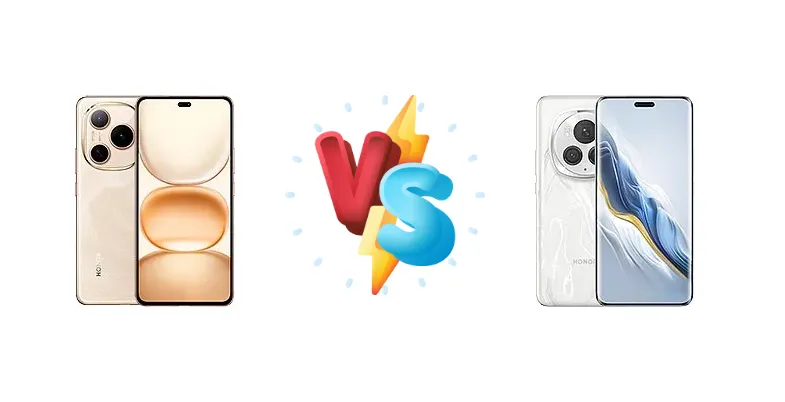
Honor is aggressively targeting different segments with the Magic6 Pro and the Power. The Magic6 Pro represents Honor’s latest flagship push, boasting the cutting-edge Snapdragon 8 Gen 3 and a stunning display. The Honor Power, conversely, aims for a more budget-conscious audience, prioritizing essential features and a long-lasting experience with the Snapdragon 7 Gen 3. This comparison dissects the key differences to help you determine which Honor device best suits your needs.
🏆 Quick Verdict
For users demanding top-tier performance, a brighter display, and faster charging, the Honor Magic6 Pro is the clear winner. However, the Honor Power provides a compelling value proposition, offering a solid Snapdragon 7 Gen 3 experience and respectable features at a significantly lower price point, making it ideal for everyday users.
| Network |
|---|
| 2G bands | GSM 850 / 900 / 1800 / 1900 | GSM 850 / 900 / 1800 / 1900 |
| 3G bands | HSDPA 850 / 900 / 1900 / 2100 | HSDPA 800 / 850 / 900 / 1700(AWS) / 1900 / 2100 |
| 4G bands | LTE | LTE |
| 5G bands | SA/NSA | SA/NSA |
| Speed | HSPA, LTE, 5G | HSPA, LTE, 5G |
| Technology | GSM / HSPA / LTE / 5G | GSM / CDMA / HSPA / CDMA2000 / LTE / 5G |
| Launch |
|---|
| Announced | 2025, April 15 | 2024, January 11 |
| Status | Available. Released 2025, April 18 | Available. Released 2024, January 18 |
| Body |
|---|
| Build | - | Glass front (NanoCrystal Shield), glass back or silicone polymer back (eco leather) |
| Dimensions | 163.7 x 76.7 x 8 mm (6.44 x 3.02 x 0.31 in) | 162.5 x 75.8 x 8.9 mm (6.40 x 2.98 x 0.35 in) |
| SIM | Nano-SIM + Nano-SIM | · Nano-SIM + eSIM· Nano-SIM + Nano-SIM |
| Weight | 209 g (7.37 oz) | 225 g or 229 g (7.94 oz) |
| Display |
|---|
| Protection | Scratch/drop-resistant glass | NanoCrystal Shield |
| Resolution | 1224 x 2700 pixels (~437 ppi density) | 1280 x 2800 pixels, 19.5:9 ratio (~453 ppi density) |
| Size | 6.78 inches, 111.5 cm2 (~88.8% screen-to-body ratio) | 6.8 inches, 112.8 cm2 (~91.6% screen-to-body ratio) |
| Type | AMOLED, 1B colors, 120Hz, HDR, 4000 nits (peak) | LTPO OLED, 1B colors, 120Hz, Dolby Vision, HDR, 1600 nits (HBM), 5000 nits (peak) |
| Platform |
|---|
| CPU | Octa-core (1x2.63 GHz Cortex-A715 & 3x2.4 GHz Cortex-A715 & 4x1.8 GHz Cortex-A510) | Octa-core (1x3.3 GHz Cortex-X4 & 3x3.2 GHz Cortex-A720 & 2x3.0 GHz Cortex-A720 & 2x2.3 GHz Cortex-A520) |
| Chipset | Qualcomm SM7550-AB Snapdragon 7 Gen 3 (4 nm) | Qualcomm SM8650-AB Snapdragon 8 Gen 3 (4 nm) |
| GPU | Adreno 720 | Adreno 750 |
| OS | Android 15, MagicOS 9 | Android 14, up to 4 major Android upgrades, MagicOS 8 |
| Memory |
|---|
| Card slot | No | No |
| Internal | 256GB 8GB RAM, 256GB 12GB RAM, 512GB 12GB RAM | 256GB 12GB RAM, 256GB 16GB RAM, 512GB 12GB RAM, 512GB 16GB RAM, 1TB 16GB RAM |
| Main Camera |
|---|
| Dual | 50 MP, f/2.0, (wide), 1/1.56", 1.0µm, PDAF, OIS
5 MP, (ultrawide) | - |
| Features | LED flash, HDR, panorama | Laser AF, color spectrum sensor, LED flash, HDR, panorama |
| Triple | - | 50 MP, f/1.4-2.0, 23mm (wide), 1/1.3", 1.2µm, PDAF, OIS
180 MP, f/2.6, (periscope telephoto), 1/1.49", 0.56µm, PDAF, OIS, 2.5x optical zoom
50 MP, f/2.0, 13mm, 122˚ (ultrawide), 1/2.88", 0.61µm, AF |
| Video | 4K@30fps, 1080p@30fps, gyro-EIS | 4K@24/30/60fps, 1080p@30/60/120/240fps, gyro-EIS, OIS, HDR, 10-bit video |
| Selfie camera |
|---|
| Single | 16 MP, f/2.5, (wide) | 50 MP, f/2.0, 22mm (wide), 1/2.93", 0.6µm, AF
TOF 3D, (depth/biometrics sensor) |
| Video | 1080p@30fps | 4K@30fps, 1080p@30/60fps, gyro-EIS |
| Sound |
|---|
| 35mm jack | No | No |
| Loudspeaker | Yes, with stereo speakers | Yes, with stereo speakers |
| Comms |
|---|
| Bluetooth | 5.3, A2DP, LE, aptX HD | 5.3, A2DP, LE, aptX HD |
| Infrared port | - | Yes |
| NFC | Yes | Yes |
| Positioning | GPS (L1+L5), GLONASS, BDS (B1I+B1c+B2a), GALILEO (E5a+E5b), QZSS (L1+L5), NavIC (L1+L5) | GPS (L1+L5), GLONASS, BDS (B1I+B1c+B2a), GALILEO (E1+E5a) |
| Radio | No | No |
| USB | USB Type-C 2.0, OTG | USB Type-C 3.2, DisplayPort 1.2, OTG |
| WLAN | Wi-Fi 802.11 a/b/g/n/ac/6, dual-band, Wi-Fi Direct | Wi-Fi 802.11 a/b/g/n/ac/6/7, dual-band, Wi-Fi Direct |
| Features |
|---|
| Sensors | Fingerprint (under display, optical), accelerometer, gyro, compass, proximity (ultrasonic) | Fingerprint (under display, optical), Face ID, accelerometer, gyro, proximity, compass |
| Battery |
|---|
| Charging | 66W wired
5W reverse wired | 80W wired
66W wireless
Reverse wireless
5W reverse wired |
| Type | Si/C Li-Ion 8000 mAh | Si/C Li-Ion 5600 mAh |
| Misc |
|---|
| Colors | Black, White, Gold | Black, Green, Blue, Purple, White |
| Models | DVD-AN00 | BVL-AN16, BVL-N49 |
| Price | About 240 EUR | € 455.54 / $ 899.00 / £ 598.99 |
Honor Power
- Excellent value for money
- Solid Snapdragon 7 Gen 3 performance
- Respectable battery life
- Display likely lacks the brightness and features of the Magic6 Pro
- Camera system likely less advanced
Honor Magic6 Pro
- Top-tier Snapdragon 8 Gen 3 performance
- Incredibly bright and likely LTPO display
- Fast 80W wired and 66W wireless charging
- Higher price point
- May be overkill for basic users
Display Comparison
The Honor Magic6 Pro boasts a significantly brighter display, reaching a measured peak of 1578 nits, compared to an unspecified brightness on the Honor Power. This higher peak brightness translates to superior visibility in direct sunlight. While the Power’s display specs are not provided, the Magic6 Pro’s likely utilizes LTPO technology for adaptive refresh rates, conserving battery life. The Magic6 Pro’s panel is geared towards a more immersive and visually vibrant experience, while the Power likely focuses on efficiency and cost-effectiveness.
Camera Comparison
Detailed camera specifications for the Honor Power are unavailable. However, the Magic6 Pro is expected to feature a more advanced camera system, leveraging the processing power of the Snapdragon 8 Gen 3 for superior image quality and computational photography. While the Power may offer a decent camera for everyday snapshots, the Magic6 Pro is likely to excel in low-light conditions and offer more advanced features like improved optical image stabilization (OIS) and more sophisticated image processing algorithms. Without specific sensor details for the Power, it’s difficult to make a direct comparison, but the Magic6 Pro’s flagship status suggests a more capable camera system.
Performance
The core difference lies in the chipsets: the Magic6 Pro utilizes the Qualcomm SM8650-AB Snapdragon 8 Gen 3 (4nm), while the Power features the SM7550-AB Snapdragon 7 Gen 3 (4nm). The Snapdragon 8 Gen 3’s Cortex-X4 prime core, clocked at 3.3 GHz, offers a substantial performance leap over the Power’s 2.63 GHz Cortex-A715. The Magic6 Pro’s CPU configuration (1x3.3 GHz Cortex-X4, 3x3.2 GHz Cortex-A720, 2x3.0 GHz Cortex-A720, 2x2.3 GHz Cortex-A520) is architecturally superior, promising faster app loading, smoother multitasking, and improved gaming performance. The Power’s Snapdragon 7 Gen 3 is still capable, but will show its limitations in graphically intensive applications. Both chips are built on a 4nm process, but the 8 Gen 3 benefits from architectural improvements for better thermal efficiency.
Battery Life
The Honor Magic6 Pro demonstrates impressive battery life, achieving an active use score of 14:06h. While the Honor Power’s battery capacity is not specified, the Magic6 Pro’s score indicates excellent power efficiency. The Magic6 Pro also supports 80W wired charging and 66W wireless charging, significantly faster than the Power’s 66W wired and 5W reverse wired charging. This means the Magic6 Pro can be rapidly topped up, minimizing downtime. The inclusion of reverse wireless charging on the Magic6 Pro adds further convenience, allowing it to charge other devices wirelessly.
Buying Guide
Buy the Honor Power if you need a reliable daily driver with good battery life and don't require the absolute latest processing power or display technology. It's perfect for students, casual gamers, and those prioritizing affordability. Buy the Honor Magic6 Pro if you prioritize a premium experience, demanding performance for demanding tasks like video editing or high-end gaming, and appreciate features like incredibly fast charging and a class-leading display.
Frequently Asked Questions
❓ Does the Snapdragon 7 Gen 3 in the Honor Power struggle with demanding games like Genshin Impact?
While the Snapdragon 7 Gen 3 is a capable chip, Genshin Impact and other graphically intensive games will likely require reduced graphics settings for a smooth experience on the Honor Power. The Magic6 Pro’s Snapdragon 8 Gen 3 will handle these games at higher settings with ease.
❓ How much faster is the 80W charging on the Magic6 Pro compared to the 66W charging on the Honor Power in real-world use?
The 80W charging on the Magic6 Pro will significantly reduce charging times. Expect a full charge in approximately 30-40 minutes, while the Honor Power’s 66W charging will likely take closer to 45-60 minutes. The Magic6 Pro also has the added benefit of 66W wireless charging, which the Power lacks.
❓ Is the lack of specific display details for the Honor Power a cause for concern?
The absence of detailed display specs suggests Honor prioritized cost savings in this area. Expect a display that is adequate for everyday use, but likely lacks the brightness, color accuracy, and potentially the refresh rate of the Magic6 Pro’s panel.