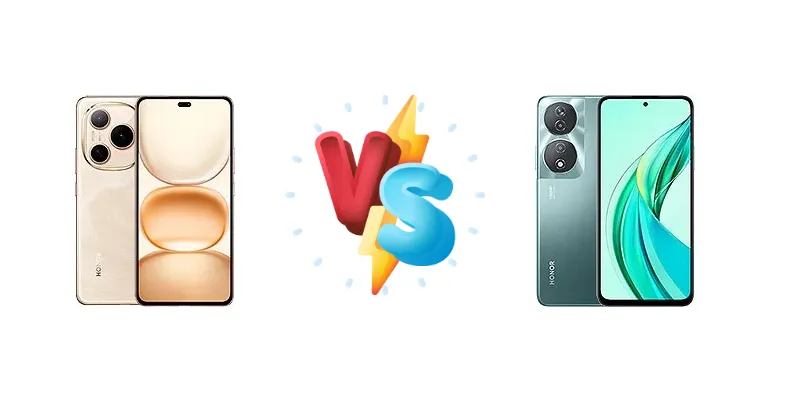
Honor's mid-range offerings, the Power and 90 Smart, present a compelling choice for budget-conscious buyers. The Power prioritizes rapid charging and a newer chipset, while the 90 Smart aims for a balance of features at a potentially lower price point. This comparison dissects the key differences to determine which device delivers the best overall experience.
🏆 Quick Verdict
For most users, the Honor Power emerges as the stronger contender. Its Snapdragon 7 Gen 3 chipset, built on a more efficient 4nm process, provides a noticeable performance advantage and better long-term thermal management. While the 90 Smart offers a respectable experience, the Power’s faster charging and superior processing power justify the potential price difference.
| Network |
|---|
| 2G bands | GSM 850 / 900 / 1800 / 1900 | GSM 850 / 900 / 1800 / 1900 |
| 3G bands | HSDPA 850 / 900 / 1900 / 2100 | HSDPA 850 / 900 / 1900 / 2100 |
| 4G bands | LTE | LTE |
| 5G bands | SA/NSA | SA/NSA |
| Speed | HSPA, LTE, 5G | HSPA, LTE, 5G |
| Technology | GSM / HSPA / LTE / 5G | GSM / HSPA / LTE / 5G |
| Launch |
|---|
| Announced | 2025, April 15 | 2024, April 09 |
| Status | Available. Released 2025, April 18 | Available. Released 2024, April 12 |
| Body |
|---|
| Dimensions | 163.7 x 76.7 x 8 mm (6.44 x 3.02 x 0.31 in) | 166.7 x 76.5 x 8.2 mm (6.56 x 3.01 x 0.32 in) |
| SIM | Nano-SIM + Nano-SIM | Nano-SIM + Nano-SIM |
| Weight | 209 g (7.37 oz) | 199 g (7.02 oz) |
| Display |
|---|
| Protection | Scratch/drop-resistant glass | - |
| Resolution | 1224 x 2700 pixels (~437 ppi density) | 1080 x 2412 pixels, 20:9 ratio (~389 ppi density) |
| Size | 6.78 inches, 111.5 cm2 (~88.8% screen-to-body ratio) | 6.8 inches, 111.3 cm2 (~87.3% screen-to-body ratio) |
| Type | AMOLED, 1B colors, 120Hz, HDR, 4000 nits (peak) | IPS LCD, 90Hz, 850 nits (peak) |
| Platform |
|---|
| CPU | Octa-core (1x2.63 GHz Cortex-A715 & 3x2.4 GHz Cortex-A715 & 4x1.8 GHz Cortex-A510) | Octa-core (2x2.2 GHz Cortex-A76 & 6x2.0 GHz Cortex-A55) |
| Chipset | Qualcomm SM7550-AB Snapdragon 7 Gen 3 (4 nm) | Mediatek Dimensity 6020 (7 nm) |
| GPU | Adreno 720 | Mali-G57 MC2 |
| OS | Android 15, MagicOS 9 | Android 13, Magic OS 7.2 |
| Memory |
|---|
| Card slot | No | No |
| Internal | 256GB 8GB RAM, 256GB 12GB RAM, 512GB 12GB RAM | 128GB 4GB RAM, 256GB 4GB RAM, 256GB 6GB RAM |
| Main Camera |
|---|
| Dual | 50 MP, f/2.0, (wide), 1/1.56", 1.0µm, PDAF, OIS
5 MP, (ultrawide) | - |
| Features | LED flash, HDR, panorama | LED flash, HDR, panorama |
| Triple | - | 108 MP, f/1.8, (wide), PDAF
2 MP (macro)
Auxiliary lens |
| Video | 4K@30fps, 1080p@30fps, gyro-EIS | 1080p@30fps |
| Selfie camera |
|---|
| Single | 16 MP, f/2.5, (wide) | 8 MP, f/2.0, (wide) |
| Video | 1080p@30fps | 1080p@30fps |
| Sound |
|---|
| 35mm jack | No | Yes |
| Loudspeaker | Yes, with stereo speakers | Yes, with stereo speakers |
| Comms |
|---|
| Bluetooth | 5.3, A2DP, LE, aptX HD | 5.1, A2DP, LE |
| NFC | Yes | Yes |
| Positioning | GPS (L1+L5), GLONASS, BDS (B1I+B1c+B2a), GALILEO (E5a+E5b), QZSS (L1+L5), NavIC (L1+L5) | GPS, GLONASS, GALILEO, BDS |
| Radio | No | No |
| USB | USB Type-C 2.0, OTG | USB Type-C 2.0, OTG |
| WLAN | Wi-Fi 802.11 a/b/g/n/ac/6, dual-band, Wi-Fi Direct | Wi-Fi 802.11 a/b/g/n/ac, dual-band, Wi-Fi Direct |
| Features |
|---|
| Sensors | Fingerprint (under display, optical), accelerometer, gyro, compass, proximity (ultrasonic) | Fingerprint (side-mounted), accelerometer, compass |
| Battery |
|---|
| Charging | 66W wired
5W reverse wired | 35W wired |
| Type | Si/C Li-Ion 8000 mAh | Li-Po 5330 mAh |
| Misc |
|---|
| Colors | Black, White, Gold | Emerald Green, Midnight Black |
| Models | DVD-AN00 | CLK-NX1, CLK-NX3 |
| Price | About 240 EUR | About 170 EUR |
Honor Power
- Faster Snapdragon 7 Gen 3 chipset for superior performance
- 66W fast charging for quick top-ups
- More efficient 4nm fabrication process
- Potentially higher price point
- Specific display details are unknown
Honor 90 Smart
- Likely more affordable price
- Decent performance for everyday tasks
- Acceptable 35W charging
- Less powerful Dimensity 6020 chipset
- 7nm process less efficient than 4nm
- Slower charging speeds
Display Comparison
Neither device boasts a standout display. While specific display specs (resolution, panel type) are missing, the focus here is on the underlying processing power impacting UI smoothness. The Snapdragon 7 Gen 3 in the Power likely provides a more responsive experience when navigating the UI and playing games, even if the panels themselves are similar. The absence of high refresh rate information suggests both are likely 60Hz, limiting visual fluidity.
Camera Comparison
Without detailed camera specifications, a direct comparison is limited. However, the chipset’s image signal processor (ISP) plays a vital role. Qualcomm’s ISPs are generally known for their strong image processing capabilities, potentially leading to better dynamic range and noise reduction in the Honor Power’s photos. The absence of information regarding sensor sizes and optical image stabilization (OIS) makes it difficult to assess image quality definitively, but the Power’s superior processing power gives it an edge. We can assume both phones will feature a standard array of lenses, but the Power is likely to deliver more refined results.
Performance
The core difference lies in the chipsets. The Honor Power’s Qualcomm Snapdragon 7 Gen 3 (4nm) is a significant step up from the Honor 90 Smart’s MediaTek Dimensity 6020 (7nm). The 4nm fabrication process of the Snapdragon translates to improved power efficiency and reduced heat generation, crucial for sustained performance. The Snapdragon 7 Gen 3’s CPU configuration – a 1x2.63 GHz Cortex-A715 prime core alongside three more Cortex-A715 cores – offers a more robust architecture than the Dimensity 6020’s 2x2.2 GHz Cortex-A76 setup. This means faster app loading, smoother multitasking, and a better gaming experience on the Honor Power. The Dimensity 6020, while capable, is geared towards efficiency rather than outright speed.
Battery Life
The Honor Power’s 66W wired charging is a clear advantage over the 90 Smart’s 35W charging. This translates to significantly faster charging times – a full charge from 0-100% will be considerably quicker on the Power. While battery capacity isn’t specified, the Snapdragon 7 Gen 3’s efficiency helps mitigate the impact of a potentially smaller battery. The 5W reverse wired charging on the Power is a useful addition for topping up accessories, a feature absent on the 90 Smart.
Buying Guide
Buy the Honor Power if you prioritize performance for gaming and demanding applications, and value the convenience of significantly faster 66W charging. This phone is ideal for users who frequently use their device throughout the day and need quick top-ups. Buy the Honor 90 Smart if you are looking for a more affordable option and your usage primarily revolves around everyday tasks like social media, browsing, and light multimedia consumption. It’s a solid choice for those who prioritize value over raw power.
Frequently Asked Questions
❓ Will the Dimensity 6020 in the Honor 90 Smart struggle with graphically intensive games like Genshin Impact?
The Dimensity 6020 can run Genshin Impact, but you’ll likely need to lower the graphics settings to medium or low to maintain a stable frame rate. The Snapdragon 7 Gen 3 in the Honor Power will provide a smoother experience at higher settings due to its more powerful GPU and efficient thermal management.
❓ How long does it realistically take to charge the Honor Power from 0% to 100% with the 66W charger?
With 66W charging, the Honor Power should be able to charge from 0% to 100% in approximately 45-55 minutes, depending on usage during charging. This is a substantial improvement over the 90 Smart’s 35W charging, which will likely take over an hour and a half.
❓ Is the difference in chipset performance noticeable for everyday tasks like browsing and social media?
For basic tasks, the difference won't be dramatically apparent. However, the Snapdragon 7 Gen 3 will provide a snappier and more responsive experience, especially when switching between apps or loading complex web pages. The 90 Smart will handle these tasks adequately, but the Power offers a more fluid user experience.