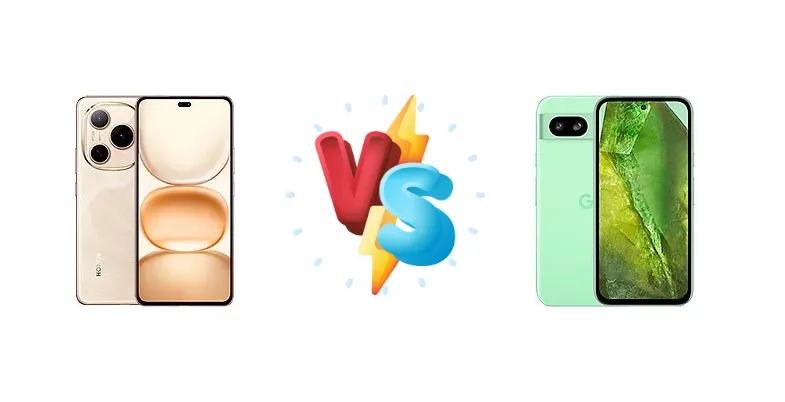
The Honor Power and Google Pixel 8a represent compelling options in the increasingly competitive mid-range smartphone market. The Honor Power prioritizes rapid charging and sustained performance, while the Pixel 8a leverages Google’s Tensor G3 chip and renowned camera software. This comparison dissects their key differences to determine which device best suits your needs.
🏆 Quick Verdict
For users prioritizing all-day battery life and blazing-fast 66W charging, the Honor Power is the clear winner. However, the Google Pixel 8a’s superior display brightness and Google’s image processing prowess make it the better choice for photography enthusiasts and those deeply integrated into the Google ecosystem.
| Network |
|---|
| 2G bands | GSM 850 / 900 / 1800 / 1900 | GSM 850 / 900 / 1800 / 1900 |
| 3G bands | HSDPA 850 / 900 / 1900 / 2100 | HSDPA 800 / 850 / 900 / 1700(AWS) / 1900 / 2100 |
| 4G bands | LTE | 1, 2, 3, 4, 5, 7, 8, 12, 17, 18, 19, 20, 26, 28, 32, 38, 40, 41, 42, 66 - G6GPR (International) |
| 5G bands | SA/NSA | 1, 2, 3, 5, 7, 8, 12, 20, 26, 28, 38, 40, 41, 66, 75, 76, 77, 78 SA/NSA/Sub6 - G6GPR (International) |
| Speed | HSPA, LTE, 5G | HSPA, LTE, 5G |
| Technology | GSM / HSPA / LTE / 5G | GSM / HSPA / LTE / 5G |
| Launch |
|---|
| Announced | 2025, April 15 | 2024, May 07 |
| Status | Available. Released 2025, April 18 | Available. Released 2024, May 14 |
| Body |
|---|
| Build | - | Glass front (Gorilla Glass 3), aluminum frame, plastic back |
| Dimensions | 163.7 x 76.7 x 8 mm (6.44 x 3.02 x 0.31 in) | 152.1 x 72.7 x 8.9 mm (5.99 x 2.86 x 0.35 in) |
| SIM | Nano-SIM + Nano-SIM | Nano-SIM + eSIM |
| Weight | 209 g (7.37 oz) | 188 g (6.63 oz) |
| Display |
|---|
| Protection | Scratch/drop-resistant glass | Corning Gorilla Glass 3, Mohs level 5 |
| Resolution | 1224 x 2700 pixels (~437 ppi density) | 1080 x 2400 pixels, 20:9 ratio (~430 ppi density) |
| Size | 6.78 inches, 111.5 cm2 (~88.8% screen-to-body ratio) | 6.1 inches, 90.3 cm2 (~81.6% screen-to-body ratio) |
| Type | AMOLED, 1B colors, 120Hz, HDR, 4000 nits (peak) | OLED, HDR, 120Hz, 2000 nits (peak) |
| Platform |
|---|
| CPU | Octa-core (1x2.63 GHz Cortex-A715 & 3x2.4 GHz Cortex-A715 & 4x1.8 GHz Cortex-A510) | Nona-core (1x3.0 GHz Cortex-X3 & 4x2.45 GHz Cortex-A715 & 4x2.15 GHz Cortex-A510) |
| Chipset | Qualcomm SM7550-AB Snapdragon 7 Gen 3 (4 nm) | Google Tensor G3 (4 nm) |
| GPU | Adreno 720 | Immortalis-G715s MC10 |
| OS | Android 15, MagicOS 9 | Android 14, upgradable to Android 16, up to 7 major Android upgrades |
| Memory |
|---|
| Card slot | No | No |
| Internal | 256GB 8GB RAM, 256GB 12GB RAM, 512GB 12GB RAM | 128GB 8GB RAM, 256GB 8GB RAM |
| Main Camera |
|---|
| Dual | 50 MP, f/2.0, (wide), 1/1.56", 1.0µm, PDAF, OIS
5 MP, (ultrawide) | 64 MP (16 MP eff.), f/1.9, 26mm (wide), 1/1.73", 0.8µm, dual pixel PDAF, OIS
13 MP, f/2.2, 120˚ (ultrawide), 1.12µm |
| Features | LED flash, HDR, panorama | Dual-LED flash, Pixel Shift, Ultra HDR, panorama, Best Take |
| Video | 4K@30fps, 1080p@30fps, gyro-EIS | 4K@30/60fps, 1080p@30/60/120/240fps, OIS |
| Selfie camera |
|---|
| Features | - | HDR, panorama |
| Single | 16 MP, f/2.5, (wide) | 13 MP, f/2.2, 20mm (ultrawide), 1.12µm |
| Video | 1080p@30fps | 4K@30fps, 1080p@30/60fps |
| Sound |
|---|
| 35mm jack | No | No |
| Loudspeaker | Yes, with stereo speakers | Yes, with stereo speakers |
| Comms |
|---|
| Bluetooth | 5.3, A2DP, LE, aptX HD | 5.3, A2DP, LE |
| NFC | Yes | Yes |
| Positioning | GPS (L1+L5), GLONASS, BDS (B1I+B1c+B2a), GALILEO (E5a+E5b), QZSS (L1+L5), NavIC (L1+L5) | GPS, GLONASS, GALILEO, BDS, QZSS, NavIC |
| Radio | No | No |
| USB | USB Type-C 2.0, OTG | USB Type-C 3.2 |
| WLAN | Wi-Fi 802.11 a/b/g/n/ac/6, dual-band, Wi-Fi Direct | Wi-Fi 802.11 a/b/g/n/ac/6e, dual/tri-band (market/region dependent) |
| Features |
|---|
| Sensors | Fingerprint (under display, optical), accelerometer, gyro, compass, proximity (ultrasonic) | Fingerprint (under display, optical), accelerometer, gyro, proximity, compass, barometer |
| Battery |
|---|
| Charging | 66W wired
5W reverse wired | 18W wired, PD3.0
7.5W wireless
Bypass charging |
| Type | Si/C Li-Ion 8000 mAh | Li-Po 4492 mAh |
| Misc |
|---|
| Colors | Black, White, Gold | Obsidian, Porcelain, Bay, Aloe |
| Models | DVD-AN00 | GKV4X, G6GPR, G8HHN, G576D |
| Price | About 240 EUR | $ 229.98 / C$ 417.99 / £ 279.00 / € 299.99 / ₹ 33,300 |
| EU LABEL |
|---|
| Battery | - | 40:06h endurance, 1000 cycles |
| Energy | - | Class B |
| Free fall | - | Class A (270 falls) |
| Repairability | - | Class B |
Honor Power
- 66W wired charging for incredibly fast top-ups
- Snapdragon 7 Gen 3 offers efficient performance
- Potentially better thermal management for sustained gaming
- Camera specs are unknown, potentially lagging behind Pixel 8a
- Slower charging speeds compared to some competitors
Google Pixel 8a
- Exceptional battery life and longevity (40:06h endurance)
- Superior display brightness (1508 nits)
- Google’s renowned camera software and image processing
- Slower 18W wired charging
- Tensor G3 may throttle under sustained heavy load
Display Comparison
The Google Pixel 8a boasts a significantly brighter display, reaching a measured 1508 nits, ensuring excellent visibility even in direct sunlight. While the Honor Power’s display specs are not provided, the Pixel 8a’s brightness advantage is substantial. The Pixel 8a’s OLED panel likely offers superior contrast and color accuracy. The absence of LTPO technology in either phone suggests neither offers adaptive refresh rates for optimal power efficiency, but the Pixel 8a’s brightness is a key differentiator.
Camera Comparison
The context data lacks detailed camera specifications for the Honor Power, making a direct comparison challenging. However, the Pixel 8a’s strength lies in Google’s computational photography. While sensor size and aperture are crucial, Google’s image processing algorithms consistently deliver excellent dynamic range, color accuracy, and low-light performance. The Pixel 8a’s software features, like Magic Eraser and Photo Unblur, add significant value. Without knowing the Honor Power’s sensor details, it’s difficult to assess its capabilities, but it’s unlikely to match the Pixel 8a’s software-driven image quality.
Performance
Both phones utilize a 4nm process, but their chipsets differ significantly. The Google Pixel 8a’s Tensor G3 employs a nona-core configuration with a Cortex-X3 prime core clocked at 3.0 GHz, designed for AI and machine learning tasks. The Honor Power’s Snapdragon 7 Gen 3 uses an octa-core setup, topping out at 2.63 GHz. While clock speed isn’t everything, the Tensor G3’s Cortex-X3 core provides a performance edge in demanding applications. However, the Snapdragon 7 Gen 3 is known for its efficiency, potentially leading to better sustained performance and thermal management during prolonged gaming sessions. The Pixel 8a’s focus on AI processing will benefit features like voice assistant and image editing.
Battery Life
The Google Pixel 8a’s endurance rating of 40:06h and active use score of 11:25h demonstrate exceptional battery life, supported by 1000 charge cycles indicating long-term battery health. The Honor Power’s battery capacity is not specified, but its 66W wired charging is significantly faster than the Pixel 8a’s 18W charging. This means the Honor Power can replenish its battery much quicker, even if its overall capacity is smaller. The Pixel 8a also offers 7.5W wireless charging and bypass charging, allowing use while charging, features absent on the Honor Power.
Buying Guide
Buy the Honor Power if you need a phone that can withstand heavy daily use with minimal downtime thanks to its rapid charging and efficient Snapdragon 7 Gen 3. It’s ideal for power users, gamers, and those who frequently travel. Buy the Google Pixel 8a if you prioritize camera quality, a vibrant display, and a clean, streamlined Android experience with guaranteed software updates. It’s perfect for everyday users, social media enthusiasts, and those invested in Google’s services.
Frequently Asked Questions
❓ Does the Snapdragon 7 Gen 3 in the Honor Power get hot during extended gaming sessions?
The Snapdragon 7 Gen 3 is known for its efficiency, which generally translates to better thermal management compared to higher-end, more power-hungry chips. While it will get warm during prolonged gaming, it’s less likely to experience significant throttling than the Tensor G3 in the Pixel 8a, potentially offering more consistent frame rates over longer periods.
❓ How does the 18W charging on the Pixel 8a compare to the 66W charging on the Honor Power in real-world use?
The 66W charging on the Honor Power will dramatically reduce charging times. Expect a full charge in under an hour, while the Pixel 8a will take considerably longer – likely over two hours. This makes the Honor Power ideal for users who need quick top-ups throughout the day.
❓ Is the Google Tensor G3’s AI processing noticeable in everyday tasks on the Pixel 8a?
Yes, the Tensor G3 excels in AI-powered features. You’ll notice improvements in voice assistant responsiveness, real-time translation, and especially in camera features like Magic Eraser and Photo Unblur, which leverage machine learning to enhance your photos.
❓ Does the Pixel 8a support features like Call Screen and Hold for Me, and how do they benefit users?
Yes, the Pixel 8a fully supports Google’s Call Screen and Hold for Me features. Call Screen filters spam calls and provides a transcript, while Hold for Me waits on hold for you, alerting you when a representative is available, saving you valuable time and frustration.