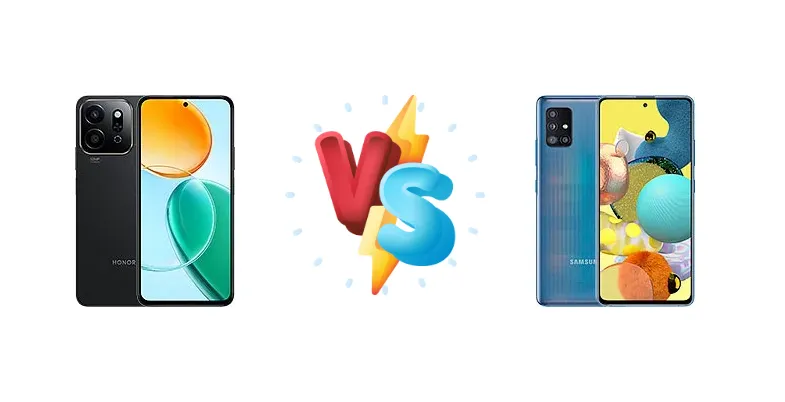
The Honor Play9T and Samsung Galaxy A51 5G UW represent compelling options in the increasingly competitive sub-$300 5G smartphone market. While both aim to deliver 5G connectivity at an accessible price, they take distinctly different approaches to chipset selection and feature prioritization. This comparison dissects their core specifications to determine which device offers the best overall value.
🏆 Quick Verdict
For the average user prioritizing sustained performance and future-proofing, the Honor Play9T emerges as the winner. Its newer Snapdragon 4 Gen 2 (4nm) chipset, despite a lower clock speed, offers superior efficiency and processing power compared to the older 7nm Snapdragon 765G in the A51 5G UW, making it better suited for demanding tasks and longer-term use.
| Network |
|---|
| 2G bands | GSM 850 / 900 / 1800 / 1900 | GSM 850 / 900 / 1800 / 1900 |
| 3G bands | HSDPA 850 / 900 / 1900 / 2100 | HSDPA 850 / 900 / 1900 / 2100 |
| 4G bands | 1, 3, 5, 8, 34, 38, 39, 40, 41 | 2, 4, 5, 13, 66 |
| 5G bands | 1, 5, 8, 28, 41, 78 SA/NSA | 260, 261 mmWave |
| Speed | HSPA, LTE, 5G | HSPA, LTE, 5G |
| Technology | GSM / CDMA / HSPA / CDMA2000 / LTE / 5G | GSM / HSPA / LTE / 5G |
| Launch |
|---|
| Announced | 2024, September 06 | 2020, August 14 |
| Status | Available. Released 2024, September 06 | Available. Released 2020, August 14 |
| Body |
|---|
| Build | - | Glass front (Gorilla Glass 3), plastic back, aluminum frame |
| Dimensions | 166.9 x 76.8 x 8.1 mm (6.57 x 3.02 x 0.32 in) | 158.8 x 73.4 x 8.6 mm (6.25 x 2.89 x 0.34 in) |
| SIM | Nano-SIM + Nano-SIM | Nano-SIM (pre-installed) |
| Weight | 197 g or 199 g (6.95 oz) | 188.8 g (6.67 oz) |
| Display |
|---|
| Protection | - | Corning Gorilla Glass 3 |
| Resolution | 720 x 1610 pixels, 20:9 ratio (~261 ppi density) | 1080 x 2400 pixels, 20:9 ratio (~405 ppi density) |
| Size | 6.77 inches, 110.2 cm2 (~86.0% screen-to-body ratio) | 6.5 inches, 102.0 cm2 (~87.5% screen-to-body ratio) |
| Type | TFT LCD, 120Hz | Super AMOLED |
| Platform |
|---|
| CPU | Octa-core (2x2.2 GHz Cortex-A78 & 6x1.95 GHz Cortex-A55) | Octa-core (1x2.4 GHz Kryo 475 Prime & 1x2.2 GHz Kryo 475 Gold & 6x1.8 GHz Kryo 475 Silver) |
| Chipset | Qualcomm SM4450 Snapdragon 4 Gen 2 (4 nm) | Qualcomm SM7250 Snapdragon 765G 5G (7 nm) |
| GPU | Adreno 613 | Adreno 620 |
| OS | Android 14, Magic OS 8 | Android 10, One UI 2 |
| Memory |
|---|
| Card slot | No | microSDXC (uses shared SIM slot) |
| Internal | 128GB 8GB RAM, 256GB 8GB RAM, 256GB 12GB RAM | 128GB 6GB RAM |
| | - | UFS 2.1 |
| Main Camera |
|---|
| Dual | 50 MP, f/1.8, (wide), AF
Auxiliary lens | - |
| Features | LED flash, HDR, panorama | LED flash, panorama, HDR |
| Quad | - | 48 MP, f/2.0, 26mm (wide), 1/2.0", 0.8µm, PDAF
12 MP, f/2.2, 123˚ (ultrawide)
5 MP (macro)
Auxiliary lens |
| Single | - | 5 MP, AF |
| Video | 1080p@30fps | 4K@30fps, 1080p@30/120fps; gyro-EIS |
| Selfie camera |
|---|
| Features | - | HDR |
| Single | 5 MP, f/2.2, (wide) | 32 MP, f/2.2, 26mm (wide), 1/2.8", 0.8µm |
| Video | 1080p@30fps | 4K@30fps, 1080p@30fps |
| Sound |
|---|
| 3.5mm jack | - | Yes |
| 35mm jack | Yes | Yes |
| Loudspeaker | Yes, with stereo speakers | Yes |
| Comms |
|---|
| Bluetooth | 5.0, A2DP, LE | 5.0, A2DP, LE |
| NFC | No | Yes |
| Positioning | GPS, GLONASS, GALILEO, BDS | GPS, GLONASS, GALILEO, BDS |
| Radio | No | FM radio, RDS, recording |
| USB | USB Type-C 2.0, OTG | USB Type-C 2.0, OTG |
| WLAN | Wi-Fi 802.11 a/b/g/n/ac, dual-band, Wi-Fi Direct | Wi-Fi 802.11 a/b/g/n/ac, dual-band, Wi-Fi Direct |
| Features |
|---|
| Sensors | Fingerprint (side-mounted), accelerometer, proximity (ultrasound), compass | Fingerprint (under display, optical), accelerometer, gyro, proximity, compass |
| | - | ANT+ |
| Battery |
|---|
| Charging | 35W wired | 15W wired |
| Stand-by | - | Up to 672 h |
| Talk time | - | Up to 5 h |
| Type | Li-Po 6000 mAh | Li-Po 4500 mAh |
| Misc |
|---|
| Colors | Black, White, Green | Prism Bricks Blue |
| Models | ALT-AN00 | SM-A516V |
| Price | About 120 EUR | About 470 EUR |
| SAR | - | 0.70 W/kg (head) 1.25 W/kg (body) |
| SAR EU | - | 0.59 W/kg (head) 1.32 W/kg (body) |
Honor Play9T
- Faster 35W charging for quicker top-ups.
- More efficient Snapdragon 4 Gen 2 (4nm) chipset.
- Potentially better long-term software support due to newer architecture.
- Brand recognition is lower than Samsung.
- Specific display details are unknown.
Samsung Galaxy A51 5G UW
- Established Samsung brand reputation.
- Potentially wider carrier compatibility.
- Likely larger display size for media consumption.
- Slower 15W charging.
- Less efficient Snapdragon 765G (7nm) chipset.
- Potential for thermal throttling under sustained load.
Display Comparison
Neither device boasts a particularly standout display. While specific display specs (resolution, panel type) are missing, the focus here is on the underlying processing power needed to drive a high-refresh-rate panel, which neither phone appears to offer. The A51 5G UW's larger screen size (likely) will be beneficial for media consumption, but the Play9T's chipset could potentially handle more complex visual processing if a comparable display were present.
Camera Comparison
Without detailed camera specifications, a direct comparison is difficult. However, the market segment suggests both phones will rely on software processing to enhance image quality. The A51 5G UW, being a slightly older model, may have a more refined image processing pipeline, but the Play9T’s newer chipset could potentially offer faster image processing speeds. The presence of OIS (Optical Image Stabilization) on either device is unknown, but would be a significant advantage for low-light photography.
Performance
The core difference lies in the chipsets. The Honor Play9T’s Qualcomm SM4450 Snapdragon 4 Gen 2 (4nm) is built on a significantly more efficient 4nm process compared to the Samsung Galaxy A51 5G UW’s Snapdragon 765G (7nm). While the 765G has higher peak clock speeds (2.4 GHz Kryo 475 Prime vs 2.2 GHz Cortex-A78), the 4nm node of the 4 Gen 2 translates to better thermal management and sustained performance. The Play9T’s CPU configuration – 2x Cortex-A78 and 6x Cortex-A55 – provides a strong balance of performance and efficiency, potentially outperforming the A51 5G UW’s more complex but less efficient Kryo configuration in real-world scenarios. The A51 5G UW's GPU may offer a slight edge in raw graphical power, but the Play9T's efficiency will likely result in less throttling during extended gaming sessions.
Battery Life
The Samsung Galaxy A51 5G UW’s 15W charging is a clear disadvantage compared to the Honor Play9T’s 35W wired charging. This translates to significantly faster charging times for the Play9T, reducing downtime. While battery capacity is unknown for both devices, the Snapdragon 4 Gen 2’s superior efficiency in the Play9T means it will likely deliver comparable or better battery life despite potentially having a smaller battery capacity. The faster charging speed of the Play9T is a substantial convenience factor.
Buying Guide
Buy the Honor Play9T if you need a phone that can handle everyday tasks and light gaming with efficiency, and you value a more modern chipset architecture for potential software updates and longevity. Buy the Samsung Galaxy A51 5G UW if you prioritize a more established brand reputation and potentially wider carrier compatibility, but are willing to compromise on raw processing power and thermal performance under sustained load.
Frequently Asked Questions
❓ Will the Snapdragon 4 Gen 2 in the Honor Play9T struggle with demanding games like PUBG Mobile?
While not a flagship chipset, the Snapdragon 4 Gen 2 is surprisingly capable. Its efficient architecture and Cortex-A78 cores should allow for playable frame rates in PUBG Mobile at medium settings. The 4nm process will also help mitigate thermal throttling, providing a more consistent gaming experience compared to the A51 5G UW.
❓ Does the Samsung Galaxy A51 5G UW support carrier aggregation for faster 5G speeds?
The Snapdragon 765G does support carrier aggregation, but the extent of its support depends on the specific carrier and network configuration. It's likely to offer improved 5G speeds compared to non-aggregated networks, but the Honor Play9T's newer modem may offer even better performance in certain scenarios.
❓ How long will it take to fully charge each phone from 0%?
With 35W charging, the Honor Play9T should fully charge in approximately 60-75 minutes. The Samsung Galaxy A51 5G UW, with its 15W charging, will likely take over 2 hours to reach 100%.