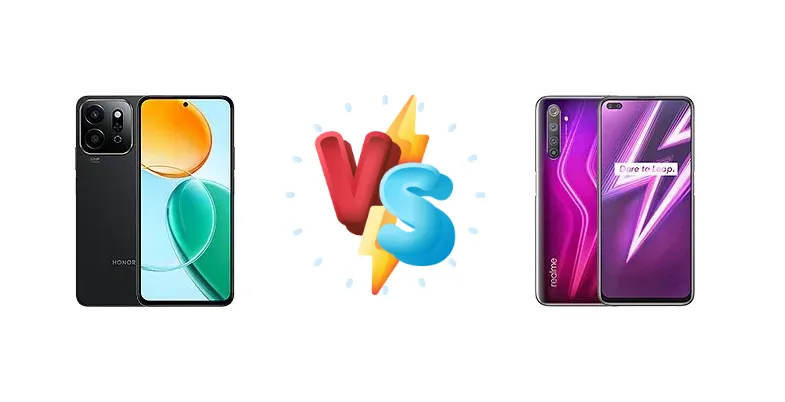
The Honor Play9T and Realme 6 Pro represent compelling options in the increasingly competitive budget smartphone market. While both aim to deliver a solid experience without breaking the bank, they take different approaches to achieving this goal. The Play9T leverages a newer, more efficient chipset, while the 6 Pro relies on a slightly older but more powerful processor. This comparison will dissect their key differences to determine which device best suits your needs.
🏆 Quick Verdict
For the average user prioritizing sustained performance and future-proofing, the Honor Play9T emerges as the better choice. Its Snapdragon 4 Gen 2 (4nm) offers superior thermal efficiency and a modern architecture, despite slightly lower peak CPU clock speeds compared to the Realme 6 Pro’s Snapdragon 720G.
| Network |
|---|
| 2G bands | GSM 850 / 900 / 1800 / 1900 | GSM 850 / 900 / 1800 / 1900 |
| 3G bands | HSDPA 850 / 900 / 1900 / 2100 | HSDPA 850 / 900 / 1700(AWS) / 1900 / 2100 - Global |
| 4G bands | 1, 3, 5, 8, 34, 38, 39, 40, 41 | 1, 2, 3, 4, 5, 7, 8, 20, 28, 38, 40, 41 - Global |
| 5G bands | 1, 5, 8, 28, 41, 78 SA/NSA | - |
| Speed | HSPA, LTE, 5G | HSPA 42.2/11.5 Mbps, LTE (2CA) Cat6 300/150 Mbps |
| Technology | GSM / CDMA / HSPA / CDMA2000 / LTE / 5G | GSM / HSPA / LTE |
| | - | 1, 3, 5, 8, 38, 40, 41 - India |
| Launch |
|---|
| Announced | 2024, September 06 | 2020, March 05. Released 2020, March 13 |
| Status | Available. Released 2024, September 06 | Discontinued |
| Body |
|---|
| Build | - | Glass front (Gorilla Glass 5), glass back, plastic frame |
| Dimensions | 166.9 x 76.8 x 8.1 mm (6.57 x 3.02 x 0.32 in) | 163.8 x 75.8 x 8.9 mm (6.45 x 2.98 x 0.35 in) |
| SIM | Nano-SIM + Nano-SIM | Nano-SIM + Nano-SIM |
| Weight | 197 g or 199 g (6.95 oz) | 202 g (7.13 oz) |
| Display |
|---|
| Protection | - | Corning Gorilla Glass 5 |
| Resolution | 720 x 1610 pixels, 20:9 ratio (~261 ppi density) | 1080 x 2400 pixels, 20:9 ratio (~399 ppi density) |
| Size | 6.77 inches, 110.2 cm2 (~86.0% screen-to-body ratio) | 6.6 inches, 105.2 cm2 (~84.7% screen-to-body ratio) |
| Type | TFT LCD, 120Hz | IPS LCD, 90Hz, 480 nits (typ) |
| Platform |
|---|
| CPU | Octa-core (2x2.2 GHz Cortex-A78 & 6x1.95 GHz Cortex-A55) | Octa-core (2x2.3 GHz Kryo 465 Gold & 6x1.8 GHz Kryo 465 Silver) |
| Chipset | Qualcomm SM4450 Snapdragon 4 Gen 2 (4 nm) | Qualcomm SM7125 Snapdragon 720G (8 nm) |
| GPU | Adreno 613 | Adreno 618 |
| OS | Android 14, Magic OS 8 | Android 10, upgradable to Android 11, Realme UI 2.0 |
| Memory |
|---|
| Card slot | No | microSDXC (dedicated slot) |
| Internal | 128GB 8GB RAM, 256GB 8GB RAM, 256GB 12GB RAM | 64GB 6GB RAM, 128GB 6GB RAM, 128GB 8GB RAM |
| | - | UFS 2.1 |
| Main Camera |
|---|
| Dual | 50 MP, f/1.8, (wide), AF
Auxiliary lens | - |
| Features | LED flash, HDR, panorama | LED flash, HDR, panorama |
| Quad | - | 64 MP, f/1.8, 26mm (wide), 1/1.72", 0.8µm, PDAF
12 MP, f/2.5, 54mm (telephoto), 1/3.4", 1.0µm, PDAF, 2x optical zoom
8 MP, f/2.3, 13mm (ultrawide), 1/4.0", 1.12µm
2 MP (macro) |
| Video | 1080p@30fps | 4K@30fps, 1080p@30/60/120fps, gyro-EIS |
| Selfie camera |
|---|
| Dual | - | 16 MP, f/2.1, 26mm (wide), 1/3.06", 1.0µm
8 MP, f/2.2, 105˚ (ultrawide), 1/4.0", 1.12µm |
| Features | - | HDR, panorama |
| Single | 5 MP, f/2.2, (wide) | - |
| Video | 1080p@30fps | 1080p@30fps |
| Sound |
|---|
| 3.5mm jack | - | Yes |
| 35mm jack | Yes | Yes |
| Loudspeaker | Yes, with stereo speakers | Yes |
| | - | 24-bit/192kHz audio |
| Comms |
|---|
| Bluetooth | 5.0, A2DP, LE | 5.1, A2DP, LE |
| NFC | No | Yes (market/region dependent) |
| Positioning | GPS, GLONASS, GALILEO, BDS | GPS (L1+L5), GLONASS, BDS, NavIC |
| Radio | No | FM radio |
| USB | USB Type-C 2.0, OTG | USB Type-C 2.0, OTG |
| WLAN | Wi-Fi 802.11 a/b/g/n/ac, dual-band, Wi-Fi Direct | Wi-Fi 802.11 a/b/g/n/ac, dual-band, Wi-Fi Direct |
| Features |
|---|
| Sensors | Fingerprint (side-mounted), accelerometer, proximity (ultrasound), compass | Fingerprint (side-mounted), accelerometer, gyro, proximity, compass |
| Battery |
|---|
| Charging | 35W wired | 30W wired, 100% in 57 min |
| Type | Li-Po 6000 mAh | 4300 mAh |
| Misc |
|---|
| Colors | Black, White, Green | Lightning Blue, Lightning Orange, Lightning Red |
| Models | ALT-AN00 | RMX2061, RMX2063 |
| Price | About 120 EUR | About 540 EUR |
| SAR | - | 1.19 W/kg (head) 0.92 W/kg (body) |
| Tests |
|---|
| Battery life | - |
Endurance rating 107h
|
| Camera | - |
Photo / Video |
| Display | - |
Contrast ratio: 1324:1 (nominal) |
| Loudspeaker | - |
-28.5 LUFS (Average)
|
| Performance | - |
AnTuTu: 268785 (v8)
GeekBench: 7027 (v4.4), 1666 (v5.1)
GFXBench: 19fps (ES 3.1 onscreen) |
Honor Play9T
- More efficient 4nm Snapdragon 4 Gen 2 chipset
- Potentially faster 35W charging
- Modern CPU architecture (Cortex-A78)
- Display specifications currently unknown
- Camera details are limited
Realme 6 Pro
- Brighter display (421 nits)
- Proven Snapdragon 720G performance
- Solid 107-hour endurance rating
- 8nm process may lead to thermal throttling
- Older CPU architecture
Display Comparison
The Realme 6 Pro boasts a measured peak brightness of 421 nits and a 1324:1 contrast ratio, providing a reasonably vibrant viewing experience. However, the Honor Play9T’s display specifications are currently unavailable. Given the Play9T’s focus on efficiency, it’s likely to prioritize power saving over absolute brightness. The identical contrast ratio suggests similar panel technology, but the Realme 6 Pro’s measured brightness gives it a slight edge for outdoor visibility. Without further data on the Play9T’s panel type and color accuracy, the Realme 6 Pro holds a marginal advantage in display quality.
Camera Comparison
Both devices feature 'Photo / Video' capabilities, but detailed camera specifications are lacking. Without sensor size, aperture, or OIS information, a direct comparison is difficult. However, it’s reasonable to assume the Realme 6 Pro, being a slightly older and more feature-rich model, might offer a more refined camera experience. The prevalence of 2MP macro lenses in this price bracket suggests both phones likely include one, but their utility is questionable. A deeper analysis requires detailed camera samples and specification breakdowns.
Performance
This is where the core difference lies. The Honor Play9T features the Qualcomm SM4450 Snapdragon 4 Gen 2 (4nm), utilizing an octa-core configuration with 2x2.2 GHz Cortex-A78 and 6x1.95 GHz Cortex-A55 cores. The Realme 6 Pro, on the other hand, employs the Snapdragon 720G (8nm) with 2x2.3 GHz Kryo 465 Gold and 6x1.8 GHz Kryo 465 Silver cores. While the 720G has slightly higher peak clock speeds, the Play9T’s 4nm process node is significantly more efficient. This translates to better thermal management and sustained performance, preventing the throttling that the 8nm 720G might experience during prolonged gaming or demanding tasks. The newer Cortex-A78 cores in the Play9T also offer architectural improvements over the Kryo 465 Gold cores, further enhancing efficiency.
Battery Life
The Realme 6 Pro has an endurance rating of 107 hours, indicating solid battery life. It supports 30W wired charging, achieving a 100% charge in 57 minutes. The Honor Play9T counters with 35W wired charging, potentially offering slightly faster charging speeds. However, without knowing the Play9T’s battery capacity, it’s difficult to assess its overall endurance. The 4nm process of the Snapdragon 4 Gen 2 in the Play9T should contribute to improved power efficiency, potentially offsetting a smaller battery capacity compared to the Realme 6 Pro.
Buying Guide
Buy the Honor Play9T if you need a phone that prioritizes long-term efficiency and consistent performance under load, making it ideal for everyday tasks and moderate gaming. Buy the Realme 6 Pro if you prefer a phone with a proven track record of solid performance and a slightly brighter display, and are willing to accept potentially more thermal throttling during extended intensive use.
Frequently Asked Questions
❓ Will the Snapdragon 720G in the Realme 6 Pro overheat during prolonged gaming sessions?
The Snapdragon 720G, built on an 8nm process, is known to generate more heat under sustained load compared to newer, more efficient chipsets. While the Realme 6 Pro has adequate cooling, expect some performance throttling during extended gaming sessions, particularly with graphically demanding titles. The Honor Play9T's 4nm Snapdragon 4 Gen 2 is less prone to this issue.
❓ How much faster is the 35W charging on the Honor Play9T compared to the 30W charging on the Realme 6 Pro?
While a 5W difference may seem small, the efficiency gains from the 4nm process in the Play9T could contribute to slightly faster overall charging times. The Realme 6 Pro takes 57 minutes to reach 100%; the Play9T may shave off a few minutes, but a precise estimate requires testing.
❓ Is the Snapdragon 4 Gen 2 in the Honor Play9T powerful enough for demanding apps and games?
The Snapdragon 4 Gen 2 is a capable chipset for everyday tasks and moderate gaming. While it doesn't match the raw power of the Snapdragon 720G, its modern architecture and 4nm efficiency provide a smooth experience for most users. Demanding games may require lower graphics settings for optimal performance.