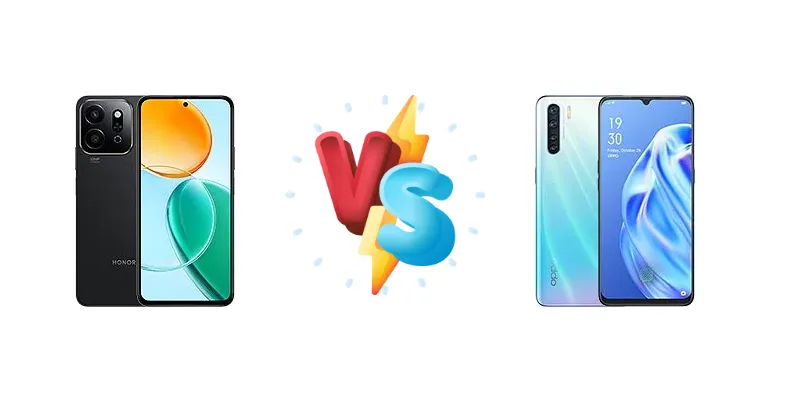
The Honor Play9T and Oppo F15 represent compelling options in the crowded budget smartphone market. While both aim to deliver essential features at an accessible price, they take fundamentally different approaches to core components like the chipset and charging technology. This comparison dissects these differences to determine which device offers the best overall experience.
🏆 Quick Verdict
For most users, the Honor Play9T emerges as the stronger choice. Its newer Qualcomm Snapdragon 4 Gen 2 chipset, built on a more efficient 4nm process, provides a noticeable performance advantage and better long-term efficiency compared to the Oppo F15’s older Helio P70. While the Oppo F15 boasts slightly faster initial charging, the Play9T’s superior processing power makes it the better all-rounder.
| Network |
|---|
| 2G bands | GSM 850 / 900 / 1800 / 1900 | GSM 850 / 900 / 1800 / 1900 |
| 3G bands | HSDPA 850 / 900 / 1900 / 2100 | HSDPA 850 / 900 / 2100 |
| 4G bands | 1, 3, 5, 8, 34, 38, 39, 40, 41 | 1, 3, 5, 8, 38, 40, 41 |
| 5G bands | 1, 5, 8, 28, 41, 78 SA/NSA | - |
| Speed | HSPA, LTE, 5G | HSPA, LTE |
| Technology | GSM / CDMA / HSPA / CDMA2000 / LTE / 5G | GSM / HSPA / LTE |
| Launch |
|---|
| Announced | 2024, September 06 | 2020, January 16. Released 2020, January |
| Status | Available. Released 2024, September 06 | Discontinued |
| Body |
|---|
| Build | - | Glass front (Gorilla Glass 5), plastic back, plastic frame |
| Dimensions | 166.9 x 76.8 x 8.1 mm (6.57 x 3.02 x 0.32 in) | 160.2 x 73.3 x 7.9 mm (6.31 x 2.89 x 0.31 in) |
| SIM | Nano-SIM + Nano-SIM | Nano-SIM + Nano-SIM |
| Weight | 197 g or 199 g (6.95 oz) | 172 g (6.07 oz) |
| Display |
|---|
| Protection | - | Corning Gorilla Glass 5 |
| Resolution | 720 x 1610 pixels, 20:9 ratio (~261 ppi density) | 1080 x 2400 pixels, 20:9 ratio (~408 ppi density) |
| Size | 6.77 inches, 110.2 cm2 (~86.0% screen-to-body ratio) | 6.4 inches, 100.4 cm2 (~85.5% screen-to-body ratio) |
| Type | TFT LCD, 120Hz | AMOLED, 430 nits (typ) |
| Platform |
|---|
| CPU | Octa-core (2x2.2 GHz Cortex-A78 & 6x1.95 GHz Cortex-A55) | Octa-core (4x2.1 GHz Cortex-A73 & 4x2.0 GHz Cortex-A53) |
| Chipset | Qualcomm SM4450 Snapdragon 4 Gen 2 (4 nm) | Mediatek MT6771V Helio P70 (12 nm) |
| GPU | Adreno 613 | Mali-G72 MP3 |
| OS | Android 14, Magic OS 8 | Android 9.0 (Pie), upgradable to Android 11, ColorOS 11.1 |
| Memory |
|---|
| Card slot | No | microSDXC (dedicated slot) |
| Internal | 128GB 8GB RAM, 256GB 8GB RAM, 256GB 12GB RAM | 128GB 4GB RAM, 128GB 8GB RAM |
| | - | UFS 2.1 |
| Main Camera |
|---|
| Dual | 50 MP, f/1.8, (wide), AF
Auxiliary lens | - |
| Features | LED flash, HDR, panorama | LED flash, HDR, panorama |
| Quad | - | 48 MP, f/1.8, 26mm (wide), 1/2.0", 0.8µm, PDAF
8 MP, f/2.3, 13mm (ultrawide), 1/4.0", 1.12µm
2 MP B/W, f/2.4, 1/5.0", 1.75µm
Auxiliary lens |
| Video | 1080p@30fps | 1080p@30fps, gyro-EIS |
| Selfie camera |
|---|
| Features | - | HDR |
| Single | 5 MP, f/2.2, (wide) | 16 MP, f/2.0, 26mm (wide), 1/3.06", 1.0µm |
| Video | 1080p@30fps | 1080p@30fps |
| Sound |
|---|
| 3.5mm jack | - | Yes |
| 35mm jack | Yes | Yes |
| Loudspeaker | Yes, with stereo speakers | Yes |
| Comms |
|---|
| Bluetooth | 5.0, A2DP, LE | 4.2, A2DP, LE |
| NFC | No | No |
| Positioning | GPS, GLONASS, GALILEO, BDS | GPS, GLONASS, BDS |
| Radio | No | FM radio |
| USB | USB Type-C 2.0, OTG | USB Type-C 2.0, OTG |
| WLAN | Wi-Fi 802.11 a/b/g/n/ac, dual-band, Wi-Fi Direct | Wi-Fi 802.11 a/b/g/n/ac, dual-band, Wi-Fi Direct |
| Features |
|---|
| Sensors | Fingerprint (side-mounted), accelerometer, proximity (ultrasound), compass | Fingerprint (under display, optical), accelerometer, gyro, proximity, compass |
| Battery |
|---|
| Charging | 35W wired | 20W wired, 50% in 30 min |
| Type | Li-Po 6000 mAh | Li-Po 4025 mAh |
| Misc |
|---|
| Colors | Black, White, Green | Lightening Black, Unicorn White |
| Models | ALT-AN00 | CPH2001 |
| Price | About 120 EUR | About 250 EUR |
| SAR | - | 1.20 W/kg (head) 0.55 W/kg (body) |
Honor Play9T
- More powerful and efficient Snapdragon 4 Gen 2 chipset
- Superior CPU architecture for better multitasking
- Potentially longer battery life due to 4nm process
- Slower advertised charging speed (35W)
- Display specifications unknown
Oppo F15
- Faster initial charging speed (20W, 50% in 30 min)
- Potentially more refined software experience (Oppo's ColorOS)
- Aesthetically focused design (historically)
- Older and less efficient Helio P70 chipset
- Less capable CPU architecture
- Potential for throttling under heavy load
Display Comparison
Neither device’s display specifications are provided, so we must infer. Given the price bracket, both likely feature LCD panels with 1080p+ resolution. The Oppo F15, historically, has focused on aesthetic design, potentially offering slightly slimmer bezels. However, the real difference will be in color accuracy and brightness, which are unknown. Without specific data, it’s difficult to declare a clear winner; the display experience will likely be comparable.
Camera Comparison
Without sensor details, a direct comparison is challenging. However, the market segment suggests both phones will rely on multi-camera setups with a primary sensor and supporting lenses. It’s likely the Oppo F15 will emphasize software-based image enhancements, a common Oppo strategy. The Honor Play9T, leveraging Qualcomm’s image signal processor, may offer more natural image processing. The absence of information on optical image stabilization (OIS) suggests neither phone will feature it, limiting low-light performance. We can assume both will include a standard macro lens, but its utility will be limited by the 2MP resolution.
Performance
The core differentiator lies in the chipsets. The Honor Play9T’s Qualcomm Snapdragon 4 Gen 2 (4nm) is a significant upgrade over the Oppo F15’s MediaTek Helio P70 (12nm). The 4nm fabrication process of the Snapdragon offers superior power efficiency, translating to less heat generation and potentially less throttling during extended use. The Snapdragon’s CPU configuration – 2x2.2 GHz Cortex-A78 & 6x1.95 GHz Cortex-A55 – also provides a more modern and capable architecture compared to the Helio P70’s 4x2.1 GHz Cortex-A73 & 4x2.0 GHz Cortex-A53. This means the Play9T will handle demanding apps and games with greater ease. The Snapdragon’s integrated GPU will also deliver a better graphical experience.
Battery Life
The Oppo F15’s 20W charging with a claimed 50% charge in 30 minutes is faster than the Honor Play9T’s 35W charging, which doesn't have a specified time. However, the Snapdragon 4 Gen 2’s superior efficiency means the Play9T will likely consume less power overall, potentially offsetting the slower charging speed. Battery capacity is unknown for both devices, but the Snapdragon’s efficiency will contribute to longer real-world battery life, even with a potentially smaller battery.
Buying Guide
Buy the Honor Play9T if you prioritize sustained performance for gaming, multitasking, and future-proofing. The Snapdragon 4 Gen 2 offers a significant leap over the Helio P70, ensuring a smoother experience. Buy the Oppo F15 if your primary concern is a quick initial battery boost and you primarily use your phone for basic tasks like calls, messaging, and light social media. However, be prepared for potential performance limitations with demanding applications.
Frequently Asked Questions
❓ Will the Snapdragon 4 Gen 2 in the Honor Play9T handle demanding games like PUBG Mobile?
Yes, the Snapdragon 4 Gen 2 is a significant step up from the Helio P70 and should provide a playable experience in PUBG Mobile, likely at medium settings. While it won't match flagship performance, the 4nm process and Cortex-A78 cores will offer a noticeable improvement over the Oppo F15.
❓ How much faster is the charging on the Oppo F15 compared to the Honor Play9T in real-world use?
While the Oppo F15 claims 50% charge in 30 minutes, the Honor Play9T’s 35W charging, combined with the Snapdragon’s efficiency, may close the gap. The F15 will be faster initially, but the Play9T’s lower power consumption could mean less frequent charging overall.
❓ Is the difference between the Helio P70 and Snapdragon 4 Gen 2 noticeable for everyday tasks?
For basic tasks like browsing, social media, and messaging, the difference might be subtle. However, when multitasking, opening multiple apps, or using more demanding applications, the Snapdragon 4 Gen 2 will provide a smoother and more responsive experience.