
Honor Play9T vs Huawei nova 7i: Which Mid-Range Phone Reigns Supreme?
| Phones Images | |||||
|---|---|---|---|---|---|
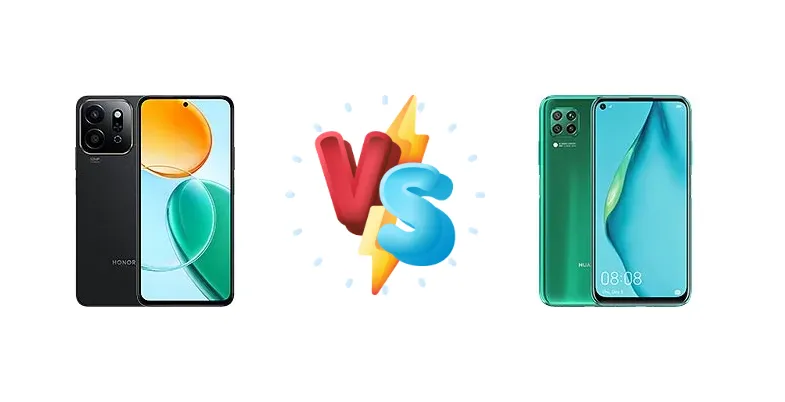
|
🏆 Quick Verdict
For the average user prioritizing long-term efficiency and future-proofing, the Honor Play9T emerges as the winner. Its Snapdragon 4 Gen 2, built on a 4nm process, offers superior power efficiency and potential for sustained performance compared to the 7nm Kirin 810 in the nova 7i. While the nova 7i boasts faster 40W charging, the Play9T’s more modern chipset provides a more balanced overall package.
| PHONES | ||
|---|---|---|
| Phone Names | Honor Play9T | Huawei nova 7i |
| Network | ||
|---|---|---|
| 2G bands | GSM 850 / 900 / 1800 / 1900 | GSM 850 / 900 / 1800 / 1900 |
| 3G bands | HSDPA 850 / 900 / 1900 / 2100 | HSDPA 800 / 850 / 900 / 1700(AWS) / 2100 |
| 4G bands | 1, 3, 5, 8, 34, 38, 39, 40, 41 | 1, 2, 3, 4, 5, 7, 8, 18, 19, 20, 28, 34, 38, 39, 40, 41 - JNY-L21A, JNY-L01A, JNY-L21B |
| 5G bands | 1, 5, 8, 28, 41, 78 SA/NSA | - |
| Speed | HSPA, LTE, 5G | HSPA 42.2/5.76 Mbps, LTE (2CA) Cat13 400/75 Mbps |
| Technology | GSM / CDMA / HSPA / CDMA2000 / LTE / 5G | GSM / CDMA / HSPA / LTE |
| - | 1, 2, 3, 4, 5, 7, 8, 18, 19, 28, 34, 38, 39, 40, 41 - JNY-L22A, JNY-L02A, JNY-L22B | |
| Launch | ||
|---|---|---|
| Announced | 2024, September 06 | 2020, January 30. Released 2020, February 14 |
| Status | Available. Released 2024, September 06 | Discontinued |
| Body | ||
|---|---|---|
| Build | - | Glass front, plastic back, plastic frame |
| Dimensions | 166.9 x 76.8 x 8.1 mm (6.57 x 3.02 x 0.32 in) | 159.2 x 76.3 x 8.7 mm (6.27 x 3.00 x 0.34 in) |
| SIM | Nano-SIM + Nano-SIM | · Nano-SIM· Nano-SIM + Nano-SIM |
| Weight | 197 g or 199 g (6.95 oz) | 183 g (6.46 oz) |
| Display | ||
|---|---|---|
| Resolution | 720 x 1610 pixels, 20:9 ratio (~261 ppi density) | 1080 x 2310 pixels (~398 ppi density) |
| Size | 6.77 inches, 110.2 cm2 (~86.0% screen-to-body ratio) | 6.4 inches, 101.4 cm2 (~83.5% screen-to-body ratio) |
| Type | TFT LCD, 120Hz | IPS LCD |
| Platform | ||
|---|---|---|
| CPU | Octa-core (2x2.2 GHz Cortex-A78 & 6x1.95 GHz Cortex-A55) | Octa-core (2x2.27 GHz Cortex-A76 & 6x1.88 GHz Cortex-A55) |
| Chipset | Qualcomm SM4450 Snapdragon 4 Gen 2 (4 nm) | Kirin 810 (7 nm) |
| GPU | Adreno 613 | Mali-G52 MP6 |
| OS | Android 14, Magic OS 8 | Android 10, EMUI 10, no Google Play Services |
| Memory | ||
|---|---|---|
| Card slot | No | Nano Memory (uses shared SIM slot) |
| Internal | 128GB 8GB RAM, 256GB 8GB RAM, 256GB 12GB RAM | 128GB 8GB RAM |
| - | UFS 2.1 | |
| Main Camera | ||
|---|---|---|
| Dual | 50 MP, f/1.8, (wide), AF Auxiliary lens | - |
| Features | LED flash, HDR, panorama | LED flash, HDR, panorama |
| Quad | - | 48 MP, f/1.8, 26mm (wide), 1/2.0", 0.8µm, PDAF 8 MP, f/2.4, (ultrawide) 2 MP (macro) Auxiliary lens |
| Video | 1080p@30fps | 1080p@30fps |
| Selfie camera | ||
|---|---|---|
| Features | - | HDR |
| Single | 5 MP, f/2.2, (wide) | 16 MP, f/2.0, (wide), 1/3.06", 1.0µm |
| Video | 1080p@30fps | 1080p@30fps |
| Sound | ||
|---|---|---|
| 3.5mm jack | - | Yes |
| 35mm jack | Yes | Yes |
| Loudspeaker | Yes, with stereo speakers | Yes |
| Comms | ||
|---|---|---|
| Bluetooth | 5.0, A2DP, LE | 5.1, A2DP, LE |
| NFC | No | No |
| Positioning | GPS, GLONASS, GALILEO, BDS | GPS, GLONASS, GALILEO, BDS, QZSS |
| Radio | No | FM radio (market/region dependent) |
| USB | USB Type-C 2.0, OTG | USB Type-C 2.0, OTG |
| WLAN | Wi-Fi 802.11 a/b/g/n/ac, dual-band, Wi-Fi Direct | Wi-Fi 802.11 a/b/g/n/ac, dual-band, Wi-Fi Direct |
| Features | ||
|---|---|---|
| Sensors | Fingerprint (side-mounted), accelerometer, proximity (ultrasound), compass | Fingerprint (side-mounted), accelerometer, proximity, compass |
| Battery | ||
|---|---|---|
| Charging | 35W wired | 40W wired, 70% in 30 min |
| Type | Li-Po 6000 mAh | Li-Po 4200 mAh |
| Misc | ||
|---|---|---|
| Colors | Black, White, Green | Midnight Black, Crush Green, Sakura Pink |
| Models | ALT-AN00 | JNY-L22B, JNY-L21A, JNY-L01A, JNY-L21B, JNY-L22A, JNY-L02A, JNY-LX2 |
| Price | About 120 EUR | About 240 EUR |
Honor Play9T
- More efficient Snapdragon 4 Gen 2 chipset
- 4nm process for better thermal management
- Potential for longer battery life
- Slower 35W charging
- Display specifications unknown, potentially lower quality
Huawei nova 7i
- Faster 40W charging with 30-minute 70% boost
- Potentially more mature image processing
- Established Kirin 810 performance
- Less efficient 7nm Kirin 810 chipset
- Potential for thermal throttling under heavy load
- Older chipset architecture
Display Comparison
Neither device's display specifications are provided, so a direct comparison is limited. However, given the market positioning, both likely feature LCD panels. The nova 7i, being a slightly older model, may have narrower viewing angles or lower peak brightness. The absence of information regarding refresh rates suggests both are likely capped at 60Hz. Color accuracy will likely be similar, leaning towards the saturated side typical of Chinese smartphone manufacturers.
Camera Comparison
Without detailed camera specifications, a precise comparison is difficult. However, given the price bracket, both phones likely feature a multi-camera setup with a primary sensor, an ultrawide, and potentially a macro lens. The absence of OIS on either device suggests image stabilization will rely on software algorithms. The Kirin 810’s ISP (Image Signal Processor) is likely more mature, potentially offering slightly better image processing in certain scenarios, but the Snapdragon 4 Gen 2’s newer architecture could compensate. The real-world difference in image quality will likely be minimal for casual users.
Performance
The core difference lies in the chipsets. The Honor Play9T’s Qualcomm Snapdragon 4 Gen 2 (4nm) utilizes a more modern architecture than the Huawei nova 7i’s Kirin 810 (7nm). While both CPUs feature a 2x2.2 GHz core configuration, the Snapdragon 4 Gen 2’s Cortex-A78 cores are a generation newer and more efficient than the Kirin 810’s Cortex-A76 cores. This translates to better single-core performance and improved power efficiency. The 4nm process node further enhances the Snapdragon’s efficiency, reducing heat generation and potentially minimizing throttling during prolonged use. The Kirin 810, while still capable, will likely struggle to maintain peak performance for extended periods under heavy load.
Battery Life
The Huawei nova 7i has a clear advantage in charging speed with its 40W wired charging, capable of reaching 70% charge in just 30 minutes. The Honor Play9T’s 35W charging is respectable, but slower. However, the Snapdragon 4 Gen 2’s superior power efficiency could offset the nova 7i’s faster charging. Users who prioritize quick top-ups will favor the nova 7i, while those who value all-day battery life and less frequent charging may prefer the Play9T. Actual battery life will depend heavily on usage patterns.
Buying Guide
Buy the Honor Play9T if you need a phone that prioritizes battery life and sustained performance for everyday tasks and light gaming. Its newer chipset offers better thermal management and efficiency. Buy the Huawei nova 7i if you prioritize faster charging speeds and are a heavy user who frequently needs to top up their battery quickly, and don't mind potentially experiencing more thermal throttling during extended, demanding tasks.