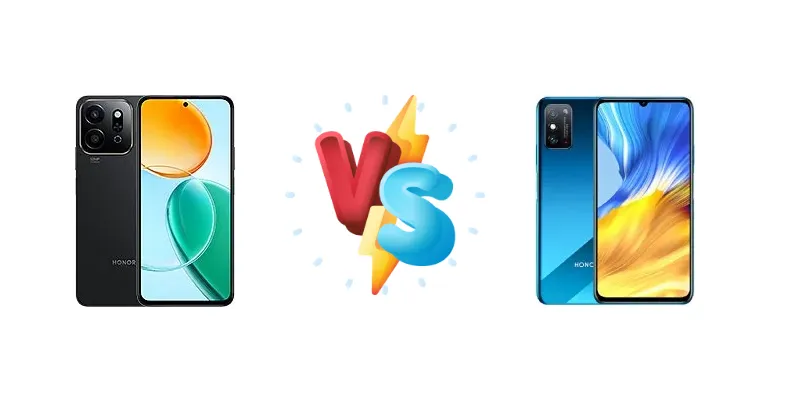
Honor's Play9T and X10 Max 5G represent distinct approaches to the mid-range 5G market. The Play9T, with its newer Snapdragon 4 Gen 2, focuses on efficiency and modern architecture, while the X10 Max 5G leverages the established Dimensity 800 for a balance of power and connectivity. This comparison dissects their key differences to determine which device delivers the best value.
🏆 Quick Verdict
For most users, the Honor Play9T emerges as the stronger choice. Its 4nm Snapdragon 4 Gen 2 offers superior power efficiency and a more modern CPU architecture, translating to better sustained performance and longer battery life despite the X10 Max 5G's larger battery. The faster 35W charging further sweetens the deal.
| Network |
|---|
| 2G bands | GSM 850 / 900 / 1800 / 1900 | GSM 850 / 900 / 1800 / 1900 |
| 3G bands | HSDPA 850 / 900 / 1900 / 2100 | HSDPA 800 / 850 / 900 / 1700(AWS) / 1900 / 2100 |
| 4G bands | 1, 3, 5, 8, 34, 38, 39, 40, 41 | 1, 2, 3, 4, 5, 8, 18, 19, 26, 34, 38, 39, 40, 41 |
| 5G bands | 1, 5, 8, 28, 41, 78 SA/NSA | 1, 3, 38, 41, 77, 78, 79, 80, 84 SA/NSA |
| Speed | HSPA, LTE, 5G | HSPA, LTE, 5G |
| Technology | GSM / CDMA / HSPA / CDMA2000 / LTE / 5G | GSM / HSPA / LTE / 5G |
| Launch |
|---|
| Announced | 2024, September 06 | 2020, July 02. Released 2020, July 03 |
| Status | Available. Released 2024, September 06 | Discontinued |
| Body |
|---|
| Dimensions | 166.9 x 76.8 x 8.1 mm (6.57 x 3.02 x 0.32 in) | 174.4 x 84.9 x 8.3 mm (6.87 x 3.34 x 0.33 in) |
| SIM | Nano-SIM + Nano-SIM | Nano-SIM + Nano-SIM |
| Weight | 197 g or 199 g (6.95 oz) | 232 g (8.18 oz) |
| Display |
|---|
| Resolution | 720 x 1610 pixels, 20:9 ratio (~261 ppi density) | 1080 x 2280 pixels, 19:9 ratio (~356 ppi density) |
| Size | 6.77 inches, 110.2 cm2 (~86.0% screen-to-body ratio) | 7.09 inches, 125.5 cm2 (~84.7% screen-to-body ratio) |
| Type | TFT LCD, 120Hz | IPS LCD, HDR10 |
| Platform |
|---|
| CPU | Octa-core (2x2.2 GHz Cortex-A78 & 6x1.95 GHz Cortex-A55) | Octa-core (4x2.0 GHz Cortex-A76 & 4x2.0 GHz Cortex-A55) |
| Chipset | Qualcomm SM4450 Snapdragon 4 Gen 2 (4 nm) | Mediatek Dimensity 800 (7 nm) |
| GPU | Adreno 613 | Mali-G57MP4 |
| OS | Android 14, Magic OS 8 | Android 10, Magic UI 3.1, no Google Play Services |
| Memory |
|---|
| Card slot | No | Nano Memory (uses shared SIM slot) |
| Internal | 128GB 8GB RAM, 256GB 8GB RAM, 256GB 12GB RAM | 64GB 6GB RAM, 128GB 6GB RAM, 128GB 8GB RAM |
| Main Camera |
|---|
| Dual | 50 MP, f/1.8, (wide), AF
Auxiliary lens | 48 MP, f/1.8, 26mm (wide), 1/2.0", 0.8µm, PDAF
Auxiliary lens |
| Features | LED flash, HDR, panorama | LED flash, panorama, HDR |
| Video | 1080p@30fps | 4K@30fps, 1080p@30fps, gyro-EIS |
| Selfie camera |
|---|
| Features | - | HDR |
| Single | 5 MP, f/2.2, (wide) | 8 MP |
| Video | 1080p@30fps | 1080p@30fps |
| Sound |
|---|
| 3.5mm jack | - | Yes |
| 35mm jack | Yes | Yes |
| Loudspeaker | Yes, with stereo speakers | Yes, with dual speakers |
| Comms |
|---|
| Bluetooth | 5.0, A2DP, LE | 5.1, A2DP, LE |
| NFC | No | Yes |
| Positioning | GPS, GLONASS, GALILEO, BDS | GPS, GLONASS, BDS |
| Radio | No | No |
| USB | USB Type-C 2.0, OTG | USB Type-C 2.0, OTG |
| WLAN | Wi-Fi 802.11 a/b/g/n/ac, dual-band, Wi-Fi Direct | Wi-Fi 802.11 a/b/g/n/ac, dual-band, Wi-Fi Direct |
| Features |
|---|
| Sensors | Fingerprint (side-mounted), accelerometer, proximity (ultrasound), compass | Fingerprint (side-mounted), accelerometer, gyro, proximity, compass |
| Battery |
|---|
| Charging | 35W wired | 22.5W wired |
| Type | Li-Po 6000 mAh | Li-Po 5000 mAh |
| Misc |
|---|
| Colors | Black, White, Green | Black, Blue, Silver |
| Models | ALT-AN00 | KKG-AN00 |
| Price | About 120 EUR | About 240 EUR |
Honor Play9T
- More efficient Snapdragon 4 Gen 2 chipset
- Faster 35W wired charging
- Modern CPU architecture (Cortex-A78)
- Potentially smaller battery capacity
- Less established chipset compared to Dimensity 800
Honor X10 Max 5G
- Potentially larger display
- Mature Mediatek Dimensity 800 platform
- Potentially wider carrier compatibility
- Less power-efficient 7nm process
- Slower 22.5W wired charging
- Older CPU architecture (Cortex-A76)
Display Comparison
Display specifications are not provided, so a direct comparison is limited. However, given the market positioning, we can infer the X10 Max 5G likely features a larger display, potentially with a higher resolution, to justify its 'Max' designation. Both are likely LCD panels. The absence of high refresh rate information suggests neither prioritizes a fluid visual experience. Color accuracy and peak brightness will be key differentiators, but without data, it's impossible to determine a clear winner.
Camera Comparison
Camera details are absent, making a thorough comparison impossible. However, given the price brackets, both phones likely feature a multi-camera setup with a primary sensor, an ultrawide, and potentially a depth or macro lens. The quality of image processing algorithms will be crucial. Without sensor size or aperture information, it's difficult to assess low-light performance. The inclusion of Optical Image Stabilization (OIS) on either device would be a significant advantage, but is unknown.
Performance
The core difference lies in the chipsets. The Honor Play9T’s Qualcomm Snapdragon 4 Gen 2 (4nm) utilizes a more modern CPU architecture – Cortex-A78 cores – compared to the X10 Max 5G’s Dimensity 800 (7nm). While the Dimensity 800 has four Cortex-A76 cores, the A78 in the Snapdragon 4 Gen 2 offers a performance uplift per clock cycle. Crucially, the 4nm process node of the Snapdragon 4 Gen 2 provides significantly better power efficiency than the 7nm node of the Dimensity 800. This translates to less heat generation and sustained performance during demanding tasks. The X10 Max 5G may show initial benchmark advantages, but the Play9T will likely maintain performance longer under load. The Play9T's CPU configuration (2x2.2 GHz Cortex-A78 & 6x1.95 GHz Cortex-A55) is also more balanced for multi-tasking than the X10 Max 5G's (4x2.0 GHz Cortex-A76 & 4x2.0 GHz Cortex-A55).
Battery Life
The Honor X10 Max 5G likely has a larger battery capacity to compensate for the less efficient Dimensity 800 chipset. However, the Play9T’s Snapdragon 4 Gen 2’s superior power efficiency could offset this difference. The Play9T’s 35W wired charging is a clear advantage over the X10 Max 5G’s 22.5W, resulting in significantly faster charging times. Expect the Play9T to reach 100% charge in considerably less time, offering a more convenient user experience.
Buying Guide
Buy the Honor Play9T if you prioritize long-term performance, efficient power usage, and faster charging speeds. It's ideal for everyday tasks, moderate gaming, and users who value a responsive experience. Buy the Honor X10 Max 5G if you specifically need the slightly more mature software ecosystem of Mediatek's Dimensity platform and potentially benefit from wider carrier compatibility, though you'll trade off some efficiency and charging speed.
Frequently Asked Questions
❓ Will the Dimensity 800 in the X10 Max 5G overheat during prolonged gaming sessions?
The Dimensity 800 is a capable chipset, but its 7nm process is less efficient than the Snapdragon 4 Gen 2's 4nm process. This means the X10 Max 5G is more likely to experience thermal throttling during extended gaming, potentially leading to reduced performance over time. The Play9T should maintain higher sustained performance.
❓ Does the Honor Play9T support carrier aggregation for improved 5G speeds?
While not explicitly stated, Qualcomm chipsets generally offer robust carrier aggregation support. The Snapdragon 4 Gen 2 is likely to support multiple 5G bands and carrier aggregation, allowing for faster and more reliable 5G connectivity, assuming your carrier supports it. The X10 Max 5G's Dimensity 800 also supports carrier aggregation, but the specific bands and implementation may vary.
❓ Is the difference in charging speed between 35W and 22.5W significant in real-world use?
Yes, the difference is substantial. 35W charging will significantly reduce the time it takes to fully charge the Play9T, potentially shaving off 30-60 minutes compared to the X10 Max 5G. This is particularly beneficial for users who frequently need to top up their battery quickly.