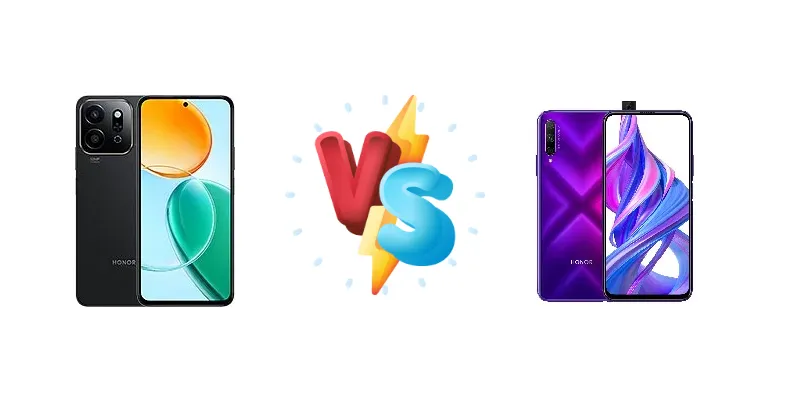
The Honor Play9T and 9X Pro represent different approaches to the budget smartphone market. The 9X Pro, while older, boasted a flagship-adjacent Kirin 810 chipset. The Play9T arrives with a newer, more efficient Snapdragon 4 Gen 2. This comparison dissects these key differences to determine which device delivers the best experience for today's user.
🏆 Quick Verdict
For most users, the Honor Play9T emerges as the better choice. Its newer Snapdragon 4 Gen 2 chipset, built on a 4nm process, offers improved efficiency and potentially better sustained performance compared to the older 7nm Kirin 810. The significantly faster 35W charging also provides a substantial convenience advantage.
| Network |
|---|
| 2G bands | GSM 850 / 900 / 1800 / 1900 | GSM 850 / 900 / 1800 / 1900 |
| 3G bands | HSDPA 850 / 900 / 1900 / 2100 | HSDPA 850 / 900 / 2100 |
| 4G bands | 1, 3, 5, 8, 34, 38, 39, 40, 41 | 1, 3, 7, 8, 20, 38, 40, 41 - International |
| 5G bands | 1, 5, 8, 28, 41, 78 SA/NSA | - |
| Speed | HSPA, LTE, 5G | HSPA 42.2/5.76 Mbps, LTE (2CA) Cat12 600/50 Mbps |
| Technology | GSM / CDMA / HSPA / CDMA2000 / LTE / 5G | GSM / CDMA / HSPA / EVDO / LTE |
| | - | 1, 3, 5, 8, 38, 39, 40, 41 - China |
| Launch |
|---|
| Announced | 2024, September 06 | 2019, July 23. Released 2019, August 09 |
| Status | Available. Released 2024, September 06 | Discontinued |
| Body |
|---|
| Build | - | Glass front, glass back, aluminum frame |
| Dimensions | 166.9 x 76.8 x 8.1 mm (6.57 x 3.02 x 0.32 in) | 163.5 x 77.3 x 8.8 mm (6.44 x 3.04 x 0.35 in) |
| SIM | Nano-SIM + Nano-SIM | Nano-SIM + Nano-SIM |
| Weight | 197 g or 199 g (6.95 oz) | 202 g (7.13 oz) |
| Display |
|---|
| Resolution | 720 x 1610 pixels, 20:9 ratio (~261 ppi density) | 1080 x 2340 pixels, 19.5:9 ratio (~391 ppi density) |
| Size | 6.77 inches, 110.2 cm2 (~86.0% screen-to-body ratio) | 6.59 inches, 106.6 cm2 (~84.3% screen-to-body ratio) |
| Type | TFT LCD, 120Hz | IPS LCD |
| Platform |
|---|
| CPU | Octa-core (2x2.2 GHz Cortex-A78 & 6x1.95 GHz Cortex-A55) | Octa-core (2x2.27 GHz Cortex-A76 & 6x1.88 GHz Cortex-A55) |
| Chipset | Qualcomm SM4450 Snapdragon 4 Gen 2 (4 nm) | Kirin 810 (7 nm) |
| GPU | Adreno 613 | Mali-G52 MP6 |
| OS | Android 14, Magic OS 8 | Android 9.0 (Pie), upgradable to Android 10, EMUI 9.1, no Google Play Services |
| Memory |
|---|
| Card slot | No | microSDXC (uses shared SIM slot) |
| Internal | 128GB 8GB RAM, 256GB 8GB RAM, 256GB 12GB RAM | 128GB 8GB RAM, 256GB 6GB RAM, 256GB 8GB RAM |
| Main Camera |
|---|
| Dual | 50 MP, f/1.8, (wide), AF
Auxiliary lens | - |
| Features | LED flash, HDR, panorama | LED flash, HDR, panorama |
| Triple | - | 48 MP, f/1.8, (wide), 1/2.0", 0.8µm, PDAF
8 MP, f/2.4, 120˚ (ultrawide)
Auxiliary lens |
| Video | 1080p@30fps | 1080p@30fps, gyro-EIS |
| Selfie camera |
|---|
| Single | 5 MP, f/2.2, (wide) | Motorized pop-up 16 MP, f/2.2, 26mm (wide), 1/3.06", 1.0µm |
| Video | 1080p@30fps | 1080p@60fps |
| Sound |
|---|
| 3.5mm jack | - | Yes |
| 35mm jack | Yes | Yes |
| Loudspeaker | Yes, with stereo speakers | Yes |
| Comms |
|---|
| Bluetooth | 5.0, A2DP, LE | 4.2, A2DP, LE (International)5.0, A2DP, LE (China) |
| NFC | No | No |
| Positioning | GPS, GLONASS, GALILEO, BDS | GPS, GLONASS, BDS |
| Radio | No | FM radio |
| USB | USB Type-C 2.0, OTG | USB Type-C 2.0 |
| WLAN | Wi-Fi 802.11 a/b/g/n/ac, dual-band, Wi-Fi Direct | Wi-Fi 802.11 a/b/g/n/ac, dual-band, Wi-Fi Direct |
| Features |
|---|
| Sensors | Fingerprint (side-mounted), accelerometer, proximity (ultrasound), compass | Fingerprint (side-mounted), accelerometer, gyro, proximity, compass |
| Battery |
|---|
| Charging | 35W wired | 10W wired |
| Type | Li-Po 6000 mAh | Li-Po 4000 mAh, non-removable |
| Misc |
|---|
| Colors | Black, White, Green | Midnight Black, Phantom Purple |
| Models | ALT-AN00 | HLK-AL10, HLK-TL10, HLK-L41, HLK-L42 |
| Price | About 120 EUR | About 230 EUR |
| Tests |
|---|
| Battery life | - |
Endurance rating 104h
|
| Camera | - |
Photo / Video |
| Display | - |
Contrast ratio: 1319:1 (nominal) |
| Loudspeaker | - |
-31.1 LUFS (Below average)
|
| Performance | - |
AnTuTu: 312668 (v8)
GeekBench: 7836 (v4.4), 1911 (v5.1)
GFXBench: 18fps (ES 3.1 onscreen) |
Honor Play9T
- Newer, more efficient Snapdragon 4 Gen 2 chipset
- Significantly faster 35W charging
- Potentially better sustained performance due to 4nm process
- Display brightness is unknown
- Camera specifications are not detailed
Honor 9X Pro
- Excellent 104-hour battery endurance
- Known display brightness of 517 nits
- Proven track record of reliability
- Slower 10W charging
- Older Kirin 810 chipset may throttle under heavy load
Display Comparison
Both the Honor Play9T and 9X Pro share a contrast ratio of 1319:1, suggesting similar visual depth. However, the 9X Pro’s measured peak brightness of 517 nits is a concrete figure, while the Play9T’s brightness remains unspecified. This suggests the 9X Pro may be more visible in direct sunlight. Without PWM frequency data for the Play9T, it’s difficult to assess potential eye strain differences, but the 9X Pro’s display is a known quantity in terms of brightness.
Camera Comparison
Both phones feature 'Photo / Video' capabilities, but lack specific details. Without sensor size, aperture, or image processing details, a direct comparison is impossible. The presence of a 2MP macro camera on either device is unlikely to significantly impact image quality, serving primarily as a marketing feature. The real differentiator would be the primary sensor and image processing algorithms, which remain unknown.
Performance
The core difference lies in the chipsets. The Honor Play9T’s Snapdragon 4 Gen 2 (4nm) utilizes ARM Cortex-A78 cores, offering a performance uplift over the Cortex-A76 cores found in the Honor 9X Pro’s Kirin 810 (7nm). The 4nm fabrication process of the Snapdragon is crucial; it translates to better thermal efficiency, meaning the Play9T is less likely to throttle under sustained loads like gaming. While the Kirin 810 was a strong performer in its time, the Snapdragon 4 Gen 2’s architecture and process node give it a clear advantage in modern workloads.
Battery Life
The Honor 9X Pro boasts an impressive endurance rating of 104 hours, a testament to its efficient hardware and software optimization. However, the Play9T compensates with significantly faster 35W wired charging, a substantial improvement over the 9X Pro’s 10W charging. This means the Play9T can replenish its battery much quicker, mitigating any potential capacity differences. While the 9X Pro excels in longevity, the Play9T prioritizes convenience.
Buying Guide
Buy the Honor Play9T if you prioritize long-term performance, efficient power usage, and fast charging. It's ideal for users who frequently multitask, enjoy mobile gaming, or simply want a phone that won't slow down noticeably over time. Buy the Honor 9X Pro if you value a proven track record of endurance – its 104-hour battery rating is impressive – and are willing to accept slower charging and potentially more thermal throttling under heavy load.
Frequently Asked Questions
❓ Will the Kirin 810 in the Honor 9X Pro overheat during extended gaming sessions?
The Kirin 810, being a 7nm chip, is prone to thermal throttling under sustained heavy loads like gaming. While it was a capable processor, the Snapdragon 4 Gen 2 in the Play9T, built on a more efficient 4nm process, is less likely to experience significant performance drops due to heat.
❓ How long does it take to fully charge the Honor Play9T with the 35W charger?
While a precise 0-100% charge time isn't specified, the 35W charging capability of the Play9T will significantly reduce charging times compared to the 9X Pro's 10W charging. Expect a full charge in well under two hours, potentially closer to an hour depending on battery capacity.
❓ Is the difference in CPU architecture (Cortex-A78 vs Cortex-A76) noticeable in everyday use?
Yes, the Cortex-A78 cores in the Snapdragon 4 Gen 2 offer a performance improvement over the Cortex-A76 cores in the Kirin 810. This translates to snappier app launches, smoother multitasking, and a more responsive overall user experience, especially when running demanding applications.