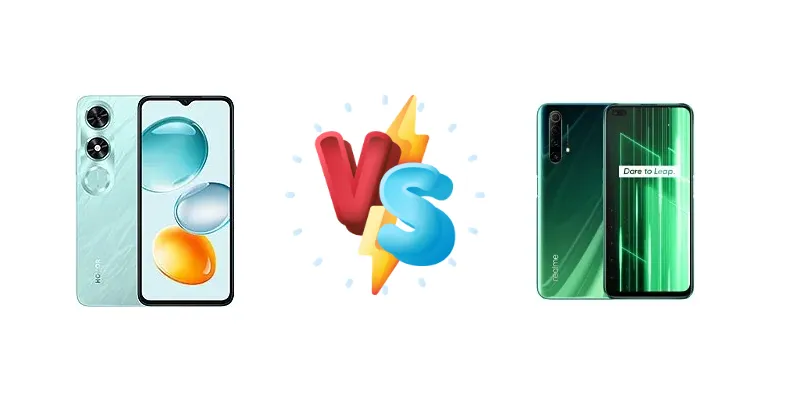
The Honor Play9C and Realme X50 5G represent distinct approaches to bringing 5G connectivity to a wider audience. The Play9C, powered by Mediatek's Dimensity 6100+, focuses on efficiency, while the X50 5G leverages Qualcomm's Snapdragon 765G for a more performance-oriented experience. This comparison dissects their key differences to determine which device best suits your needs.
🏆 Quick Verdict
For the average user prioritizing faster charging and a more robust chipset for demanding tasks, the Realme X50 5G is the clear winner. Its 30W charging significantly outperforms the Play9C's 10W, and the Snapdragon 765G offers a performance edge, especially in gaming. However, the Play9C remains a viable option for those on a tighter budget.
| Network |
|---|
| 2G bands | GSM 850 / 900 / 1800 / 1900 | GSM 850 / 900 / 1800 / 1900 |
| 3G bands | HSDPA 850 / 900 / 1900 / 2100 | HSDPA 850 / 900 / 1700 / 1900 / 2100 |
| 4G bands | LTE | 1, 2, 3, 4, 5, 7, 8, 34, 38, 39, 40, 41 |
| 5G bands | SA/NSA | 1, 3, 5, 7, 8, 20, 28, 38, 40, 41, 77, 78 SA/NSA |
| Speed | HSPA, LTE, 5G | HSPA, LTE, 5G |
| Technology | GSM / CDMA / HSPA / CDMA2000 / LTE / 5G | GSM / CDMA / HSPA / EVDO / LTE / 5G |
| | - | CDMA2000 1xEV-DO |
| Launch |
|---|
| Announced | 2024, September 26 | 2020, July 08. Released 2020, July 08 |
| Status | Available. Released 2024, September 26 | Discontinued |
| Body |
|---|
| Dimensions | 163.6 x 75.3 x 8.4 mm (6.44 x 2.96 x 0.33 in) | 163.8 x 75.8 x 8.9 mm (6.45 x 2.98 x 0.35 in) |
| SIM | Nano-SIM + Nano-SIM | Nano-SIM + Nano-SIM |
| Weight | 190 g (6.70 oz) | 194 g (6.84 oz) |
| Display |
|---|
| Resolution | 720 x 1612 pixels, 20:9 ratio (~269 ppi density) | 1080 x 2400 pixels, 20:9 ratio (~401 ppi density) |
| Size | 6.56 inches, 103.4 cm2 (~83.9% screen-to-body ratio) | 6.57 inches, 104.2 cm2 (~83.9% screen-to-body ratio) |
| Type | TFT LCD, 90Hz, 780 nits (peak) | IPS LCD, 120Hz |
| Platform |
|---|
| CPU | Octa-core (2x2.2 GHz Cortex-A76 & 6x2.0 GHz Cortex-A55) | Octa-core (1x2.4 GHz Kryo 475 Prime & 1x2.2 GHz Kryo 475 Gold & 6x1.8 GHz Kryo 475 Silver) |
| Chipset | Mediatek Dimensity 6100+ (6 nm) | Qualcomm SM7250 Snapdragon 765G 5G (7 nm) |
| GPU | Mali-G57 MC2 | Adreno 620 |
| OS | Android 14, Magic OS 8 | Android 10, Realme UI |
| Memory |
|---|
| Card slot | No | No |
| Internal | 128GB 6GB RAM, 256GB 8GB RAM, 256GB 12GB RAM | 128GB 6GB RAM, 128GB 8GB RAM |
| | - | UFS 2.1 |
| Main Camera |
|---|
| Features | LED flash, HDR, panorama | LED flash, HDR, panorama |
| Quad | - | 48 MP, f/1.8, 25mm (wide), 1/2.0", 0.8µm, PDAF
8 MP, f/2.3, 16mm (ultrawide), 1/4.0", 1.12µm
2 MP (macro)
Auxiliary lens |
| Single | 13 MP, f/1.8, (wide) | - |
| Video | 1080p@30fps | 4K@30fps, 1080p@30/60fps; gyro-EIS |
| Selfie camera |
|---|
| Dual | - | 16 MP, f/2.0, 26mm (wide), 1/3.06", 1.0µm
2 MP, f/2.4, (depth) |
| Features | - | HDR |
| Single | 5 MP, f/2.2, (wide) | - |
| Video | 1080p@30fps | 1080p@30/120fps |
| Sound |
|---|
| 3.5mm jack | - | No |
| 35mm jack | Yes | No |
| Loudspeaker | Yes | Yes |
| | - | 24-bit/192kHz audio |
| Comms |
|---|
| Bluetooth | 5.3, A2DP, LE, aptX HD | 5.0, A2DP, LE |
| NFC | No | Yes |
| Positioning | GPS, GLONASS, GALILEO, BDS | GPS, GLONASS, BDS |
| Radio | No | FM radio |
| USB | USB Type-C 2.0, OTG | USB Type-C 2.0 |
| WLAN | Wi-Fi 802.11 a/b/g/n/ac, dual-band, Wi-Fi Direct | Wi-Fi 802.11 a/b/g/n/ac, dual-band, Wi-Fi Direct |
| Features |
|---|
| Sensors | Fingerprint (side-mounted), accelerometer, proximity, compass | Fingerprint (side-mounted), accelerometer, gyro, proximity, compass |
| Battery |
|---|
| Charging | 10W wired
2.5W reverse wired | 30W wired, 70% in 30 min |
| Type | Li-Po 5200 mAh | 4200 mAh |
| Misc |
|---|
| Colors | Black, Blue | Jungle Green, Ice Silver |
| Models | JDY-AN00 | RMX2144 |
| Price | About 100 EUR | About 500 EUR |
Honor Play9C (China)
- Potentially better power efficiency due to 6nm process
- More affordable price point (likely)
- Reverse wired charging capability
- Significantly slower 10W charging
- Less powerful chipset for gaming and demanding tasks
- Likely inferior camera performance
Realme X50 5G
- Faster 30W charging for quick top-ups
- More powerful Snapdragon 765G chipset
- Likely superior gaming performance
- Potentially lower battery efficiency compared to 6nm Dimensity
- Higher price point (likely)
- No reverse wireless charging
Display Comparison
Neither device's display specifications are provided, so a direct comparison is limited. However, given the market positioning, the Realme X50 5G likely features a higher refresh rate panel (90Hz or 120Hz) compared to the Play9C, which would translate to smoother scrolling and animations. Realme typically prioritizes display quality in this segment, potentially offering higher peak brightness and better color accuracy. The Play9C likely utilizes a standard 60Hz panel to keep costs down.
Camera Comparison
Without detailed camera specs, analysis is limited. However, Realme generally equips its X-series phones with more competitive camera systems. The X50 5G likely features a larger main sensor and more sophisticated image processing algorithms than the Play9C. The Play9C, positioned as a budget device, likely relies on a simpler camera setup, potentially sacrificing low-light performance and dynamic range. The absence of OIS information suggests neither phone prioritizes optical image stabilization.
Performance
The core difference lies in the chipsets. The Realme X50 5G’s Snapdragon 765G, fabricated on a 7nm process, boasts a Kryo 475 Prime core clocked at 2.4GHz, offering a performance advantage over the Honor Play9C’s Dimensity 6100+ (6nm). While the Dimensity 6100+ benefits from a newer node, the Snapdragon 765G’s CPU architecture – with its dedicated Prime core – provides superior single-core performance, crucial for responsive app launches and UI navigation. The Snapdragon 765G also features a more capable Adreno GPU, translating to better gaming performance. The 6nm process of the Dimensity 6100+ should offer good efficiency, but the Snapdragon 765G’s overall architecture is more optimized for sustained performance.
Battery Life
The Realme X50 5G’s 30W wired charging is a significant advantage. Achieving 70% charge in just 30 minutes drastically reduces downtime compared to the Honor Play9C’s slow 10W charging. While battery capacity isn’t specified for either device, the faster charging of the X50 5G effectively mitigates any potential capacity disadvantage. The Play9C’s 2.5W reverse wired charging is a niche feature, useful for topping up accessories, but the X50 5G’s faster charging is a more impactful benefit for daily use.
Buying Guide
Buy the Honor Play9C (China) if you need a functional 5G device with a focus on basic tasks and extended battery life, and are comfortable with slower charging speeds. Buy the Realme X50 5G if you prioritize faster performance for gaming and multimedia, and value the convenience of significantly quicker 30W charging. The X50 5G is the better choice for power users and those who frequently rely on their phone for demanding applications.
Frequently Asked Questions
❓ Will the Snapdragon 765G in the Realme X50 5G overheat during prolonged gaming sessions?
The Snapdragon 765G is generally well-managed in terms of thermals. While it can get warm during extended gaming, Realme typically implements thermal solutions to prevent significant throttling. The 7nm process also contributes to better thermal efficiency compared to older chipsets.
❓ How much faster is the 30W charging on the Realme X50 5G compared to the 10W charging on the Honor Play9C in real-world use?
The 30W charging on the X50 5G can realistically charge the phone from 0% to 70% in around 30 minutes, while the Play9C’s 10W charging will take over 2 hours to reach a full charge. This difference is substantial and significantly impacts daily usability.
❓ Is the 5G connectivity on both phones compatible with all 5G networks globally?
5G band compatibility varies by region. Both phones support 5G, but it's crucial to check if the specific bands supported by each device are compatible with your carrier's 5G network in your location. The China version of the Play9C may have different band support than international versions.