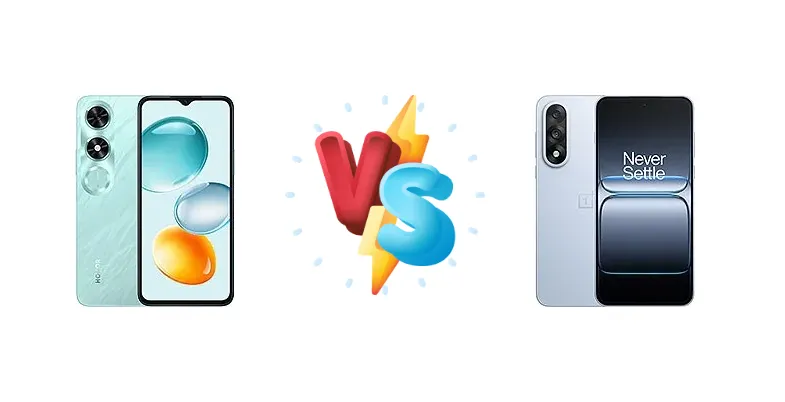
The smartphone landscape is increasingly segmented, with the OnePlus Nord 5 aiming for near-flagship performance at a competitive price, while the Honor Play9C focuses on delivering essential features at an even more accessible price point. This comparison dissects the core differences between these two devices, focusing on their chipsets, displays, battery capabilities, and overall user experience.
🏆 Quick Verdict
For users prioritizing performance and rapid charging, the OnePlus Nord 5 is the clear winner. Its Snapdragon 8s Gen 3 chipset and 80W charging significantly outperform the Honor Play9C's Dimensity 6100+ and 10W charging. However, the Honor Play9C remains a viable option for budget-conscious users who prioritize value over raw power.
| Network |
|---|
| 2G bands | GSM 850 / 900 / 1800 / 1900 | GSM 850 / 900 / 1800 / 1900 |
| 3G bands | HSDPA 850 / 900 / 1900 / 2100 | HSDPA 850 / 900 / 1900 / 2100 |
| 4G bands | LTE | 1, 2, 3, 4, 5, 7, 8, 12, 17, 18, 19, 20, 26, 28, 32, 38, 39, 40, 41, 42, 66 - International |
| 5G bands | SA/NSA | 1, 2, 3, 5, 7, 8, 12, 20, 28, 38, 40, 41, 66, 75, 77, 78 SA/NSA - International |
| Speed | HSPA, LTE, 5G | HSPA, LTE, 5G |
| Technology | GSM / CDMA / HSPA / CDMA2000 / LTE / 5G | GSM / HSPA / LTE / 5G |
| Launch |
|---|
| Announced | 2024, September 26 | 2025, July 08 |
| Status | Available. Released 2024, September 26 | Available. Released 2025, July 08 |
| Body |
|---|
| Build | - | Glass front (Gorilla Glass 7i), glass back, plastic frame |
| Dimensions | 163.6 x 75.3 x 8.4 mm (6.44 x 2.96 x 0.33 in) | 163.4 x 77 x 8.1 mm (6.43 x 3.03 x 0.32 in) |
| SIM | Nano-SIM + Nano-SIM | Nano-SIM + Nano-SIM |
| Weight | 190 g (6.70 oz) | 211 g (7.44 oz) |
| Display |
|---|
| Protection | - | Corning Gorilla Glass 7i, Mohs level 6 |
| Resolution | 720 x 1612 pixels, 20:9 ratio (~269 ppi density) | 1272 x 2800 pixels (~450 ppi density) |
| Size | 6.56 inches, 103.4 cm2 (~83.9% screen-to-body ratio) | 6.83 inches, 113.3 cm2 (~90.1% screen-to-body ratio) |
| Type | TFT LCD, 90Hz, 780 nits (peak) | Swift AMOLED, 1B colors, 144Hz, 3840Hz PWM, HDR10+, 800 nits (typ), 1400 nits (HBM), 1800 nits (peak) |
| Platform |
|---|
| CPU | Octa-core (2x2.2 GHz Cortex-A76 & 6x2.0 GHz Cortex-A55) | Octa-core (1x3.0 GHz Cortex-X4 & 4x2.8 GHz Cortex-A720 & 3x2.0 GHz Cortex-A520) |
| Chipset | Mediatek Dimensity 6100+ (6 nm) | Qualcomm SM8635 Snapdragon 8s Gen 3 (4 nm) |
| GPU | Mali-G57 MC2 | Adreno 735 |
| OS | Android 14, Magic OS 8 | Android 15, up to 4 major Android upgrades, OxygenOS 15 |
| Memory |
|---|
| Card slot | No | No |
| Internal | 128GB 6GB RAM, 256GB 8GB RAM, 256GB 12GB RAM | 256GB 8GB RAM, 256GB 12GB RAM, 512GB 12GB RAM |
| Main Camera |
|---|
| Dual | - | 50 MP, f/1.8, 24mm (wide), 1/1.56", 1.0µm, PDAF, OIS
8 MP, f/2.2, 15mm, 116˚ (ultrawide), 1/4.0", 1.12µm, AF |
| Features | LED flash, HDR, panorama | LED flash, Ultra HDR, panorama |
| Single | 13 MP, f/1.8, (wide) | - |
| Video | 1080p@30fps | 4K@30/60fps, 1080p@30/60/120fps, gyro-EIS |
| Selfie camera |
|---|
| Features | - | Panorama |
| Single | 5 MP, f/2.2, (wide) | 50 MP, f/2.0, 21mm (wide), 1/2.76", 0.64µm, AF |
| Video | 1080p@30fps | 4K@30/60fps, 1080p@30/60fps; gyro-EIS |
| Sound |
|---|
| 35mm jack | Yes | No |
| Loudspeaker | Yes | Yes, with stereo speakers |
| Comms |
|---|
| Bluetooth | 5.3, A2DP, LE, aptX HD | 5.4, A2DP, LE, aptX HD, LHDC 5 |
| Infrared port | - | Yes |
| NFC | No | Yes |
| Positioning | GPS, GLONASS, GALILEO, BDS | GPS, GLONASS, GALILEO, BDS, QZSS, NavIC |
| Radio | No | No |
| USB | USB Type-C 2.0, OTG | USB Type-C 2.0 |
| WLAN | Wi-Fi 802.11 a/b/g/n/ac, dual-band, Wi-Fi Direct | Wi-Fi 802.11 a/b/g/n/ac/6, dual-band, Wi-Fi Direct |
| Features |
|---|
| Sensors | Fingerprint (side-mounted), accelerometer, proximity, compass | Fingerprint (under display, optical), accelerometer, gyro, proximity, compass |
| Battery |
|---|
| Charging | 10W wired
2.5W reverse wired | 80W wired, 33W PPS, 18W PD, 100% in just 54 min
5W reverse wired
Bypass charging |
| Type | Li-Po 5200 mAh | Market-dependent versions:· 5200 mAh (Europe)· 6800 mAh (Global) |
| Misc |
|---|
| Colors | Black, Blue | Phantom Grey, Dry Ice, Marble Sands |
| Models | JDY-AN00 | CPH2709 |
| Price | About 100 EUR | £ 339.00 / € 294.97 / ₹ 31,998 |
| SAR | - | 1.18 W/kg (head) 0.90 W/kg (body) |
| EU LABEL |
|---|
| Battery | - | 49:12h endurance, 1200 cycles |
| Energy | - | Class B |
| Free fall | - | Class C (90 falls) |
| Repairability | - | Class B |
Honor Play9C (China)
- Highly affordable price point
- Acceptable performance for basic tasks
- Reverse wired charging capability
- Slow 10W charging
- Less powerful chipset compared to the Nord 5
- Likely lower display quality
OnePlus Nord 5
- Flagship-level Snapdragon 8s Gen 3 performance
- Blazing-fast 80W charging (54 min to 100%)
- Bright and vibrant display (1330 nits)
- Excellent battery endurance (49:12h)
- Higher price compared to the Honor Play9C
- May be more expensive to repair
- Potentially higher power consumption at peak brightness
Display Comparison
The OnePlus Nord 5 boasts a significantly brighter display, reaching a measured peak brightness of 1330 nits, making it easily viewable outdoors even in direct sunlight. While the Honor Play9C’s display specifications are not provided, it’s reasonable to assume a lower peak brightness given its price point. The Nord 5’s superior brightness, combined with potentially better color accuracy (based on OnePlus’s display calibration history), provides a more immersive viewing experience. The absence of LTPO technology in either device suggests both will rely on adaptive refresh rate switching to conserve battery, but the Nord 5’s brighter panel will likely consume more power at peak brightness.
Camera Comparison
Without detailed camera specifications for the Honor Play9C, a direct comparison is limited. However, given its price bracket, it’s likely to feature a more basic camera system. The OnePlus Nord 5, while not explicitly detailed in the provided data, typically features a more sophisticated camera setup in its class, potentially including features like Optical Image Stabilization (OIS) and larger sensor sizes. The Snapdragon 8s Gen 3’s image signal processor (ISP) also contributes to superior image processing capabilities, resulting in better dynamic range, noise reduction, and overall image quality. The absence of information regarding the Honor Play9C’s sensor size and aperture makes it difficult to assess its low-light performance.
Performance
The core difference lies in the chipsets: the OnePlus Nord 5 utilizes the Qualcomm SM8635 Snapdragon 8s Gen 3 (4nm), while the Honor Play9C features the Mediatek Dimensity 6100+ (6nm). The Snapdragon 8s Gen 3’s Cortex-X4 prime core, clocked at 3.0 GHz, offers a substantial performance advantage over the Dimensity 6100+'s Cortex-A76 cores. The 4nm process node of the Snapdragon further enhances efficiency, leading to better thermal management and sustained performance during demanding tasks. The Nord 5’s CPU configuration (1x3.0 GHz Cortex-X4, 4x2.8 GHz Cortex-A720, 3x2.0 GHz Cortex-A520) is architecturally superior, promising faster app loading times, smoother multitasking, and a more responsive gaming experience. The Honor Play9C will handle everyday tasks adequately, but will struggle with graphically intensive games and demanding applications.
Battery Life
The OnePlus Nord 5 excels in battery charging, supporting 80W wired charging, 33W PPS, and 18W PD, achieving a full charge in just 54 minutes. This is a massive advantage over the Honor Play9C’s slow 10W wired charging. While the Honor Play9C’s battery capacity isn’t specified, the Nord 5’s endurance is rated at 49:12h, with an active use score of 13:47h, indicating excellent battery life. The Nord 5 also offers 5W reverse wired charging and bypass charging, adding to its versatility. The slower charging speed of the Play9C will require significantly longer to replenish the battery, making it less convenient for users who frequently need to top up their device.
Buying Guide
Buy the Honor Play9C (China) if you need a reliable smartphone for basic tasks like calling, messaging, and light social media use, and are on a very tight budget. You'll appreciate its affordability and acceptable performance for everyday tasks. Buy the OnePlus Nord 5 if you prefer a smoother, more responsive experience for gaming, multitasking, and content creation, and value the convenience of incredibly fast charging and a brighter, more vibrant display.
Frequently Asked Questions
❓ Does the Dimensity 6100+ in the Honor Play9C struggle with demanding games like Genshin Impact?
Yes, the Dimensity 6100+ is a mid-range chipset and will likely struggle to maintain stable frame rates in graphically intensive games like Genshin Impact, even at lower settings. Expect noticeable frame drops and potential overheating during extended gaming sessions.
❓ How does the 80W charging on the OnePlus Nord 5 compare to other fast charging standards?
80W charging is exceptionally fast, significantly outpacing most other fast charging standards. It can fully charge the Nord 5 in approximately 54 minutes, compared to the 10W charging on the Honor Play9C which would take several hours. The Nord 5 also supports 33W PPS and 18W PD for compatibility with a wider range of chargers.
❓ Is the lack of detailed camera specs on the Honor Play9C a major concern?
Yes, the absence of information regarding the camera sensors and features suggests a more basic camera system. Users prioritizing photography should strongly consider the OnePlus Nord 5, which typically offers a more capable camera setup in its price range.
❓ What is 'bypass charging' on the OnePlus Nord 5 and why is it useful?
Bypass charging allows the phone to be powered directly from the charger, bypassing the battery. This reduces heat generation during gaming or other demanding tasks while charging, potentially extending the battery's lifespan and improving performance.