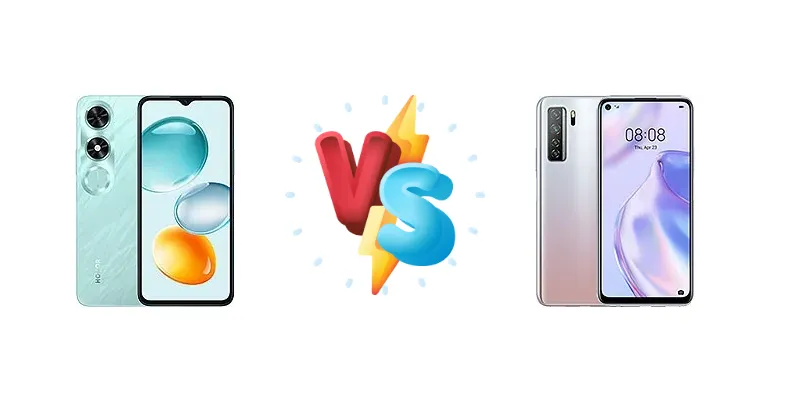
Both the Honor Play9C (China) and Huawei nova 7 SE 5G Youth target the competitive mid-range 5G smartphone market. However, they diverge significantly in chipset choice and charging capabilities, creating a clear distinction for performance-focused versus budget-conscious users. This comparison dissects these differences to reveal which device delivers the best value.
🏆 Quick Verdict
For most users, the Huawei nova 7 SE 5G Youth is the superior choice. Its Dimensity 800U chipset offers a noticeable performance uplift, and the 40W fast charging dramatically improves usability compared to the Honor Play9C’s slow 10W charging. While the Play9C is cheaper, the convenience of the nova 7 SE outweighs the cost savings.
| Network |
|---|
| 2G bands | GSM 850 / 900 / 1800 / 1900 | GSM 850 / 900 / 1800 / 1900 |
| 3G bands | HSDPA 850 / 900 / 1900 / 2100 | HSDPA 800 / 850 / 900 / 1700(AWS) / 1900 / 2100 |
| 4G bands | LTE | 1, 2, 3, 4, 5, 8, 18, 19, 26, 34, 38, 39, 40, 41 |
| 5G bands | SA/NSA | 1, 41, 77, 78 SA/NSA |
| Speed | HSPA, LTE, 5G | HSPA, LTE, 5G |
| Technology | GSM / CDMA / HSPA / CDMA2000 / LTE / 5G | GSM / CDMA / HSPA / LTE / 5G |
| | - | CDMA 800 & TD-SCDMA |
| Launch |
|---|
| Announced | 2024, September 26 | 2020, October 16. Released 2020, October 16 |
| Status | Available. Released 2024, September 26 | Discontinued |
| Body |
|---|
| Dimensions | 163.6 x 75.3 x 8.4 mm (6.44 x 2.96 x 0.33 in) | 162.3 x 75 x 8.6 mm (6.39 x 2.95 x 0.34 in) |
| SIM | Nano-SIM + Nano-SIM | Nano-SIM + Nano-SIM |
| Weight | 190 g (6.70 oz) | 189 g (6.67 oz) |
| Display |
|---|
| Resolution | 720 x 1612 pixels, 20:9 ratio (~269 ppi density) | 1080 x 2400 pixels, 20:9 ratio (~405 ppi density) |
| Size | 6.56 inches, 103.4 cm2 (~83.9% screen-to-body ratio) | 6.5 inches, 102.0 cm2 (~83.8% screen-to-body ratio) |
| Type | TFT LCD, 90Hz, 780 nits (peak) | IPS LCD, HDR10 |
| Platform |
|---|
| CPU | Octa-core (2x2.2 GHz Cortex-A76 & 6x2.0 GHz Cortex-A55) | Octa-core (2x2.4 GHz Cortex-A76 & 6x2.0 GHz Cortex-A55) |
| Chipset | Mediatek Dimensity 6100+ (6 nm) | Mediatek Dimensity 800U (7 nm) |
| GPU | Mali-G57 MC2 | Mali-G57 MC3 |
| OS | Android 14, Magic OS 8 | Android 10, EMUI 10.1, no Google Play Services |
| Memory |
|---|
| Card slot | No | No |
| Internal | 128GB 6GB RAM, 256GB 8GB RAM, 256GB 12GB RAM | 128GB 8GB RAM |
| Main Camera |
|---|
| Features | LED flash, HDR, panorama | LED flash, Panorama, HDR |
| Quad | - | 64 MP, f/1.8, 26mm (wide), PDAF
8 MP, f/2.4, 17mm (ultrawide)
2 MP (macro)
Auxiliary lens |
| Single | 13 MP, f/1.8, (wide) | - |
| Video | 1080p@30fps | 4K@30fps, 1080p@30fps |
| Selfie camera |
|---|
| Features | - | HDR |
| Single | 5 MP, f/2.2, (wide) | 16 MP, f/2.0, (wide) |
| Video | 1080p@30fps | 1080p@30fps |
| Sound |
|---|
| 3.5mm jack | - | Yes |
| 35mm jack | Yes | Yes |
| Loudspeaker | Yes | Yes |
| Comms |
|---|
| Bluetooth | 5.3, A2DP, LE, aptX HD | 5.1, A2DP, LE |
| NFC | No | No |
| Positioning | GPS, GLONASS, GALILEO, BDS | GPS, GLONASS, GALILEO, BDS, QZSS |
| Radio | No | No |
| USB | USB Type-C 2.0, OTG | USB Type-C 2.0, OTG |
| WLAN | Wi-Fi 802.11 a/b/g/n/ac, dual-band, Wi-Fi Direct | Wi-Fi 802.11 a/b/g/n/ac, dual-band, Wi-Fi Direct |
| Features |
|---|
| Sensors | Fingerprint (side-mounted), accelerometer, proximity, compass | Fingerprint (side-mounted), accelerometer, proximity, compass |
| Battery |
|---|
| Charging | 10W wired
2.5W reverse wired | 40W wired, 70% in 30 min
5W reverse wired |
| Type | Li-Po 5200 mAh | Li-Po 4000 mAh |
| Misc |
|---|
| Colors | Black, Blue | Crush Green, Space Silver, Midnight Black, Purple |
| Models | JDY-AN00 | CND-AN00 |
| Price | About 100 EUR | About 290 EUR |
Honor Play9C (China)
- Lower price point makes it accessible.
- 6nm Dimensity 6100+ offers decent efficiency.
- Reverse wired charging capability.
- Extremely slow 10W charging.
- Noticeably weaker performance compared to the nova 7 SE.
- Likely inferior camera image processing.
Huawei nova 7 SE 5G Youth
- Faster Dimensity 800U chipset for improved performance.
- 40W fast charging significantly reduces downtime.
- Potentially better camera image quality due to Huawei’s processing.
- Higher price compared to the Honor Play9C.
- Slower reverse wired charging (5W vs 2.5W).
- May not be available in all markets.
Display Comparison
Neither device’s display specifications are provided, so a direct comparison is limited. However, given the market positioning, both likely utilize LCD panels. The nova 7 SE, being a slightly higher-tier device, *may* feature a higher resolution or slightly improved color accuracy. The absence of information regarding refresh rates suggests both are likely capped at 60Hz. Bezels are expected to be comparable, typical of this price bracket.
Camera Comparison
Without detailed camera specifications, a precise comparison is impossible. However, Huawei’s image processing algorithms are generally more sophisticated than Honor’s, suggesting the nova 7 SE 5G Youth will likely produce more visually appealing photos, particularly in challenging lighting conditions. The absence of OIS information suggests neither device features optical image stabilization. The presence of a 2MP macro camera on either device is largely inconsequential; its limited resolution and fixed focus make it a novelty feature rather than a practical tool.
Performance
The core difference lies in the chipsets. The Huawei nova 7 SE 5G Youth’s Mediatek Dimensity 800U (7nm) boasts a higher clock speed (2.4 GHz vs 2.2 GHz) for its Cortex-A76 cores compared to the Honor Play9C’s Dimensity 6100+ (6nm). While the 6nm process of the 6100+ *should* offer better efficiency, the 800U’s architectural advantages and higher clock speeds translate to a tangible performance boost in demanding applications and gaming. The Dimensity 800U also benefits from a more mature GPU, further widening the performance gap. Both devices share the same Cortex-A55 efficiency cores, meaning multi-tasking performance will be similar for less intensive tasks.
Battery Life
The charging disparity is the most significant difference. The Huawei nova 7 SE 5G Youth’s 40W charging can replenish 70% of the battery in just 30 minutes, a massive convenience factor. The Honor Play9C’s 10W charging is comparatively glacial, requiring significantly longer to reach a full charge. While battery capacity isn’t specified, the faster charging of the nova 7 SE effectively mitigates any potential disadvantage from a slightly smaller battery size. The 5W reverse wired charging on both devices is a niche feature, useful for topping up accessories but not a primary selling point.
Buying Guide
Buy the Honor Play9C (China) if you prioritize absolute affordability and are willing to compromise on charging speed and overall performance. It’s a suitable option for basic smartphone tasks and light usage. Buy the Huawei nova 7 SE 5G Youth if you value faster performance for gaming and multitasking, and demand significantly quicker charging times, making it ideal for users who are constantly on the go.
Frequently Asked Questions
❓ Is the Dimensity 800U in the Huawei nova 7 SE 5G Youth capable of running demanding games like Genshin Impact?
Yes, the Dimensity 800U is well-equipped to handle Genshin Impact, though you may need to lower graphics settings for a consistently smooth experience. The chipset’s Mali-G57 MC4 GPU provides sufficient graphical power, and the faster processing speed will minimize frame drops compared to the Dimensity 6100+.
❓ How long will it take to fully charge the Honor Play9C with its 10W charger?
Given the slow 10W charging speed, a full charge from 0% on the Honor Play9C will likely take over 3 hours, potentially even longer depending on battery capacity. This is a significant drawback compared to the Huawei nova 7 SE 5G Youth’s 40W fast charging.
❓ Does the Huawei nova 7 SE 5G Youth support VoLTE and VoWiFi?
While not explicitly stated, Huawei devices generally support VoLTE (Voice over LTE) and VoWiFi (Voice over Wi-Fi) in regions where these technologies are deployed by carriers. However, compatibility can vary depending on your specific carrier and region, so it’s best to confirm with your provider.