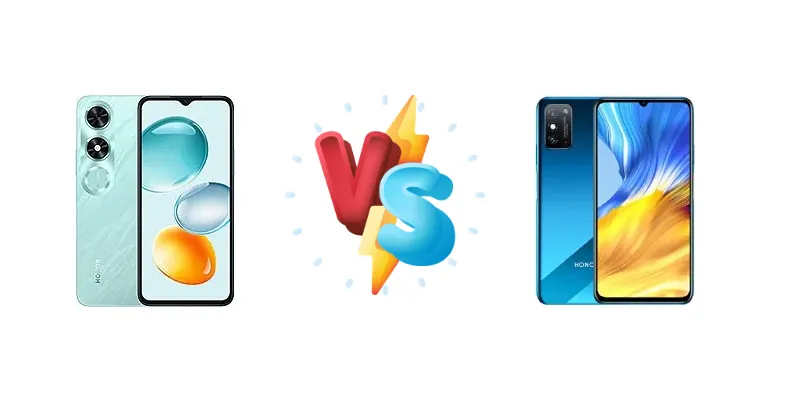
Honor's Play9C and X10 Max 5G represent different approaches to the mid-range 5G market. The Play9C aims for affordability, while the X10 Max 5G prioritizes performance and faster charging. Both utilize Mediatek Dimensity chipsets, but significant architectural differences dictate which phone is better suited for specific users.
🏆 Quick Verdict
For the average user prioritizing value, the Honor Play9C offers a solid experience. However, the Honor X10 Max 5G is the clear winner for those demanding faster performance and quicker charging, thanks to its more powerful Dimensity 800 chipset and 22.5W charging capability.
| Network |
|---|
| 2G bands | GSM 850 / 900 / 1800 / 1900 | GSM 850 / 900 / 1800 / 1900 |
| 3G bands | HSDPA 850 / 900 / 1900 / 2100 | HSDPA 800 / 850 / 900 / 1700(AWS) / 1900 / 2100 |
| 4G bands | LTE | 1, 2, 3, 4, 5, 8, 18, 19, 26, 34, 38, 39, 40, 41 |
| 5G bands | SA/NSA | 1, 3, 38, 41, 77, 78, 79, 80, 84 SA/NSA |
| Speed | HSPA, LTE, 5G | HSPA, LTE, 5G |
| Technology | GSM / CDMA / HSPA / CDMA2000 / LTE / 5G | GSM / HSPA / LTE / 5G |
| Launch |
|---|
| Announced | 2024, September 26 | 2020, July 02. Released 2020, July 03 |
| Status | Available. Released 2024, September 26 | Discontinued |
| Body |
|---|
| Dimensions | 163.6 x 75.3 x 8.4 mm (6.44 x 2.96 x 0.33 in) | 174.4 x 84.9 x 8.3 mm (6.87 x 3.34 x 0.33 in) |
| SIM | Nano-SIM + Nano-SIM | Nano-SIM + Nano-SIM |
| Weight | 190 g (6.70 oz) | 232 g (8.18 oz) |
| Display |
|---|
| Resolution | 720 x 1612 pixels, 20:9 ratio (~269 ppi density) | 1080 x 2280 pixels, 19:9 ratio (~356 ppi density) |
| Size | 6.56 inches, 103.4 cm2 (~83.9% screen-to-body ratio) | 7.09 inches, 125.5 cm2 (~84.7% screen-to-body ratio) |
| Type | TFT LCD, 90Hz, 780 nits (peak) | IPS LCD, HDR10 |
| Platform |
|---|
| CPU | Octa-core (2x2.2 GHz Cortex-A76 & 6x2.0 GHz Cortex-A55) | Octa-core (4x2.0 GHz Cortex-A76 & 4x2.0 GHz Cortex-A55) |
| Chipset | Mediatek Dimensity 6100+ (6 nm) | Mediatek Dimensity 800 (7 nm) |
| GPU | Mali-G57 MC2 | Mali-G57MP4 |
| OS | Android 14, Magic OS 8 | Android 10, Magic UI 3.1, no Google Play Services |
| Memory |
|---|
| Card slot | No | Nano Memory (uses shared SIM slot) |
| Internal | 128GB 6GB RAM, 256GB 8GB RAM, 256GB 12GB RAM | 64GB 6GB RAM, 128GB 6GB RAM, 128GB 8GB RAM |
| Main Camera |
|---|
| Dual | - | 48 MP, f/1.8, 26mm (wide), 1/2.0", 0.8µm, PDAF
Auxiliary lens |
| Features | LED flash, HDR, panorama | LED flash, panorama, HDR |
| Single | 13 MP, f/1.8, (wide) | - |
| Video | 1080p@30fps | 4K@30fps, 1080p@30fps, gyro-EIS |
| Selfie camera |
|---|
| Features | - | HDR |
| Single | 5 MP, f/2.2, (wide) | 8 MP |
| Video | 1080p@30fps | 1080p@30fps |
| Sound |
|---|
| 3.5mm jack | - | Yes |
| 35mm jack | Yes | Yes |
| Loudspeaker | Yes | Yes, with dual speakers |
| Comms |
|---|
| Bluetooth | 5.3, A2DP, LE, aptX HD | 5.1, A2DP, LE |
| NFC | No | Yes |
| Positioning | GPS, GLONASS, GALILEO, BDS | GPS, GLONASS, BDS |
| Radio | No | No |
| USB | USB Type-C 2.0, OTG | USB Type-C 2.0, OTG |
| WLAN | Wi-Fi 802.11 a/b/g/n/ac, dual-band, Wi-Fi Direct | Wi-Fi 802.11 a/b/g/n/ac, dual-band, Wi-Fi Direct |
| Features |
|---|
| Sensors | Fingerprint (side-mounted), accelerometer, proximity, compass | Fingerprint (side-mounted), accelerometer, gyro, proximity, compass |
| Battery |
|---|
| Charging | 10W wired
2.5W reverse wired | 22.5W wired |
| Type | Li-Po 5200 mAh | Li-Po 5000 mAh |
| Misc |
|---|
| Colors | Black, Blue | Black, Blue, Silver |
| Models | JDY-AN00 | KKG-AN00 |
| Price | About 100 EUR | About 240 EUR |
Honor Play9C (China)
- More affordable price point
- Decent performance for everyday tasks
- 5G connectivity
- Slower charging speed (10W)
- Less powerful chipset compared to X10 Max
Honor X10 Max 5G
- Faster Dimensity 800 chipset
- Significantly faster 22.5W charging
- Likely better camera performance
- Higher price compared to Play9C
- Potentially larger and heavier form factor
Display Comparison
Display specifications are not provided, so a direct comparison is impossible. However, given the X10 Max's positioning, it likely features a larger display with potentially higher resolution and brightness. Both phones likely utilize LCD panels, common in this price bracket. The X10 Max's larger size may also translate to smaller bezels, offering a more immersive viewing experience.
Camera Comparison
Camera details are absent, making a detailed comparison impossible. However, the X10 Max, being the higher-tier device, likely features a more capable main sensor and potentially additional lenses. Image processing algorithms are also likely more refined on the X10 Max, leading to better dynamic range and low-light performance. Without specific sensor information, it's reasonable to assume the X10 Max offers a superior photography experience.
Performance
The core difference lies in the chipsets. The Honor X10 Max 5G’s Dimensity 800 (7nm) boasts a more mature process node than the Play9C’s Dimensity 6100+ (6nm). While the 6nm node *can* be more efficient, the Dimensity 800’s CPU configuration – four Cortex-A76 cores versus the Play9C’s two – provides a significant advantage in multi-threaded tasks and sustained performance. The X10 Max’s CPU, while clocked at the same 2.0 GHz as the Play9C’s A55 cores, benefits from the superior architecture of the A76, resulting in faster processing speeds. This translates to quicker app loading times and smoother multitasking. The X10 Max is the better choice for gamers and power users.
Battery Life
Battery capacity is not specified for either device. However, the X10 Max 5G’s 22.5W charging is a substantial upgrade over the Play9C’s 10W charging. This means the X10 Max can replenish its battery significantly faster, reducing downtime. Even with a similar battery capacity, the faster charging speed makes the X10 Max more convenient for users who frequently use their phones throughout the day. The Play9C’s 2.5W reverse wired charging is a niche feature, useful for topping up accessories, but unlikely to be a deciding factor for most buyers.
Buying Guide
Buy the Honor Play9C (China) if you need a reliable, affordable 5G phone for everyday tasks like browsing, social media, and light gaming. Its Dimensity 6100+ provides sufficient power for these scenarios. Buy the Honor X10 Max 5G if you prefer a smoother experience with demanding apps, enjoy mobile gaming, and value faster charging to minimize downtime. The Dimensity 800 offers a noticeable performance boost.
Frequently Asked Questions
❓ Will the Dimensity 800 in the X10 Max 5G handle demanding games like PUBG Mobile at high settings?
Yes, the Dimensity 800 is capable of running PUBG Mobile at high settings with stable frame rates. Its more powerful CPU and GPU, combined with the 7nm process, provide the necessary thermal headroom for sustained gaming performance, unlike the Dimensity 6100+ which may experience more throttling.
❓ Is the 10W charging on the Play9C slow enough to be a major inconvenience?
For casual users, 10W charging is manageable, but it will take considerably longer to fully charge the device compared to the X10 Max 5G. Expect a full charge to take well over two hours. If you frequently find yourself needing to quickly top up your phone, the X10 Max’s 22.5W charging is a significant advantage.
❓ Does the Honor X10 Max 5G support VoLTE and VoWiFi on all carriers?
Carrier compatibility can vary. While the X10 Max 5G supports 5G connectivity, VoLTE and VoWiFi support depends on the specific carrier and region. It's crucial to check with your carrier to ensure compatibility before purchasing.