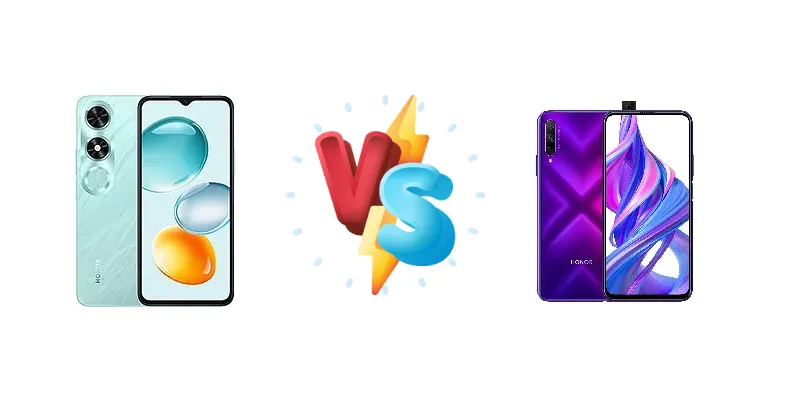
The Honor Play9C (China) and the Honor 9X Pro represent different points in Honor’s mid-range strategy. The Play9C, powered by the newer Mediatek Dimensity 6100+, aims to deliver modern performance at an accessible price. The 9X Pro, with its Kirin 810, was a strong contender in its time, boasting a solid all-around experience. This comparison dissects their key differences to determine which device offers the best value in today’s market.
🏆 Quick Verdict
For the average user prioritizing modern processor architecture and potential for future software updates, the Honor Play9C (China) is the better choice. While the 9X Pro offers comparable battery endurance, the Dimensity 6100+'s 6nm process and Cortex-A76 cores provide a performance edge, especially in demanding applications.
| Network |
|---|
| 2G bands | GSM 850 / 900 / 1800 / 1900 | GSM 850 / 900 / 1800 / 1900 |
| 3G bands | HSDPA 850 / 900 / 1900 / 2100 | HSDPA 850 / 900 / 2100 |
| 4G bands | LTE | 1, 3, 7, 8, 20, 38, 40, 41 - International |
| 5G bands | SA/NSA | - |
| Speed | HSPA, LTE, 5G | HSPA 42.2/5.76 Mbps, LTE (2CA) Cat12 600/50 Mbps |
| Technology | GSM / CDMA / HSPA / CDMA2000 / LTE / 5G | GSM / CDMA / HSPA / EVDO / LTE |
| | - | 1, 3, 5, 8, 38, 39, 40, 41 - China |
| Launch |
|---|
| Announced | 2024, September 26 | 2019, July 23. Released 2019, August 09 |
| Status | Available. Released 2024, September 26 | Discontinued |
| Body |
|---|
| Build | - | Glass front, glass back, aluminum frame |
| Dimensions | 163.6 x 75.3 x 8.4 mm (6.44 x 2.96 x 0.33 in) | 163.5 x 77.3 x 8.8 mm (6.44 x 3.04 x 0.35 in) |
| SIM | Nano-SIM + Nano-SIM | Nano-SIM + Nano-SIM |
| Weight | 190 g (6.70 oz) | 202 g (7.13 oz) |
| Display |
|---|
| Resolution | 720 x 1612 pixels, 20:9 ratio (~269 ppi density) | 1080 x 2340 pixels, 19.5:9 ratio (~391 ppi density) |
| Size | 6.56 inches, 103.4 cm2 (~83.9% screen-to-body ratio) | 6.59 inches, 106.6 cm2 (~84.3% screen-to-body ratio) |
| Type | TFT LCD, 90Hz, 780 nits (peak) | IPS LCD |
| Platform |
|---|
| CPU | Octa-core (2x2.2 GHz Cortex-A76 & 6x2.0 GHz Cortex-A55) | Octa-core (2x2.27 GHz Cortex-A76 & 6x1.88 GHz Cortex-A55) |
| Chipset | Mediatek Dimensity 6100+ (6 nm) | Kirin 810 (7 nm) |
| GPU | Mali-G57 MC2 | Mali-G52 MP6 |
| OS | Android 14, Magic OS 8 | Android 9.0 (Pie), upgradable to Android 10, EMUI 9.1, no Google Play Services |
| Memory |
|---|
| Card slot | No | microSDXC (uses shared SIM slot) |
| Internal | 128GB 6GB RAM, 256GB 8GB RAM, 256GB 12GB RAM | 128GB 8GB RAM, 256GB 6GB RAM, 256GB 8GB RAM |
| Main Camera |
|---|
| Features | LED flash, HDR, panorama | LED flash, HDR, panorama |
| Single | 13 MP, f/1.8, (wide) | - |
| Triple | - | 48 MP, f/1.8, (wide), 1/2.0", 0.8µm, PDAF
8 MP, f/2.4, 120˚ (ultrawide)
Auxiliary lens |
| Video | 1080p@30fps | 1080p@30fps, gyro-EIS |
| Selfie camera |
|---|
| Single | 5 MP, f/2.2, (wide) | Motorized pop-up 16 MP, f/2.2, 26mm (wide), 1/3.06", 1.0µm |
| Video | 1080p@30fps | 1080p@60fps |
| Sound |
|---|
| 3.5mm jack | - | Yes |
| 35mm jack | Yes | Yes |
| Loudspeaker | Yes | Yes |
| Comms |
|---|
| Bluetooth | 5.3, A2DP, LE, aptX HD | 4.2, A2DP, LE (International)5.0, A2DP, LE (China) |
| NFC | No | No |
| Positioning | GPS, GLONASS, GALILEO, BDS | GPS, GLONASS, BDS |
| Radio | No | FM radio |
| USB | USB Type-C 2.0, OTG | USB Type-C 2.0 |
| WLAN | Wi-Fi 802.11 a/b/g/n/ac, dual-band, Wi-Fi Direct | Wi-Fi 802.11 a/b/g/n/ac, dual-band, Wi-Fi Direct |
| Features |
|---|
| Sensors | Fingerprint (side-mounted), accelerometer, proximity, compass | Fingerprint (side-mounted), accelerometer, gyro, proximity, compass |
| Battery |
|---|
| Charging | 10W wired
2.5W reverse wired | 10W wired |
| Type | Li-Po 5200 mAh | Li-Po 4000 mAh, non-removable |
| Misc |
|---|
| Colors | Black, Blue | Midnight Black, Phantom Purple |
| Models | JDY-AN00 | HLK-AL10, HLK-TL10, HLK-L41, HLK-L42 |
| Price | About 100 EUR | About 230 EUR |
| Tests |
|---|
| Battery life | - |
Endurance rating 104h
|
| Camera | - |
Photo / Video |
| Display | - |
Contrast ratio: 1319:1 (nominal) |
| Loudspeaker | - |
-31.1 LUFS (Below average)
|
| Performance | - |
AnTuTu: 312668 (v8)
GeekBench: 7836 (v4.4), 1911 (v5.1)
GFXBench: 18fps (ES 3.1 onscreen) |
Honor Play9C (China)
- More modern chipset (Dimensity 6100+)
- Improved thermal efficiency
- Potential for better future software support
- Charging speed is slow (10W)
- Display brightness likely lower than 9X Pro
Honor 9X Pro
- Excellent battery endurance (104h)
- Brighter display (517 nits)
- Proven performance in its class
- Older chipset (Kirin 810)
- Less efficient processor
Display Comparison
Both the Honor Play9C and 9X Pro share a contrast ratio of 1319:1, suggesting similar panel characteristics in terms of black levels. However, the 9X Pro’s measured peak brightness of 517 nits provides a noticeably brighter viewing experience, particularly outdoors. While the Play9C’s display specifications are not provided, the lack of brightness data suggests it may not match the 9X Pro in direct sunlight visibility. Both devices lack high refresh rate displays, focusing on power efficiency over visual fluidity.
Camera Comparison
Both phones are listed as having 'Photo / Video' capabilities, but lack specific details regarding sensor size, aperture, or features like OIS. Given the market positioning, it’s likely both devices rely on multi-camera setups with a primary sensor and supporting lenses. Without further information, it’s difficult to definitively assess camera quality. However, the absence of any mention of advanced features suggests neither phone will excel in challenging lighting conditions or offer exceptional image detail. The 2MP macro cameras often found in this segment are unlikely to provide significant value.
Performance
The core difference lies in the chipsets. The Honor Play9C’s Mediatek Dimensity 6100+ (6nm) utilizes newer Cortex-A76 cores, offering a performance advantage over the Kirin 810 (7nm) in the 9X Pro. While both CPUs feature a 2x2.2 GHz Cortex-A76 and 6x2.0 GHz/1.88 GHz Cortex-A55 configuration, the 6nm process of the Dimensity 6100+ translates to improved thermal efficiency and sustained performance. This means the Play9C is less likely to throttle under prolonged load, benefiting gamers and power users. The Kirin 810, while capable, is showing its age against newer mid-range SoCs.
Battery Life
The Honor 9X Pro boasts an endurance rating of 104 hours, indicating excellent battery life. The Play9C’s battery capacity is not specified, but its 10W charging suggests a focus on efficiency rather than rapid replenishment. Both devices share the same 10W wired charging, meaning neither offers fast charging capabilities. The 9X Pro’s established endurance rating gives it an edge for users who prioritize long-lasting battery performance, while the Play9C’s more efficient chipset may partially offset its potentially smaller battery capacity.
Buying Guide
Buy the Honor Play9C (China) if you need a phone with a more modern chipset for improved efficiency and performance in current and future apps. It’s ideal for users who value a responsive experience and aren’t heavily invested in the Huawei/Honor ecosystem. Buy the Honor 9X Pro if you prioritize a proven track record of battery life and are comfortable with a slightly older chipset. It’s a good option for users who primarily use their phone for basic tasks and value longevity in battery performance.
Frequently Asked Questions
❓ Does the Mediatek Dimensity 6100+ in the Play9C offer a noticeable gaming improvement over the Kirin 810 in the 9X Pro?
Yes, the Dimensity 6100+'s newer CPU architecture and 6nm process provide a performance advantage in gaming. While the Kirin 810 is still capable, the Play9C is likely to deliver higher frame rates and smoother gameplay, especially in demanding titles. The improved thermal efficiency also reduces the risk of throttling during extended gaming sessions.
❓ The Honor 9X Pro has a 104-hour endurance rating. Does the Play9C's battery life fall significantly short of this?
While the Play9C's battery capacity isn't specified, its more efficient Dimensity 6100+ chipset may help mitigate the difference. However, the 9X Pro's 104-hour rating is exceptional, and the Play9C is unlikely to match it. If battery life is your absolute top priority, the 9X Pro remains the better choice.
❓ Is the 10W charging on both phones a significant drawback in 2024?
Yes, 10W charging is quite slow by today's standards. Expect a full charge to take well over two hours. This is a compromise both phones make to keep costs down. If fast charging is important to you, you'll need to consider other options.