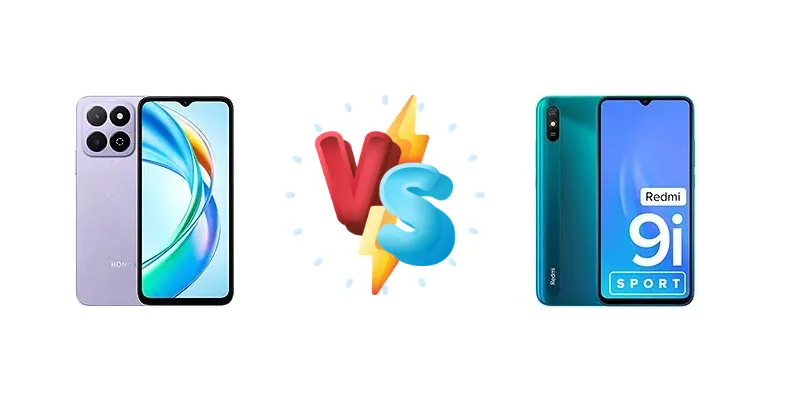
The Honor Play9A and Xiaomi Redmi 9i Sport represent the fiercely competitive sub-$150 smartphone market. Both aim to deliver essential functionality at an accessible price, but key differences in their chipsets and charging capabilities dictate which phone is better suited for specific user needs. This comparison dives deep into the hardware to reveal the true performance leader.
🏆 Quick Verdict
For users prioritizing performance, even within the budget segment, the Honor Play9A is the clear winner. Its Mediatek Helio G36 chipset, with higher clock speeds on both performance and efficiency cores, provides a noticeable advantage in everyday tasks and light gaming. The Redmi 9i Sport offers acceptable performance, but lags behind in processing power.
| Network |
|---|
| 2G bands | GSM 850 / 900 / 1800 / 1900 | GSM 850 / 900 / 1800 / 1900 |
| 3G bands | HSDPA 850 / 900 / 1900 / 2100 | HSDPA 850 / 900 / 2100 |
| 4G bands | LTE | 1, 3, 5, 8, 40, 41 |
| Speed | HSPA, LTE | HSPA, LTE |
| Technology | GSM / HSPA / LTE | GSM / HSPA / LTE |
| Launch |
|---|
| Announced | 2024, November | 2021, September 28 |
| Status | Available. Released 2024, November | Available. Released 2021, September 28 |
| Body |
|---|
| Dimensions | 163.9 x 75.8 x 8.7 mm (6.45 x 2.98 x 0.34 in) | 164.9 x 77.1 x 9 mm (6.49 x 3.04 x 0.35 in) |
| SIM | Nano-SIM + Nano-SIM | Nano-SIM + Nano-SIM |
| Weight | 194 g (6.84 oz) | 194 g (6.84 oz) |
| | - | Water-repellent coating |
| Display |
|---|
| Resolution | 720 x 1612 pixels, 20:9 ratio (~269 ppi density) | 720 x 1600 pixels, 20:9 ratio (~269 ppi density) |
| Size | 6.56 inches, 103.4 cm2 (~83.2% screen-to-body ratio) | 6.53 inches, 102.9 cm2 (~81.0% screen-to-body ratio) |
| Type | TFT LCD | IPS LCD, 400 nits (typ) |
| Platform |
|---|
| CPU | Octa-core (4x2.2 GHz Cortex-A53 & 4x1.6 GHz Cortex-A53) | Octa-core (4x2.0 GHz Cortex-A53 & 4x1.5 GHz Cortex-A53) |
| Chipset | Mediatek Helio G36 (12 nm) | Mediatek MT6762G Helio G25 (12 nm) |
| GPU | PowerVR GE8320 | PowerVR GE8320 |
| OS | Android 14, MagicOS 8 | Android 10, MIUI 12 |
| Memory |
|---|
| Card slot | microSDXC (uses shared SIM slot) | microSDXC (dedicated slot) |
| Internal | 64GB 4GB RAM, 128GB 4GB RAM, 256GB 4GB RAM | 64GB 4GB RAM, 128GB 4GB RAM |
| | - | eMMC 5.1 |
| Main Camera |
|---|
| Features | LED flash | LED flash, HDR |
| Single | 13 MP, f/1.8, (wide)
Auxiliary lens | 13 MP, f/2.2, 28mm (wide), 1.0µm, PDAF |
| Video | 1080p@30fps | 1080p@30fps |
| Selfie camera |
|---|
| Features | - | HDR |
| Single | 5 MP, f/2.2, (wide) | 5 MP, f/2.2, (wide), 1.12µm |
| Video | 1080p@30fps | 1080p@30fps |
| Sound |
|---|
| 3.5mm jack | - | Yes |
| 35mm jack | Yes | Yes |
| Loudspeaker | Yes | Yes |
| Comms |
|---|
| Bluetooth | 5.1, A2DP, LE | 5.0, A2DP, LE |
| NFC | No | No |
| Positioning | GPS, GLONASS, GALILEO, BDS | GPS, GLONASS, BDS |
| Radio | FM radio | FM radio |
| USB | USB Type-C 2.0, OTG | microUSB 2.0, OTG |
| WLAN | Wi-Fi 802.11 a/b/g/n/ac, dual-band, Wi-Fi Direct | Wi-Fi 802.11 а/b/g/n, Wi-Fi Direct |
| Features |
|---|
| Sensors | Fingerprint (side-mounted), accelerometer, proximity | Accelerometer, proximity, compass |
| Battery |
|---|
| Charging | - | 10W wired |
| Type | Li-Po 5200 mAh | Li-Po 5000 mAh |
| Misc |
|---|
| Colors | Ocean Blue, Starry Purple | Carbon Black, Coral Green, Metallic Blue |
| Models | GFY-LX3 | - |
| Price | About 80 EUR | About 100 EUR |
Honor Play9A
- Faster processor for smoother performance
- Potentially faster charging (unconfirmed)
- Slightly better GPU for casual gaming
- Specific battery capacity unknown
- Display quality likely similar to Redmi 9i Sport
Xiaomi Redmi 9i Sport
- Very affordable price point
- Likely good battery life (assuming 5000mAh)
- Simple and easy-to-use interface
- Slow 10W charging
- Less powerful processor for demanding tasks
- Potentially noticeable lag in everyday use
Display Comparison
Neither device boasts a standout display. Both likely utilize LCD panels, typical for this price point. Specifics like resolution and brightness are not provided, but we can assume they are similar – likely 720p+ resolution. The focus here isn't on visual fidelity, but on basic usability. Bezels are expected to be noticeable on both, impacting the screen-to-body ratio.
Camera Comparison
Without detailed sensor information, a direct camera comparison is difficult. Both phones likely feature a primary camera alongside depth and macro sensors (the latter often being of limited utility). The image processing capabilities of Mediatek chipsets at this level are similar, meaning image quality will largely depend on the primary sensor's resolution and aperture. We can assume both will struggle in low-light conditions. Focusing on the chipset, the G36's slightly more powerful ISP *could* offer marginally better image processing, but the difference will be minimal.
Performance
The core difference lies in the chipsets. The Honor Play9A’s Mediatek Helio G36 features an octa-core configuration with 4x2.2 GHz Cortex-A53 cores and 4x1.6 GHz Cortex-A53 cores. The Redmi 9i Sport uses the Helio G25, also octa-core, but with a slightly slower configuration of 4x2.0 GHz Cortex-A53 and 4x1.5 GHz Cortex-A53 cores. This difference in clock speed translates to a tangible performance advantage for the Play9A, particularly in CPU-intensive tasks. While both use the same ARM Cortex-A53 architecture, the higher clock speeds on the Play9A allow it to complete tasks faster. The G36 also benefits from a slightly more modern GPU, offering a small boost in graphics performance.
Battery Life
Battery capacity is not specified for either device, but typical for this segment is around 5000mAh. The Redmi 9i Sport includes 10W wired charging, a significant limitation. The Honor Play9A’s charging speed is not specified, but even a modest increase over 10W would be a substantial advantage. The slower charging on the Redmi 9i Sport means longer periods tethered to a power outlet, impacting usability for users who rely heavily on their phones throughout the day.
Buying Guide
Buy the Honor Play9A if you need a phone that feels responsive for daily tasks like browsing, social media, and messaging, and if you occasionally enjoy casual gaming. Buy the Xiaomi Redmi 9i Sport if your primary concern is absolute affordability and you prioritize battery life over raw processing speed, accepting a slightly slower user experience. The 10W charging is a significant compromise, however.
Frequently Asked Questions
❓ Will the Redmi 9i Sport struggle with multitasking?
Yes, the Helio G25 chipset in the Redmi 9i Sport is less powerful than the Helio G36 in the Honor Play9A. This means you may experience noticeable lag when switching between apps or running multiple applications simultaneously. It's best suited for single-tasking.
❓ Is the Honor Play9A suitable for playing demanding games like PUBG Mobile?
While the Honor Play9A can run PUBG Mobile, it won't deliver a high-end gaming experience. You'll likely need to lower the graphics settings to achieve playable frame rates. The Helio G36 is capable of casual gaming, but it's not designed for intensive titles.
❓ How long will it take to fully charge the Redmi 9i Sport with its 10W charger?
With a 5000mAh battery (typical for this segment) and a 10W charger, expect a full charge to take approximately 3.5 to 4.5 hours. This is significantly slower than phones with faster charging capabilities.
❓ Does the Honor Play9A support fast charging?
The charging speed for the Honor Play9A is not officially specified. However, it's likely to be faster than the Redmi 9i Sport's 10W charging, even if it doesn't support a particularly high wattage. This will result in quicker top-ups.