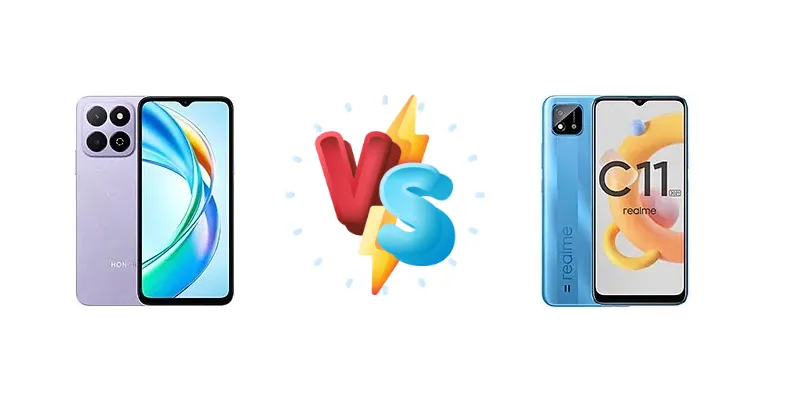
Both the Honor Play9A and Realme C11 (2021) target the ultra-budget smartphone market, but they take distinctly different approaches to achieving affordability. The Realme C11 (2021) prioritizes a lower manufacturing cost with an older chipset, while the Honor Play9A opts for a more recent, albeit still entry-level, processor. This comparison dissects these choices to determine which phone delivers the best user experience.
🏆 Quick Verdict
For the average user, the Honor Play9A is the better choice. Its Mediatek Helio G36, built on a 12nm process, offers a more modern CPU architecture and generally superior performance compared to the Realme C11 (2021)'s Unisoc SC9863A, which is fabricated on a significantly older 28nm node. While both phones are limited, the Play9A provides a smoother experience.
| Network |
|---|
| 2G bands | GSM 850 / 900 / 1800 / 1900 | GSM 850 / 900 / 1800 / 1900 |
| 3G bands | HSDPA 850 / 900 / 1900 / 2100 | HSDPA 850 / 900 / 1900 / 2100 |
| 4G bands | LTE | 1, 3, 5, 8, 38, 40, 41 |
| Speed | HSPA, LTE | HSPA, LTE |
| Technology | GSM / HSPA / LTE | GSM / HSPA / LTE |
| Launch |
|---|
| Announced | 2024, November | 2021, June 28 |
| Status | Available. Released 2024, November | Available. Released 2021, June 28 |
| Body |
|---|
| Build | - | Glass front, plastic frame, plastic back |
| Dimensions | 163.9 x 75.8 x 8.7 mm (6.45 x 2.98 x 0.34 in) | 165.2 x 76.4 x 8.9 mm (6.50 x 3.01 x 0.35 in) |
| SIM | Nano-SIM + Nano-SIM | Nano-SIM + Nano-SIM |
| Weight | 194 g (6.84 oz) | 190 g (6.70 oz) |
| | - | Splash resistant design |
| Display |
|---|
| Resolution | 720 x 1612 pixels, 20:9 ratio (~269 ppi density) | 720 x 1600 pixels, 20:9 ratio (~269 ppi density) |
| Size | 6.56 inches, 103.4 cm2 (~83.2% screen-to-body ratio) | 6.52 inches, 102.6 cm2 (~81.3% screen-to-body ratio) |
| Type | TFT LCD | IPS LCD, 400 nits (typ) |
| Platform |
|---|
| CPU | Octa-core (4x2.2 GHz Cortex-A53 & 4x1.6 GHz Cortex-A53) | Octa-core (4x1.6 GHz Cortex-A55 & 4x1.2 GHz Cortex-A55) |
| Chipset | Mediatek Helio G36 (12 nm) | Unisoc SC9863A (28 nm) |
| GPU | PowerVR GE8320 | IMG8322 |
| OS | Android 14, MagicOS 8 | Android 11, Realme Go UI |
| Memory |
|---|
| Card slot | microSDXC (uses shared SIM slot) | microSDXC (dedicated slot) |
| Internal | 64GB 4GB RAM, 128GB 4GB RAM, 256GB 4GB RAM | 32GB 2GB RAM, 64GB 4GB RAM |
| | - | eMMC 5.1 |
| Main Camera |
|---|
| Features | LED flash | LED flash, HDR, panorama |
| Single | 13 MP, f/1.8, (wide)
Auxiliary lens | 8 MP, f/2.0, (wide), AF |
| Video | 1080p@30fps | 1080p@30fps |
| Selfie camera |
|---|
| Features | - | HDR, panorama |
| Single | 5 MP, f/2.2, (wide) | 5 MP, f/2.2, (wide) |
| Video | 1080p@30fps | 1080p@30fps |
| Sound |
|---|
| 3.5mm jack | - | Yes |
| 35mm jack | Yes | Yes |
| Loudspeaker | Yes | Yes |
| Comms |
|---|
| Bluetooth | 5.1, A2DP, LE | 4.2, A2DP |
| NFC | No | No |
| Positioning | GPS, GLONASS, GALILEO, BDS | GPS, GLONASS, GALILEO, BDS |
| Radio | FM radio | Unspecified |
| USB | USB Type-C 2.0, OTG | microUSB 2.0, OTG |
| WLAN | Wi-Fi 802.11 a/b/g/n/ac, dual-band, Wi-Fi Direct | Wi-Fi 802.11 b/g/n |
| Features |
|---|
| Sensors | Fingerprint (side-mounted), accelerometer, proximity | Accelerometer, gyro, proximity, compass |
| Battery |
|---|
| Charging | - | 10W wired
Reverse wired |
| Type | Li-Po 5200 mAh | 5000 mAh |
| Misc |
|---|
| Colors | Ocean Blue, Starry Purple | Cool Blue, Cool Grey |
| Models | GFY-LX3 | RMX3231 |
| Price | About 80 EUR | About 80 EUR |
Honor Play9A
- More modern CPU architecture (Cortex-A53)
- More efficient 12nm fabrication process
- Potentially better image processing
- Still an entry-level chipset
- Display details are unknown
Realme C11 (2021)
- Lower price point (likely)
- 10W reverse wired charging
- Simple and straightforward operation
- Older and less efficient 28nm chipset
- Slower CPU cores (Cortex-A55)
- Potentially more throttling under load
Display Comparison
Neither device boasts a standout display. Details regarding panel type, resolution, and brightness are absent from the provided data, suggesting both utilize basic LCD panels common in this price bracket. However, the lack of information on PWM dimming rates is concerning; users sensitive to flicker may want to investigate further before purchasing either device. Bezels are likely substantial on both, maximizing screen real estate is not a priority.
Camera Comparison
Camera performance is likely to be similar on both devices, given the lack of detailed sensor information. Both will likely feature a primary camera accompanied by lower-resolution auxiliary lenses. Without knowing sensor sizes or apertures, it’s difficult to make a definitive judgment. However, the image signal processor (ISP) within the Helio G36 may offer slightly better image processing capabilities, potentially leading to marginally better photos in good lighting conditions. The 28nm process of the SC9863A may limit the ISP's capabilities.
Performance
The core difference lies in the chipsets. The Honor Play9A’s Mediatek Helio G36, while still an entry-level chip, utilizes Cortex-A53 cores clocked up to 2.2 GHz. This is a significant advantage over the Realme C11 (2021)’s Unisoc SC9863A, which employs slower Cortex-A55 cores peaking at 1.6 GHz. The 12nm fabrication process of the Helio G36 is also crucial; it’s far more efficient than the SC9863A’s 28nm process, resulting in lower heat generation and potentially less throttling under sustained load. The architectural improvements in the G36, despite using older core designs, translate to a more responsive user experience.
Battery Life
Battery capacity is not specified for either device, making a direct comparison difficult. However, the Realme C11 (2021) includes 10W wired charging and reverse wired charging. The Unisoc SC9863A’s 28nm process is less power-efficient than the Helio G36’s 12nm process, meaning the Realme C11 (2021) may require more frequent charging despite potentially having a similar battery capacity. The reverse wired charging is a unique feature, allowing the C11 to act as a power bank for accessories, but the slow 10W output limits its practicality.
Buying Guide
Buy the Honor Play9A if you need a phone capable of handling basic multitasking and light gaming without significant lag. Its newer chipset provides a noticeable advantage in responsiveness. Buy the Realme C11 (2021) if your primary concern is absolute cost and you only need a phone for the most basic tasks like calls, texts, and occasional social media browsing. The 10W reverse wired charging is a niche benefit for those needing to top up accessories.
Frequently Asked Questions
❓ Will the Realme C11 (2021) struggle with popular apps like WhatsApp and Facebook?
The Unisoc SC9863A is a very basic chipset. While it can handle lightweight apps like WhatsApp and Facebook, expect noticeable lag when switching between apps or loading complex content. The Honor Play9A’s Helio G36 will provide a smoother experience, even if it’s not a powerhouse.
❓ Is the 10W reverse charging on the Realme C11 (2021) useful for anything beyond emergencies?
The 10W reverse charging is primarily useful for topping up accessories like Bluetooth headphones or a smartwatch in a pinch. It’s far too slow to significantly charge a smartphone, and the limited power output means it won’t work with all devices. It's a niche feature, not a core selling point.
❓ Can either of these phones handle basic mobile games like Candy Crush or Subway Surfers?
Both phones *can* run simple games like Candy Crush or Subway Surfers, but don't expect high frame rates or smooth performance. The Honor Play9A will likely offer a slightly more stable experience due to its more powerful GPU and efficient chipset, but both will require lowering graphics settings.