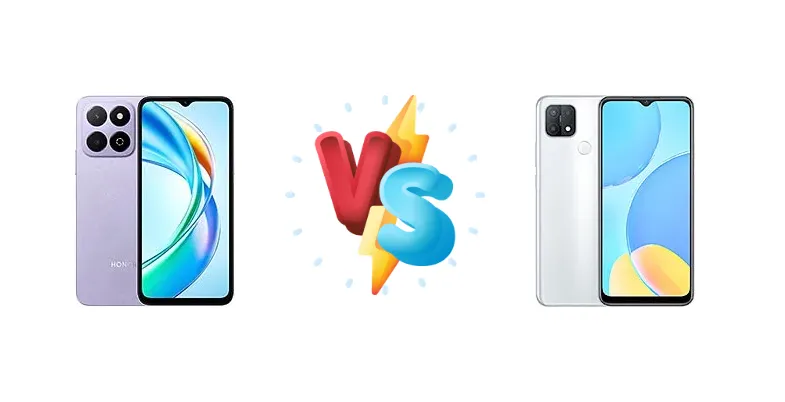
The Honor Play9A and Oppo A15s represent the fiercely competitive sub-$150 smartphone market. Both devices aim to deliver essential smartphone functionality at an accessible price point, but they achieve this with different hardware choices. This comparison dives deep into the specifications to determine which phone offers the best balance of performance, features, and value.
🏆 Quick Verdict
For most users, the Honor Play9A emerges as the slightly better choice. Its Mediatek Helio G36 chipset, with its higher clocked Cortex-A53 cores, provides a noticeable performance edge over the Oppo A15s’ Helio P35, making it more suitable for everyday tasks and light gaming. While the Oppo A15s offers 10W charging, the Play9A’s overall processing power is more impactful for the average user.
| Network |
|---|
| 2G bands | GSM 850 / 900 / 1800 / 1900 | GSM 850 / 900 / 1800 / 1900 |
| 3G bands | HSDPA 850 / 900 / 1900 / 2100 | HSDPA 850 / 900 / 2100 |
| 4G bands | LTE | 1, 3, 5, 8, 38, 40, 41 |
| Speed | HSPA, LTE | HSPA, LTE |
| Technology | GSM / HSPA / LTE | GSM / HSPA / LTE |
| Launch |
|---|
| Announced | 2024, November | 2020, December 18. Released 2020, December 18 |
| Status | Available. Released 2024, November | Discontinued |
| Body |
|---|
| Build | - | Glass front, plastic back, plastic frame |
| Dimensions | 163.9 x 75.8 x 8.7 mm (6.45 x 2.98 x 0.34 in) | 164 x 75.4 x 7.9 mm (6.46 x 2.97 x 0.31 in) |
| SIM | Nano-SIM + Nano-SIM | Nano-SIM + Nano-SIM |
| Weight | 194 g (6.84 oz) | 177 g (6.24 oz) |
| Display |
|---|
| Resolution | 720 x 1612 pixels, 20:9 ratio (~269 ppi density) | 720 x 1600 pixels, 20:9 ratio (~269 ppi density) |
| Size | 6.56 inches, 103.4 cm2 (~83.2% screen-to-body ratio) | 6.52 inches, 102.6 cm2 (~83.0% screen-to-body ratio) |
| Type | TFT LCD | IPS LCD, 480 nits (typ) |
| Platform |
|---|
| CPU | Octa-core (4x2.2 GHz Cortex-A53 & 4x1.6 GHz Cortex-A53) | Octa-core (4x2.35 GHz Cortex-A53 & 4x1.8 GHz Cortex-A53) |
| Chipset | Mediatek Helio G36 (12 nm) | Mediatek MT6765 Helio P35 (12 nm) |
| GPU | PowerVR GE8320 | PowerVR GE8320 |
| OS | Android 14, MagicOS 8 | Android 10, ColorOS 7.2 |
| Memory |
|---|
| Card slot | microSDXC (uses shared SIM slot) | microSDXC |
| Internal | 64GB 4GB RAM, 128GB 4GB RAM, 256GB 4GB RAM | 64GB 4GB RAM, 128GB 4GB RAM |
| | - | eMMC 5.1 |
| Main Camera |
|---|
| Features | LED flash | LED flash, HDR, panorama |
| Single | 13 MP, f/1.8, (wide)
Auxiliary lens | - |
| Triple | - | 13 MP, f/2.2, (wide), 1/3.1", 1.12µm, PDAF
2 MP (macro)
Auxiliary lens |
| Video | 1080p@30fps | 1080p@30fps |
| Selfie camera |
|---|
| Features | - | HDR |
| Single | 5 MP, f/2.2, (wide) | 8 MP, f/2.0, (wide) |
| Video | 1080p@30fps | 1080p@30fps |
| Sound |
|---|
| 3.5mm jack | - | Yes |
| 35mm jack | Yes | Yes |
| Loudspeaker | Yes | Yes |
| Comms |
|---|
| Bluetooth | 5.1, A2DP, LE | 5.0, A2DP, LE, aptX |
| NFC | No | No |
| Positioning | GPS, GLONASS, GALILEO, BDS | GPS, GLONASS, GALILEO, BDS |
| Radio | FM radio | FM radio |
| USB | USB Type-C 2.0, OTG | microUSB 2.0, OTG |
| WLAN | Wi-Fi 802.11 a/b/g/n/ac, dual-band, Wi-Fi Direct | Wi-Fi 802.11 b/g/n, Wi-Fi Direct |
| Features |
|---|
| Sensors | Fingerprint (side-mounted), accelerometer, proximity | Fingerprint (rear-mounted), accelerometer, proximity |
| Battery |
|---|
| Charging | - | 10W wired |
| Type | Li-Po 5200 mAh | Li-Po 4230 mAh |
| Misc |
|---|
| Colors | Ocean Blue, Starry Purple | Dynamic Black, Fancy White |
| Models | GFY-LX3 | CPH2179 |
| Price | About 80 EUR | About 130 EUR |
Honor Play9A
- Potentially better CPU performance with the Helio G36.
- Newer chipset architecture for improved efficiency.
- Likely smoother multitasking experience.
- Charging speed is likely similar or slower than the Oppo A15s.
- Detailed specifications are limited.
Oppo A15s
- Includes 10W wired charging.
- Slightly higher peak CPU clock speeds.
- Reliable brand reputation.
- Older Helio P35 chipset may struggle with demanding tasks.
- Potentially less efficient CPU architecture.
Display Comparison
Neither Honor nor Oppo provide display specifications beyond the basic panel type. Given the price point, both likely utilize IPS LCD panels. The absence of detailed specs like peak brightness or color gamut makes a direct comparison impossible. However, the focus on processing power suggests neither phone is geared towards media consumption, so display quality is less critical. Bezels are expected to be substantial on both devices, typical for this segment.
Camera Comparison
Detailed camera specifications are unavailable. Both phones likely feature a primary camera and potentially depth or macro sensors. However, given the market segment, image quality will be heavily reliant on software processing rather than advanced hardware. The absence of Optical Image Stabilization (OIS) is almost certain on both devices. Focusing on megapixel counts alone would be misleading; the sensor size and image processing algorithms are far more important, and these details are not provided.
Performance
The core difference lies in the chipsets. The Honor Play9A’s Mediatek Helio G36 features an octa-core configuration with four cores clocked at 2.2 GHz and four at 1.6 GHz, all Cortex-A53. The Oppo A15s utilizes the Mediatek MT6765 Helio P35, also octa-core with Cortex-A53 cores, but clocked slightly higher at 2.35 GHz and 1.8 GHz. While the P35 has a higher peak clock speed, the G36’s architecture is newer, potentially offering better efficiency and sustained performance. The G36 is built on a 12nm process, similar to the P35, but the newer design should provide a slight advantage in real-world usage. Both phones likely feature limited RAM, impacting multitasking capabilities, but the G36’s CPU will handle individual tasks more efficiently.
Battery Life
Battery capacity is not specified for either device. However, the Oppo A15s includes 10W wired charging, while the Honor Play9A’s charging speed is unknown but likely similar or slightly slower. The 10W charging on the A15s will result in a lengthy charge time, but provides a consistent power source. Without knowing the battery capacity, it’s difficult to definitively say which phone offers better battery life. The more efficient Helio G36 in the Play9A *could* translate to slightly longer usage on a similar-sized battery.
Buying Guide
Buy the Honor Play9A if you prioritize responsiveness and smoother multitasking, even if it means sacrificing slightly faster charging. This phone is ideal for users who frequently browse the web, use social media, or play casual mobile games. Buy the Oppo A15s if you value a consistently available, albeit slow, charging solution and are primarily focused on basic communication features like calls and messaging, with minimal demand on processing power.
Frequently Asked Questions
❓ Will the Honor Play9A handle popular games like PUBG Mobile or Call of Duty?
While the Helio G36 is capable of running these games, expect to play at lower graphics settings and frame rates to maintain a stable experience. The limited RAM and processing power will likely result in occasional stuttering, especially during intense firefights. The Oppo A15s will likely struggle even more with these titles.
❓ Is the 10W charging on the Oppo A15s significantly slow compared to other phones?
Yes, 10W charging is considerably slower than the charging speeds offered by many modern smartphones. Expect a full charge to take several hours. This is a trade-off for the lower price point, and is best suited for users who can charge their phone overnight.
❓ Which phone is better for streaming videos and browsing social media?
The Honor Play9A is the better choice for these tasks. The Helio G36’s slightly improved processing power will result in smoother scrolling and faster loading times when browsing social media or streaming videos. While both phones can handle these activities, the Play9A will provide a more responsive experience.