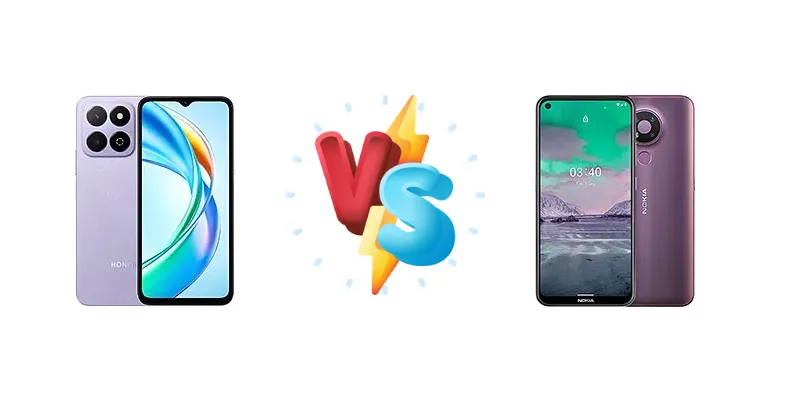
The Honor Play9A and Nokia 3.4 represent two compelling options in the ultra-budget smartphone space. While both aim to deliver essential smartphone functionality at a low price, they diverge significantly in their core processing power, relying on MediaTek and Qualcomm chipsets respectively. This comparison dives deep into the architectural differences and real-world implications of these choices.
🏆 Quick Verdict
For most users, the Nokia 3.4 offers a more balanced experience thanks to the Qualcomm Snapdragon 460. Its Cortex-A73 cores provide a noticeable performance uplift over the Play9A’s Cortex-A53 setup, making it better suited for multitasking and smoother app usage. While the Play9A is cheaper, the performance trade-off is significant.
| Network |
|---|
| 2G bands | GSM 850 / 900 / 1800 / 1900 | GSM 850 / 900 / 1800 / 1900 |
| 3G bands | HSDPA 850 / 900 / 1900 / 2100 | HSDPA 850 / 900 / 1700(AWS) / 1900 / 2100 |
| 4G bands | LTE | 1, 2, 3, 4, 5, 7, 8, 12, 17, 13, 28, 66 |
| Speed | HSPA, LTE | HSPA, LTE |
| Technology | GSM / HSPA / LTE | GSM / HSPA / LTE |
| Launch |
|---|
| Announced | 2024, November | 2020, September 22. Released 2020, October 26 |
| Status | Available. Released 2024, November | Discontinued |
| Body |
|---|
| Dimensions | 163.9 x 75.8 x 8.7 mm (6.45 x 2.98 x 0.34 in) | 161 x 76 x 8.7 mm (6.34 x 2.99 x 0.34 in) |
| SIM | Nano-SIM + Nano-SIM | · Nano-SIM· Nano-SIM + Nano-SIM |
| Weight | 194 g (6.84 oz) | 180 g (6.35 oz) |
| Display |
|---|
| Resolution | 720 x 1612 pixels, 20:9 ratio (~269 ppi density) | 720 x 1560 pixels, 19.5:9 ratio (~269 ppi density) |
| Size | 6.56 inches, 103.4 cm2 (~83.2% screen-to-body ratio) | 6.39 inches, 100.2 cm2 (~81.9% screen-to-body ratio) |
| Type | TFT LCD | IPS LCD, 400 nits (typ) |
| Platform |
|---|
| CPU | Octa-core (4x2.2 GHz Cortex-A53 & 4x1.6 GHz Cortex-A53) | Octa-core (4x1.8 GHz Cortex-A73 & 4x1.8 GHz Cortex-A53) |
| Chipset | Mediatek Helio G36 (12 nm) | Qualcomm SM4250 Snapdragon 460 (11 nm) |
| GPU | PowerVR GE8320 | Adreno 610 |
| OS | Android 14, MagicOS 8 | Android 10, upgradable to Android 11 |
| Memory |
|---|
| Card slot | microSDXC (uses shared SIM slot) | microSDXC (dedicated slot) |
| Internal | 64GB 4GB RAM, 128GB 4GB RAM, 256GB 4GB RAM | 32GB 3GB RAM, 64GB 3GB RAM, 64GB 4GB RAM |
| | - | eMMC 5.1 |
| Main Camera |
|---|
| Features | LED flash | LED flash, HDR, panorama |
| Single | 13 MP, f/1.8, (wide)
Auxiliary lens | - |
| Triple | - | 13 MP, (wide), PDAF
5 MP, (ultrawide)
Auxiliary lens |
| Video | 1080p@30fps | 1080p@30fps |
| Selfie camera |
|---|
| Single | 5 MP, f/2.2, (wide) | 8 MP, (wide) |
| Video | 1080p@30fps | 1080p@30fps |
| Sound |
|---|
| 3.5mm jack | - | Yes |
| 35mm jack | Yes | Yes |
| Loudspeaker | Yes | Yes |
| Comms |
|---|
| Bluetooth | 5.1, A2DP, LE | 4.2, A2DP, aptX |
| NFC | No | Yes (market/region dependent) |
| Positioning | GPS, GLONASS, GALILEO, BDS | GPS, GLONASS, GALILEO, BDS |
| Radio | FM radio | FM radio |
| USB | USB Type-C 2.0, OTG | USB Type-C 2.0 |
| WLAN | Wi-Fi 802.11 a/b/g/n/ac, dual-band, Wi-Fi Direct | Wi-Fi 802.11 b/g/n |
| Features |
|---|
| Sensors | Fingerprint (side-mounted), accelerometer, proximity | Fingerprint (rear-mounted), accelerometer, gyro, proximity |
| Battery |
|---|
| Charging | - | 10W wired |
| Type | Li-Po 5200 mAh | Li-Po 4000 mAh |
| Misc |
|---|
| Colors | Ocean Blue, Starry Purple | Fjord, Dusk, Charcoal |
| Models | GFY-LX3 | TA-1288, TA-1285, TA-1283 |
| Price | About 80 EUR | About 100 EUR |
| SAR | - | 0.83 W/kg (head) 1.05 W/kg (body) |
| SAR EU | - | 0.36 W/kg (head) 1.56 W/kg (body) |
Honor Play9A
- Lower price point makes it highly accessible.
- MediaTek Helio G36 is relatively power efficient.
- May offer longer battery life in very light usage scenarios.
- Significantly weaker CPU performance compared to the Snapdragon 460.
- Older chipset architecture limits multitasking capabilities.
- Likely to exhibit noticeable lag with demanding apps.
Nokia 3.4
- Qualcomm Snapdragon 460 provides a smoother and more responsive user experience.
- Cortex-A73 cores offer a substantial performance boost.
- Better suited for multitasking and light gaming.
- Qualcomm's brand recognition and software support are generally stronger.
- 10W charging is slow and inconvenient.
- Slightly higher price compared to the Honor Play9A.
- May not offer significantly better battery life despite the more efficient chipset.
Display Comparison
Neither device is expected to boast a high-end display. Given the price point, both likely utilize LCD panels. However, display quality beyond resolution (which isn't specified) is likely similar. The focus here is on the internal hardware, not the visual experience.
Camera Comparison
Without detailed camera specifications, a direct comparison is difficult. Both phones likely feature a multi-camera setup, but the quality will heavily depend on sensor size and image processing. Given the budget nature of these devices, expect modest camera performance, particularly in low-light conditions. The presence of a 2MP macro lens on either device is unlikely to significantly enhance the photography experience.
Performance
The core difference lies in the chipsets. The Honor Play9A’s MediaTek Helio G36 utilizes a big.LITTLE architecture with four Cortex-A53 cores clocked at 2.2 GHz and another four at 1.6 GHz. This is a relatively older architecture. The Nokia 3.4, however, features the Qualcomm Snapdragon 460, employing four Cortex-A73 cores at 1.8 GHz alongside four Cortex-A53 cores at the same speed. The Cortex-A73 cores represent a significant architectural improvement over the A53, offering substantially better single-core performance. The Snapdragon 460’s 11nm process also provides a slight efficiency advantage over the Helio G36’s 12nm node, potentially leading to better thermal management under sustained load. This translates to a smoother experience when switching between apps and a more responsive UI on the Nokia 3.4.
Battery Life
Battery capacity isn't specified for either device, making a direct mAh comparison impossible. However, the Nokia 3.4’s 10W charging is a clear disadvantage. The slower charging speed will result in significantly longer charge times compared to a device with faster charging capabilities. While the Helio G36 might be slightly more power-efficient due to its older architecture, the Snapdragon 460’s performance benefits likely outweigh any minor battery life gains.
Buying Guide
Buy the Honor Play9A if your primary need is absolute affordability and you primarily use your phone for basic tasks like calls, texts, and light social media. It’s a viable option for first-time smartphone users or as a secondary device. Buy the Nokia 3.4 if you prioritize a more responsive user experience, occasional gaming, and a chipset from a brand known for wider carrier compatibility and software support.
Frequently Asked Questions
❓ Will the Nokia 3.4 struggle with popular apps like Facebook or WhatsApp?
The Snapdragon 460 in the Nokia 3.4 is generally capable of running apps like Facebook and WhatsApp smoothly. However, running multiple apps simultaneously or using resource-intensive features within these apps might lead to some slowdown. The Honor Play9A’s Helio G36 will likely exhibit more noticeable lag in these scenarios.
❓ Is the Snapdragon 460 in the Nokia 3.4 capable of playing mobile games?
The Snapdragon 460 can handle less demanding mobile games at lower settings. Titles like PUBG Mobile or Call of Duty: Mobile will likely require significant graphics settings reductions to achieve playable frame rates. The Helio G36 in the Honor Play9A will struggle even more with these games, making the Nokia 3.4 the preferable choice for casual gamers.
❓ How long will it take to fully charge the Nokia 3.4 with its 10W charger?
With a 10W charger, fully charging the Nokia 3.4 will likely take between 3 to 4 hours, depending on the battery capacity (which is not specified). This is considerably slower than phones with fast charging capabilities, so plan accordingly.