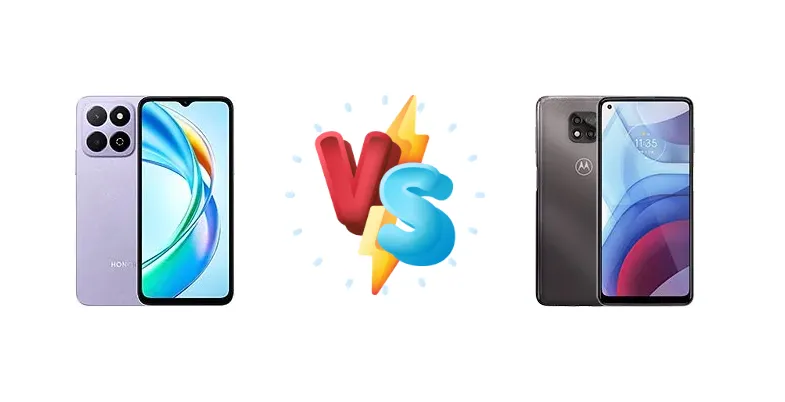
The sub-$200 smartphone market is fiercely competitive. The Honor Play9A and Motorola Moto G Power (2021) both aim to deliver essential features at an accessible price. However, they take different approaches to achieving this, primarily diverging in their chipset choices. This comparison dissects those differences and determines which phone offers the best value for your money.
🏆 Quick Verdict
For the average user prioritizing consistent performance and battery efficiency, the Motorola Moto G Power (2021) is the better choice. Its Snapdragon 662, built on an 11nm process, provides a noticeable advantage in sustained performance and power management compared to the Honor Play9A’s 12nm Helio G36.
| Network |
|---|
| 2G bands | GSM 850 / 900 / 1800 / 1900 | GSM 850 / 900 / 1800 / 1900 |
| 3G bands | HSDPA 850 / 900 / 1900 / 2100 | HSDPA 850 / 900 / 1700(AWS) / 1900 / 2100 |
| 4G bands | LTE | 1, 2, 3, 4, 5, 7, 8, 12, 13, 14, 17, 25, 26, 29, 30, 38, 41, 66, 71 |
| Speed | HSPA, LTE | HSPA, LTE |
| Technology | GSM / HSPA / LTE | GSM / CDMA / HSPA / EVDO / LTE |
| | - | CDMA2000 1xEV-DO |
| Launch |
|---|
| Announced | 2024, November | 2021, January 08 |
| Status | Available. Released 2024, November | Available. Released 2021, January 14 |
| Body |
|---|
| Build | - | Glass front, plastic back, plastic frame |
| Dimensions | 163.9 x 75.8 x 8.7 mm (6.45 x 2.98 x 0.34 in) | 165.3 x 75.9 x 9.5 mm (6.51 x 2.99 x 0.37 in) |
| SIM | Nano-SIM + Nano-SIM | Nano-SIM |
| Weight | 194 g (6.84 oz) | 206.5 g (7.30 oz) |
| | - | Water-repellent coating |
| Display |
|---|
| Resolution | 720 x 1612 pixels, 20:9 ratio (~269 ppi density) | 720 x 1600 pixels, 20:9 ratio (~266 ppi density) |
| Size | 6.56 inches, 103.4 cm2 (~83.2% screen-to-body ratio) | 6.6 inches, 105.2 cm2 (~83.8% screen-to-body ratio) |
| Type | TFT LCD | IPS LCD |
| Platform |
|---|
| CPU | Octa-core (4x2.2 GHz Cortex-A53 & 4x1.6 GHz Cortex-A53) | Octa-core (4x2.0 GHz Kryo 260 Gold & 4x1.8 GHz Kryo 260 Silver) |
| Chipset | Mediatek Helio G36 (12 nm) | Qualcomm SM6115 Snapdragon 662 (11 nm) |
| GPU | PowerVR GE8320 | Adreno 610 |
| OS | Android 14, MagicOS 8 | Android 10 |
| Memory |
|---|
| Card slot | microSDXC (uses shared SIM slot) | microSDXC (dedicated slot) |
| Internal | 64GB 4GB RAM, 128GB 4GB RAM, 256GB 4GB RAM | 32GB 3GB RAM, 64GB 4GB RAM |
| | - | eMMC 5.1 |
| Main Camera |
|---|
| Features | LED flash | LED flash, HDR, panorama |
| Single | 13 MP, f/1.8, (wide)
Auxiliary lens | - |
| Triple | - | 48 MP, f/1.7, (wide), 1/2.0", 0.8µm, PDAF
2 MP (macro)
Auxiliary lens |
| Video | 1080p@30fps | 1080p@30/60fps, gyro-EIS |
| Selfie camera |
|---|
| Features | - | HDR |
| Single | 5 MP, f/2.2, (wide) | 8 MP, f/2.0, 1.12µm |
| Video | 1080p@30fps | 1080p@30fps, gyro-EIS |
| Sound |
|---|
| 3.5mm jack | - | Yes |
| 35mm jack | Yes | Yes |
| Loudspeaker | Yes | Yes |
| Comms |
|---|
| Bluetooth | 5.1, A2DP, LE | 5.0, A2DP, LE |
| NFC | No | No |
| Positioning | GPS, GLONASS, GALILEO, BDS | GPS, GLONASS, GALILEO |
| Radio | FM radio | FM radio |
| USB | USB Type-C 2.0, OTG | USB Type-C 2.0 |
| WLAN | Wi-Fi 802.11 a/b/g/n/ac, dual-band, Wi-Fi Direct | Wi-Fi 802.11 a/b/g/n/ac, dual-band, Wi-Fi Direct |
| Features |
|---|
| Sensors | Fingerprint (side-mounted), accelerometer, proximity | Fingerprint (side-mounted), accelerometer, gyro, proximity, compass, barometer |
| Battery |
|---|
| Charging | - | 15W wired |
| Type | Li-Po 5200 mAh | Li-Po 5000 mAh |
| Misc |
|---|
| Colors | Ocean Blue, Starry Purple | Flash Gray, Polar Silver |
| Models | GFY-LX3 | - |
| Price | About 80 EUR | About 60 EUR |
Honor Play9A
- Potentially lower initial cost.
- May offer slightly faster single-core performance in benchmarks.
- MediaTek’s HyperEngine software could offer minor gaming optimizations.
- Less efficient chipset leads to shorter battery life.
- Higher likelihood of thermal throttling under sustained load.
- Potentially inferior image processing quality.
Motorola Moto G Power (2021)
- More efficient Snapdragon 662 chipset.
- Better sustained performance and multitasking.
- Likely longer battery life and faster charging.
- Qualcomm ISP generally delivers better image quality.
- May be slightly more expensive upfront.
- Peak single-core performance may be marginally lower than the Helio G36.
Display Comparison
Neither device is expected to boast a premium display. Details on panel type, resolution, and brightness are missing, but given the price point, both likely utilize LCD panels. The focus here isn't on visual fidelity, but durability and power consumption. The absence of high refresh rates is a given. Bezels are likely comparable, prioritizing cost savings over a modern, edge-to-edge design.
Camera Comparison
Without detailed camera specs beyond the presence of sensors, a direct comparison is difficult. However, it’s safe to assume both phones feature budget-oriented camera systems. The Motorola Moto G Power (2021) likely benefits from Qualcomm’s image signal processor (ISP), which generally provides better image processing and noise reduction compared to MediaTek’s offerings at this price point. The inclusion of Optical Image Stabilization (OIS) is unlikely on either device, but the Snapdragon’s ISP could compensate somewhat for shaky hands. The prevalence of low-resolution auxiliary cameras (2MP macro, depth sensors) on both phones suggests these are primarily for marketing purposes and offer limited practical benefit.
Performance
The core difference lies in the chipsets. The Motorola Moto G Power (2021) features the Qualcomm Snapdragon 662 (11nm), utilizing a Kryo 260 architecture with a split core configuration of 4x2.0 GHz Gold and 4x1.8 GHz Silver cores. This architecture is designed for a balance of performance and efficiency. Conversely, the Honor Play9A employs the MediaTek Helio G36 (12nm) with a less sophisticated octa-core setup of 4x2.2 GHz Cortex-A53 and 4x1.6 GHz Cortex-A53. The Snapdragon 662’s smaller 11nm node inherently offers better thermal efficiency, reducing the likelihood of throttling during sustained workloads. While the Helio G36’s higher clock speeds on its prime cores *suggest* faster single-core performance, the Snapdragon’s architecture and process node will likely translate to smoother multitasking and more consistent performance in real-world scenarios.
Battery Life
The Motorola Moto G Power (2021) includes 15W wired charging. While the battery capacity isn't specified in the provided data, Motorola’s ‘Power’ branding historically prioritizes large battery sizes. The Snapdragon 662’s superior power efficiency further enhances battery life. The Honor Play9A, with its less efficient Helio G36, will likely require more frequent charging despite potentially having a comparable battery capacity. The 15W charging on the Moto G Power, combined with its efficient chipset, will likely result in faster overall charging times and longer periods between charges.
Buying Guide
Buy the Honor Play9A if you prioritize a potentially lower upfront cost and are primarily focused on basic tasks like calling, texting, and light social media use. Buy the Motorola Moto G Power (2021) if you need a phone that can handle moderate multitasking, occasional gaming, and offers significantly better battery life and a more refined user experience thanks to the Snapdragon 662’s efficiency.
Frequently Asked Questions
❓ Will the Honor Play9A struggle with demanding games like PUBG Mobile?
The Helio G36 can run PUBG Mobile, but expect to play at lower graphics settings and potentially experience frame drops during intense moments. The chipset’s thermal limitations will likely lead to throttling, reducing sustained performance. The Moto G Power’s Snapdragon 662 will offer a smoother, more consistent gaming experience, even if not at maximum settings.
❓ How much faster will the Motorola Moto G Power (2021) charge compared to the Honor Play9A?
Both phones support 15W charging. However, the Snapdragon 662’s power efficiency means the Moto G Power will likely reach a usable charge level faster, as it’s not drawing as much power to maintain performance while charging. The Helio G36’s higher power draw could slightly offset the charging wattage benefit.
❓ Is the difference in chipsets noticeable for everyday tasks like browsing and social media?
For basic tasks, the difference may not be immediately apparent. However, the Snapdragon 662’s smoother multitasking capabilities will become noticeable when switching between apps or having multiple apps running in the background. The Helio G36 may exhibit slight lag or stuttering in these scenarios.