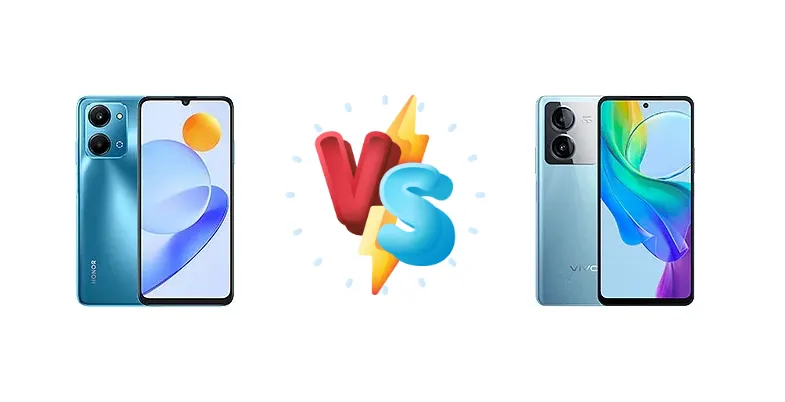
The Honor Play7T and vivo Y78t represent compelling options in the increasingly competitive budget smartphone market. Both aim to deliver a solid experience without breaking the bank, but they take different approaches to achieving this. The Play7T leverages MediaTek's Dimensity 6020, while the Y78t opts for Qualcomm's Snapdragon 6 Gen 1. This comparison will dissect the key differences to determine which device offers the best overall package.
🏆 Quick Verdict
For the average user prioritizing fast charging and potentially better long-term performance, the vivo Y78t emerges as the winner. Its Snapdragon 6 Gen 1, built on a more efficient 4nm process, and 44W charging provide a noticeable advantage over the Honor Play7T's Dimensity 6020 and 22.5W charging.
| Network |
|---|
| 2G bands | GSM 850 / 900 / 1800 / 1900 | GSM 850 / 900 / 1800 / 1900 |
| 3G bands | HSDPA 850 / 900 / 1900 / 2100 | HSDPA 850 / 900 / 2100 |
| 4G bands | LTE | 1, 3, 5, 8, 28, 34, 38, 39, 40, 41 |
| 5G bands | SA/NSA | 1, 3, 5, 8, 28, 38, 40, 41, 77, 78 SA/NSA |
| Speed | HSPA, LTE, 5G | HSPA, LTE, 5G |
| Technology | GSM / CDMA / HSPA / EVDO / LTE / 5G | GSM / CDMA / HSPA / CDMA2000 / LTE / 5G |
| | CDMA2000 1xEV-DO | - |
| Launch |
|---|
| Announced | 2023, March 28 | 2023, October 20 |
| Status | Available. Released 2023, April 04 | Available. Released 2023, October 24 |
| Body |
|---|
| Build | - | Glass front, plastic frame, plastic back |
| Dimensions | 167.5 x 76.9 x 8.3 mm (6.59 x 3.03 x 0.33 in) | 164.6 x 75.8 x 9.1 mm (6.48 x 2.98 x 0.36 in) |
| SIM | Nano-SIM + Nano-SIM | Nano-SIM + Nano-SIM |
| Weight | 196 g (6.91 oz) | 199.6 g (7.05 oz) |
| Display |
|---|
| Resolution | 720 x 1600 pixels, 20:9 ratio (~260 ppi density) | 1080 x 2388 pixels (~395 ppi density) |
| Size | 6.74 inches, 109.7 cm2 (~85.1% screen-to-body ratio) | 6.64 inches, 106.8 cm2 (~85.6% screen-to-body ratio) |
| Type | IPS LCD, 90Hz | IPS LCD, 120Hz |
| Platform |
|---|
| CPU | Octa-core (2x2.2 GHz Cortex-A76 & 6x2.0 GHz Cortex-A55) | Octa-core (4x2.2 GHz Cortex-A78 & 4x1.8 GHz Cortex-A55) |
| Chipset | Mediatek Dimensity 6020 (7 nm) | Qualcomm SM6450 Snapdragon 6 Gen 1 (4 nm) |
| GPU | Mali-G57 MC2 | Adreno 710 |
| OS | Android 12, Magic UI 6.1 | Android 13, OriginOS 3 |
| Memory |
|---|
| Card slot | No | No |
| Internal | 128GB 8GB RAM, 256GB 8GB RAM | 128GB 8GB RAM, 256GB 8GB RAM, 256GB 12GB RAM |
| Main Camera |
|---|
| Dual | 50 MP, f/1.8, (wide), PDAF
Auxiliary lens | 50 MP, f/1.8, (wide), PDAF
Auxiliary lens |
| Features | LED flash, HDR, panorama | Dual-LED dual-tone flash, HDR, panorama |
| Video | 1080p@30fps | 4K@30fps |
| Selfie camera |
|---|
| Single | 5 MP, f/2.2, (wide) | 8 MP, f/2.0, (wide) |
| Video | 1080p@30fps | 1080p@30fps |
| Sound |
|---|
| 3.5mm jack | Yes | - |
| 35mm jack | Yes | Yes |
| Loudspeaker | Yes | Yes |
| | 24-bit/192kHz audio | - |
| Comms |
|---|
| Bluetooth | 5.1, A2DP, LE | 5.1, A2DP, LE, aptX HD, aptX Adaptive |
| NFC | No | No |
| Positioning | GPS, GLONASS, GALILEO, BDS | GPS (L1), GLONASS (G1), BDS (B1c), GALILEO (E1), QZSS (L1) |
| Radio | No | No |
| USB | USB Type-C 2.0, OTG | USB Type-C 2.0, OTG |
| WLAN | Wi-Fi 802.11 a/b/g/n/ac, dual-band, Wi-Fi Direct | Wi-Fi 802.11 a/b/g/n/ac, dual-band, Wi-Fi Direct |
| Features |
|---|
| Sensors | Fingerprint (side-mounted), accelerometer, proximity, compass | Fingerprint (side-mounted), accelerometer, gyro, proximity, compass |
| Battery |
|---|
| Charging | 22.5W wired | 44W wired |
| Type | Li-Po 6000 mAh | 6000 mAh |
| Misc |
|---|
| Colors | Black, Blue, Silver | Black, Blue, Silver |
| Models | RKY-AN10 | - |
| Price | About 150 EUR | About 200 EUR |
Honor Play7T
- Potentially lower price point.
- Established Honor brand recognition.
- Decent performance for everyday tasks.
- Slower 22.5W charging.
- Less efficient 7nm Dimensity 6020 chipset.
- Potentially inferior image processing.
vivo Y78t
- Faster 44W charging.
- More efficient 4nm Snapdragon 6 Gen 1 chipset.
- Potentially better sustained performance.
- More advanced ISP for improved image quality.
- May be slightly more expensive.
- Less established brand recognition in some markets.
Display Comparison
Neither device's display specifications are provided, so a direct comparison is limited. However, given the price bracket, we can assume both utilize LCD panels. The choice between them will likely hinge on color accuracy and peak brightness, which would require hands-on testing. Brand history suggests vivo often prioritizes display quality, potentially giving the Y78t a slight edge, but this is speculative.
Camera Comparison
Without specific camera sensor details, a definitive comparison is difficult. However, the market segment suggests both phones will feature a primary camera accompanied by depth or macro sensors of limited utility. The Snapdragon 6 Gen 1’s ISP (Image Signal Processor) is generally more advanced than the equivalent in the Dimensity 6020, potentially leading to better image processing, dynamic range, and low-light performance on the vivo Y78t. The absence of OIS on either device suggests reliance on software stabilization.
Performance
The core difference lies in the chipsets. The vivo Y78t’s Snapdragon 6 Gen 1 (4nm) boasts a more modern architecture with 4x Cortex-A78 cores clocked at 2.2 GHz, compared to the Honor Play7T’s Dimensity 6020 (7nm) which uses 2x Cortex-A76 cores at the same speed. The 4nm fabrication process of the Snapdragon offers superior power efficiency, translating to less heat generation and potentially sustained performance during prolonged gaming sessions. While both are octa-core CPUs, the A78 cores in the Snapdragon are generally more performant than the A76 cores in the Dimensity. This means the Y78t will likely handle demanding applications and multitasking more smoothly.
Battery Life
While battery capacity isn't specified, the charging wattage is a significant differentiator. The vivo Y78t’s 44W wired charging is considerably faster than the Honor Play7T’s 22.5W charging. This translates to significantly reduced charging times – potentially topping up from 0-100% in under an hour on the Y78t, compared to potentially over 1.5 hours on the Play7T. Even with a similar battery capacity, the faster charging of the Y78t provides a more convenient user experience.
Buying Guide
Buy the Honor Play7T if you prioritize a slightly more established brand reputation within the Honor ecosystem and are comfortable with slower charging speeds. Buy the vivo Y78t if you value a more modern chipset architecture, faster charging, and potentially better thermal management for sustained performance during gaming or demanding tasks. The Y78t is the better choice for users who anticipate heavier usage.
Frequently Asked Questions
❓ Will the Snapdragon 6 Gen 1 in the vivo Y78t handle demanding games like PUBG Mobile smoothly?
The Snapdragon 6 Gen 1 is capable of running PUBG Mobile at medium to high settings. The 4nm process and Cortex-A78 cores provide a performance boost over the Dimensity 6020, leading to more stable frame rates and less thermal throttling during extended gaming sessions. However, don't expect flagship-level performance.
❓ How much faster is the 44W charging on the vivo Y78t compared to the 22.5W charging on the Honor Play7T?
The 44W charging on the Y78t will significantly reduce charging times. While exact figures depend on battery capacity, you can expect a 0-100% charge in under an hour, potentially around 45-60 minutes. The Play7T's 22.5W charging will likely take over 1.5 hours, making the Y78t much more convenient for users who frequently need to top up their battery.
❓ Is the difference in chipset architecture (Snapdragon 6 Gen 1 vs Dimensity 6020) noticeable in everyday use?
For basic tasks like browsing, social media, and messaging, the difference will be minimal. However, when multitasking, opening demanding apps, or editing photos/videos, the Snapdragon 6 Gen 1's more powerful Cortex-A78 cores and efficient 4nm process will provide a smoother and more responsive experience.