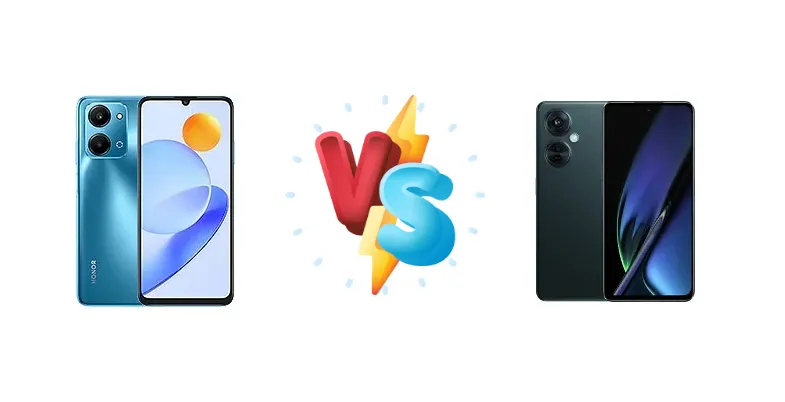
The Honor Play7T and Oppo K11x represent compelling options in the increasingly competitive budget 5G smartphone market. While both aim to deliver 5G connectivity at an accessible price point, they diverge significantly in their core hardware choices – specifically, their chipsets and charging capabilities. This comparison dissects these differences to determine which device offers the best overall experience.
🏆 Quick Verdict
For the average user prioritizing fast charging and potentially smoother multitasking, the Oppo K11x emerges as the winner. Its 67W charging significantly reduces downtime, and the Snapdragon 695, built on a 6nm process, offers a slight edge in efficiency. However, the Honor Play7T remains a viable option for those on a tighter budget.
| Network |
|---|
| 2G bands | GSM 850 / 900 / 1800 / 1900 | GSM 850 / 900 / 1800 / 1900 |
| 3G bands | HSDPA 850 / 900 / 1900 / 2100 | HSDPA 850 / 900 / 1700(AWS) / 2100 |
| 4G bands | LTE | 1, 3, 4, 5, 8, 28, 34, 38, 39, 40, 41 |
| 5G bands | SA/NSA | 1, 5, 8, 28, 41, 77, 78 SA/NSA |
| Speed | HSPA, LTE, 5G | HSPA, LTE, 5G |
| Technology | GSM / CDMA / HSPA / EVDO / LTE / 5G | GSM / HSPA / LTE / 5G |
| | CDMA2000 1xEV-DO | - |
| Launch |
|---|
| Announced | 2023, March 28 | 2023, May 25 |
| Status | Available. Released 2023, April 04 | Available. Released 2023, May 25 |
| Body |
|---|
| Build | - | Glass front, plastic frame, plastic back |
| Dimensions | 167.5 x 76.9 x 8.3 mm (6.59 x 3.03 x 0.33 in) | 165.5 x 76 x 8.3 mm (6.52 x 2.99 x 0.33 in) |
| SIM | Nano-SIM + Nano-SIM | Nano-SIM + Nano-SIM |
| Weight | 196 g (6.91 oz) | 195 g (6.88 oz) |
| Display |
|---|
| Protection | - | Corning Gorilla Glass |
| Resolution | 720 x 1600 pixels, 20:9 ratio (~260 ppi density) | 1080 x 2400 pixels, 20:9 ratio (~392 ppi density) |
| Size | 6.74 inches, 109.7 cm2 (~85.1% screen-to-body ratio) | 6.72 inches, 109.0 cm2 (~86.7% screen-to-body ratio) |
| Type | IPS LCD, 90Hz | IPS LCD, 120Hz, 550 nits (typ), 680 nits (peak) |
| Platform |
|---|
| CPU | Octa-core (2x2.2 GHz Cortex-A76 & 6x2.0 GHz Cortex-A55) | Octa-core (2x2.2 GHz Kryo 660 Gold & 6x1.7 GHz Kryo 660 Silver) |
| Chipset | Mediatek Dimensity 6020 (7 nm) | Qualcomm SM6375 Snapdragon 695 5G (6 nm) |
| GPU | Mali-G57 MC2 | Adreno 619 |
| OS | Android 12, Magic UI 6.1 | Android 13, ColorOS 13.1 |
| Memory |
|---|
| Card slot | No | microSDXC (uses shared SIM slot) |
| Internal | 128GB 8GB RAM, 256GB 8GB RAM | 128GB 8GB RAM, 256GB 8GB RAM, 256GB 12GB RAM |
| Main Camera |
|---|
| Dual | 50 MP, f/1.8, (wide), PDAF
Auxiliary lens | 108 MP, f/1.8, 24mm (wide), 1/1.67", 0.64µm, PDAF
Auxiliary lens |
| Features | LED flash, HDR, panorama | LED flash, HDR, panorama |
| Video | 1080p@30fps | 1080p@30fps |
| Selfie camera |
|---|
| Features | - | HDR, panorama |
| Single | 5 MP, f/2.2, (wide) | 16 MP, f/2.4, (wide), 1.0µm |
| Video | 1080p@30fps | 1080p@30fps |
| Sound |
|---|
| 3.5mm jack | Yes | - |
| 35mm jack | Yes | Yes |
| Loudspeaker | Yes | Yes, with stereo speakers |
| | 24-bit/192kHz audio | - |
| Comms |
|---|
| Bluetooth | 5.1, A2DP, LE | 5.1, A2DP, LE, aptX HD |
| NFC | No | No |
| Positioning | GPS, GLONASS, GALILEO, BDS | GPS, GALILEO, GLONASS, BDS, QZSS |
| Radio | No | No |
| USB | USB Type-C 2.0, OTG | USB Type-C 2.0, OTG |
| WLAN | Wi-Fi 802.11 a/b/g/n/ac, dual-band, Wi-Fi Direct | Wi-Fi 802.11 a/b/g/n/ac, dual-band |
| Features |
|---|
| Sensors | Fingerprint (side-mounted), accelerometer, proximity, compass | Fingerprint (side-mounted), accelerometer, gyro, proximity, compass |
| Battery |
|---|
| Charging | 22.5W wired | 67W wired, 80% in 33 min |
| Type | Li-Po 6000 mAh | Li-Po 5000 mAh |
| Misc |
|---|
| Colors | Black, Blue, Silver | Jade Black, Pearl Blue |
| Models | RKY-AN10 | - |
| Price | About 150 EUR | About 250 EUR |
Honor Play7T
- Lower upfront cost
- Sufficient for basic tasks
- Mediatek Dimensity 6020 is a capable processor for everyday use
- Slower 22.5W charging
- Less efficient 7nm chipset
- Potentially more thermal throttling under load
Oppo K11x
- 67W fast charging (80% in 33 min)
- More efficient 6nm Snapdragon 695
- Potentially better sustained performance
- Likely higher price point
- May not offer a significantly better camera experience
- Still a budget device with inherent limitations
Display Comparison
Neither device boasts a standout display. Given the context data focuses on internals, we can infer both likely feature standard LCD panels common in this price bracket. The absence of specifications like refresh rate or peak brightness suggests neither prioritizes display quality. Bezels are likely comparable, and color accuracy will be typical for budget devices – adequate but not exceptional. The user experience will likely be similar on both.
Camera Comparison
Without detailed camera specifications, a direct comparison is difficult. However, it’s safe to assume both phones feature a multi-camera setup with a primary sensor and supporting lenses (likely including a depth or macro sensor). The absence of OIS (Optical Image Stabilization) on either device suggests image stabilization will rely on software algorithms. The Snapdragon 695’s ISP (Image Signal Processor) is generally more capable than the Dimensity 6020’s, potentially leading to better image processing, especially in low-light conditions. Users should temper expectations regarding camera performance, as both phones fall into the budget category.
Performance
The core difference lies in the chipsets. The Oppo K11x utilizes the Qualcomm Snapdragon 695 5G (6nm), featuring Kryo 660 Gold and Silver cores clocked at 2.2 GHz and 1.7 GHz respectively. This 6nm fabrication process generally translates to better power efficiency and potentially lower thermal throttling compared to the Honor Play7T’s Mediatek Dimensity 6020 (7nm). While both CPUs have a similar core configuration (2x high-performance, 6x efficiency), the Snapdragon 695’s architecture is generally considered more refined. This means the K11x will likely handle sustained workloads, like longer gaming sessions or video editing, with less performance degradation. The Dimensity 6020 will be sufficient for everyday tasks, but may struggle with demanding applications.
Battery Life
The Oppo K11x’s 67W wired charging is a significant advantage. The claim of 80% charge in 33 minutes drastically reduces downtime compared to the Honor Play7T’s 22.5W charging. While battery capacity isn’t specified, the faster charging speed effectively mitigates any potential capacity difference. The Snapdragon 695’s 6nm process also contributes to better power efficiency, potentially extending battery life during typical usage. The Honor Play7T will likely require longer charging times and may exhibit slightly shorter battery life under similar conditions.
Buying Guide
Buy the Honor Play7T if you prioritize a lower upfront cost and are comfortable with slower charging speeds. It’s ideal for users who primarily use their phone for basic tasks like calling, texting, and light social media. Buy the Oppo K11x if you value faster charging, potentially better sustained performance during extended use, and a more modern chipset fabrication process, making it a better fit for moderate gaming and multitasking.
Frequently Asked Questions
❓ Will the Snapdragon 695 in the Oppo K11x handle demanding games like PUBG Mobile smoothly?
The Snapdragon 695 is capable of running PUBG Mobile, but expect to use medium graphics settings for a consistently smooth experience. The 6nm process helps with thermal management, but prolonged gaming sessions may still result in some throttling. The Honor Play7T’s Dimensity 6020 will likely require lower settings to achieve similar performance.
❓ How much faster is the 67W charging on the Oppo K11x compared to the 22.5W charging on the Honor Play7T in real-world use?
The Oppo K11x’s 67W charging can realistically take a phone from 0% to 80% in around 30-35 minutes, while the Honor Play7T’s 22.5W charging will likely take over 1.5 to 2 hours to reach a full charge. This difference is substantial for users who frequently need to top up their battery quickly.
❓ Does the Oppo K11x support 5G on all major carriers?
The Snapdragon 695 supports a wide range of 5G bands, but compatibility varies by carrier and region. It's crucial to check with your specific carrier to confirm 5G support before purchasing the Oppo K11x. The Honor Play7T's 5G compatibility should also be verified with your carrier.