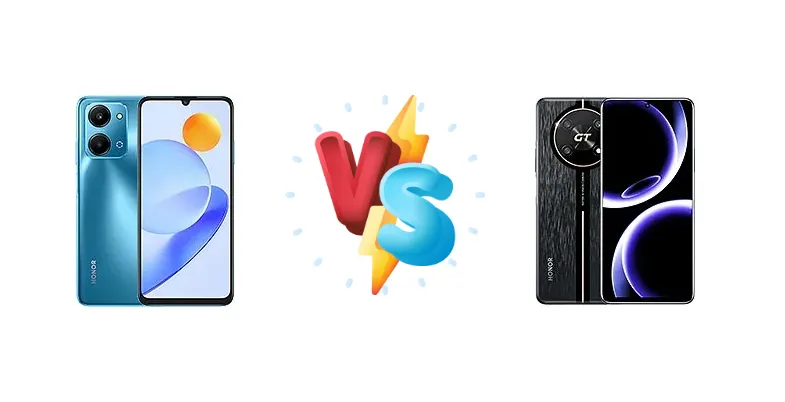
Honor's Play7T and X40 GT Racing represent distinct approaches to the budget smartphone market. The Play7T focuses on providing a solid all-around experience with a known chipset, while the X40 GT Racing prioritizes rapid charging and potentially enhanced gaming capabilities. This comparison dissects their key differences to determine which device offers the best value.
🏆 Quick Verdict
For the average user prioritizing consistent performance and a balanced experience, the Honor Play7T is the better choice. Its Mediatek Dimensity 6020 chipset provides a reliable foundation, and while charging isn't as fast, it's sufficient for daily use. The X40 GT Racing's appeal lies solely with users who absolutely need the fastest possible charging.
| Network |
|---|
| 2G bands | GSM 850 / 900 / 1800 / 1900 | GSM 850 / 900 / 1800 / 1900 |
| 3G bands | HSDPA 850 / 900 / 1900 / 2100 | HSDPA 850 / 900 / 1700(AWS) / 1900 / 2100 |
| 4G bands | LTE | LTE |
| 5G bands | SA/NSA | SA/NSA |
| Speed | HSPA, LTE, 5G | HSPA, LTE, 5G |
| Technology | GSM / CDMA / HSPA / EVDO / LTE / 5G | GSM / CDMA / HSPA / EVDO / LTE / 5G |
| | CDMA2000 1xEV-DO | - |
| Launch |
|---|
| Announced | 2023, March 28 | 2023, September 19 |
| Status | Available. Released 2023, April 04 | Available. Released 2023, September 22 |
| Body |
|---|
| Dimensions | 167.5 x 76.9 x 8.3 mm (6.59 x 3.03 x 0.33 in) | 166.1 x 75.8 x 8.5 mm (6.54 x 2.98 x 0.33 in) |
| SIM | Nano-SIM + Nano-SIM | Nano-SIM + Nano-SIM |
| Weight | 196 g (6.91 oz) | 199.5 g (7.05 oz) |
| Display |
|---|
| Resolution | 720 x 1600 pixels, 20:9 ratio (~260 ppi density) | 1080 x 2388 pixels (~385 ppi density) |
| Size | 6.74 inches, 109.7 cm2 (~85.1% screen-to-body ratio) | 6.81 inches, 112.3 cm2 (~89.2% screen-to-body ratio) |
| Type | IPS LCD, 90Hz | IPS LCD, 144Hz |
| Platform |
|---|
| CPU | Octa-core (2x2.2 GHz Cortex-A76 & 6x2.0 GHz Cortex-A55) | Octa-core |
| Chipset | Mediatek Dimensity 6020 (7 nm) | - |
| GPU | Mali-G57 MC2 | - |
| OS | Android 12, Magic UI 6.1 | Android 13, Magic OS 7.1 |
| Memory |
|---|
| Card slot | No | No |
| Internal | 128GB 8GB RAM, 256GB 8GB RAM | 256GB 12GB RAM, 512GB 12GB RAM |
| Main Camera |
|---|
| Dual | 50 MP, f/1.8, (wide), PDAF
Auxiliary lens | - |
| Features | LED flash, HDR, panorama | LED flash, panorama, HDR |
| Triple | - | 50 MP, f/1.8, (wide), PDAF
2 MP (macro)
Auxiliary lens |
| Video | 1080p@30fps | 4K@30fps, 1080p@30fps; gyro-EIS |
| Selfie camera |
|---|
| Single | 5 MP, f/2.2, (wide) | 16 MP, f/2.5 |
| Video | 1080p@30fps | 1080p@30fps |
| Sound |
|---|
| 3.5mm jack | Yes | - |
| 35mm jack | Yes | No |
| Loudspeaker | Yes | Yes |
| | 24-bit/192kHz audio | - |
| Comms |
|---|
| Bluetooth | 5.1, A2DP, LE | 5.2, A2DP, LE, aptX HD |
| NFC | No | Yes |
| Positioning | GPS, GLONASS, GALILEO, BDS | GPS, GLONASS, GALILEO, BDS |
| Radio | No | No |
| USB | USB Type-C 2.0, OTG | USB Type-C 2.0, OTG |
| WLAN | Wi-Fi 802.11 a/b/g/n/ac, dual-band, Wi-Fi Direct | Wi-Fi 802.11 a/b/g/n/ac/6, dual-band, Wi-Fi Direct |
| Features |
|---|
| Sensors | Fingerprint (side-mounted), accelerometer, proximity, compass | Fingerprint (side-mounted), accelerometer, gyro, compass |
| Battery |
|---|
| Charging | 22.5W wired | 66W wired, 90% in 30 min
5W reverse wired |
| Type | Li-Po 6000 mAh | Li-Po 4800 mAh |
| Misc |
|---|
| Colors | Black, Blue, Silver | Black, Silver |
| Models | RKY-AN10 | - |
| Price | About 150 EUR | About 300 EUR |
Honor Play7T
- Reliable Mediatek Dimensity 6020 chipset
- Potentially better power efficiency due to 7nm process
- Balanced overall experience
- Slower 22.5W charging
- Limited information on display quality
Honor X40 GT Racing
- Ultra-fast 66W charging (90% in 30 min)
- 5W reverse wired charging
- Potentially optimized for gaming (implied by 'Racing' branding)
- CPU details are vague, making performance prediction difficult
- Potential for thermal throttling if CPU isn't efficient
Display Comparison
Display specifications are currently unavailable for both devices. However, given the price points, we can anticipate both utilizing LCD panels. The X40 GT Racing, with its 'Racing' moniker, may feature a slightly higher refresh rate than the Play7T, potentially offering smoother scrolling and animations. Color accuracy will likely be standard for this segment, with neither device expected to offer exceptional color calibration out of the box.
Camera Comparison
Camera details are sparse for both devices. Without sensor size or aperture information, it's difficult to assess image quality. It's reasonable to assume both phones will feature a multi-camera setup, but the quality will heavily depend on the primary sensor. The inclusion of a 2MP macro camera on either device is likely a marketing feature with limited practical benefit due to the small sensor size and lack of optical image stabilization (OIS). Image processing will likely be the differentiating factor, with Honor's software algorithms playing a crucial role in determining the final image quality.
Performance
The Honor Play7T's Mediatek Dimensity 6020 (7nm) chipset, featuring a 2x2.2 GHz Cortex-A76 and 6x2.0 GHz Cortex-A55 configuration, provides a solid foundation for everyday tasks and light gaming. The X40 GT Racing's octa-core CPU lacks specific details, making a direct comparison difficult. However, without knowing the fabrication node (e.g., 7nm, 6nm), it's challenging to assess its efficiency and potential for sustained performance. The Dimensity 6020's 7nm process generally translates to better power efficiency than older, larger node processes, potentially leading to longer battery life during intensive tasks. The X40 GT Racing will likely rely on software optimizations to compensate for any potential hardware limitations.
Battery Life
The Honor X40 GT Racing significantly differentiates itself with its 66W wired charging, capable of reaching 90% charge in just 30 minutes. This is a substantial advantage over the Play7T's 22.5W charging. While the Play7T's battery capacity is unknown, the X40 GT Racing's faster charging mitigates concerns about battery life, allowing for quick top-ups throughout the day. The X40 GT Racing also includes 5W reverse wired charging, a feature absent on the Play7T, enabling it to charge other devices, albeit slowly.
Buying Guide
Buy the Honor Play7T if you need a dependable daily driver with a known processor and don't prioritize ultra-fast charging. It's ideal for users who value stability and a predictable experience. Buy the Honor X40 GT Racing if you frequently find yourself needing to top up your battery quickly and are willing to potentially trade off some consistent performance for that convenience. This phone is geared towards users who game or stream heavily and need minimal downtime.
Frequently Asked Questions
❓ Does the Honor X40 GT Racing's fast charging generate excessive heat during prolonged use?
While 66W charging is incredibly fast, it can generate heat. Honor likely incorporates thermal management systems to mitigate this, but sustained high-speed charging may still result in some warmth. The efficiency of the underlying chipset will also play a role in heat dissipation.
❓ Is the Mediatek Dimensity 6020 in the Honor Play7T powerful enough for demanding games like PUBG Mobile?
The Dimensity 6020 is capable of running PUBG Mobile, but you'll likely need to adjust graphics settings to medium or low to maintain a stable frame rate. It's not a flagship-level chipset, so don't expect maximum settings at consistently high frame rates.
❓ What type of charging protocol does the Honor X40 GT Racing use to achieve 66W speeds?
Honor typically utilizes its SuperCharge protocol for fast charging. It's important to use a compatible charger and cable to achieve the full 66W charging speed. Using a standard charger will result in significantly slower charging times.
❓ How does the lack of detailed CPU information for the X40 GT Racing impact its potential performance?
The absence of CPU specifics makes it difficult to predict real-world performance. Without knowing the core configuration, clock speeds, and fabrication process, it's impossible to accurately compare it to the Dimensity 6020. It could be a more powerful chip, but it could also be less efficient.