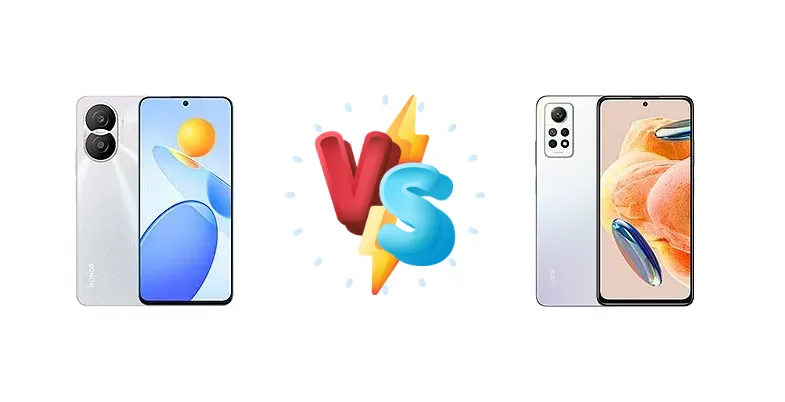
The Honor Play7T Pro and Xiaomi Redmi Note 12 Pro 4G represent compelling options in the increasingly competitive mid-range 4G smartphone market. Both aim to deliver a balanced experience, but they take different approaches to achieving it, primarily through their chipset choices and charging capabilities. This comparison dissects those differences to determine which device offers the best value.
🏆 Quick Verdict
For the average user prioritizing rapid replenishment, the Xiaomi Redmi Note 12 Pro 4G is the better choice thanks to its significantly faster 67W charging. However, the Honor Play7T Pro’s Dimensity 6020 offers a potentially more efficient architecture, which could translate to slightly better sustained performance and battery life during demanding tasks.
| Network |
|---|
| 2G bands | GSM 850 / 900 / 1800 / 1900 | GSM 850 / 900 / 1800 / 1900 |
| 3G bands | HSDPA 850 / 900 / 1900 / 2100 | HSDPA 850 / 900 / 1700(AWS) / 1900 / 2100 |
| 4G bands | LTE | 1, 2, 3, 4, 5, 7, 8, 20, 28, 38, 40, 41, 66 |
| 5G bands | SA/NSA | - |
| Speed | HSPA, LTE, 5G | HSPA, LTE |
| Technology | GSM / CDMA / HSPA / EVDO / LTE / 5G | GSM / HSPA / LTE |
| | CDMA2000 1xEV-DO | - |
| Launch |
|---|
| Announced | 2023, March 28 | 2023, March 03 |
| Status | Available. Released 2023, April 06 | Available. Released 2023, April 11 |
| Body |
|---|
| Dimensions | 162.9 x 74.5 x 7.4 mm (6.41 x 2.93 x 0.29 in) | 164.2 x 76.1 x 8.1 mm (6.46 x 3.00 x 0.32 in) |
| SIM | Nano-SIM + Nano-SIM | Nano-SIM + Nano-SIM |
| Weight | 175 g (6.17 oz) | 201.8 g (7.13 oz) |
| Display |
|---|
| Resolution | 1080 x 2388 pixels (~391 ppi density) | 1080 x 2400 pixels, 20:9 ratio (~395 ppi density) |
| Size | 6.7 inches, 108.7 cm2 (~89.6% screen-to-body ratio) | 6.67 inches, 107.4 cm2 (~86.0% screen-to-body ratio) |
| Type | IPS LCD, 90Hz | AMOLED, 120Hz, Dolby Vision, 700 nits (HBM), 1100 nits (peak) |
| Platform |
|---|
| CPU | Octa-core (2x2.2 GHz Cortex-A76 & 6x2.0 GHz Cortex-A55) | Octa-core (2x2.2 GHz Kryo 470 Gold & 6x1.8 GHz Kryo 470 Silver) |
| Chipset | Mediatek Dimensity 6020 (7 nm) | Qualcomm SM7150 Snapdragon 732G (8 nm) |
| GPU | Mali-G57 MC2 | Adreno 618 |
| OS | Android 12, Magic UI 6.1 | Android 11, MIUI 13 |
| Memory |
|---|
| Card slot | No | microSDXC (uses shared SIM slot) |
| Internal | 128GB 8GB RAM, 256GB 8GB RAM | 128GB 6GB RAM, 128GB 8GB RAM, 256GB 8GB RAM |
| | - | UFS 2.2 |
| Main Camera |
|---|
| Dual | 50 MP, f/1.8, (wide), PDAF
Auxiliary lens | - |
| Features | LED flash, HDR, panorama | LED flash, HDR, panorama |
| Quad | - | 108 MP, f/1.9, (wide), 1/1.52", 0.7µm, PDAF
8 MP, 120˚, (ultrawide)
2 MP (macro)
Auxiliary lens |
| Video | 1080p@30fps | 4K@30fps, 1080p@30/60fps |
| Selfie camera |
|---|
| Single | 8 MP, f/2.0, (wide) | 16 MP, f/2.4, (wide) |
| Video | 1080p@30fps | 1080p@30fps |
| Sound |
|---|
| 3.5mm jack | Yes | Yes |
| 35mm jack | Yes | Yes |
| Loudspeaker | Yes | Yes, with stereo speakers |
| Comms |
|---|
| Bluetooth | 5.1, A2DP, LE | 5.0, A2DP, LE |
| Infrared port | - | Yes |
| NFC | No | Yes (market/region dependent) |
| Positioning | GPS, GLONASS, BDS | GPS, GLONASS, GALILEO, BDS |
| Radio | No | Unspecified |
| USB | USB Type-C 2.0, OTG | USB Type-C 2.0, OTG |
| WLAN | Wi-Fi 802.11 a/b/g/n/ac, dual-band, Wi-Fi Direct | Wi-Fi 802.11 a/b/g/n/ac, dual-band |
| Features |
|---|
| Sensors | Fingerprint (side-mounted), accelerometer, proximity, compass | Fingerprint (side-mounted), accelerometer, gyro, compass |
| Battery |
|---|
| Charging | 40W wired | 67W wired |
| Type | Li-Po 4000 mAh | Li-Po 5000 mAh |
| Misc |
|---|
| Colors | Black, Dark Green, Silver | Star Blue, Graphite Gray, Polar White, Ice blue |
| Models | DIO-AN00 | 2209116AG, 2209116AG |
| Price | About 200 EUR | About 150 EUR |
Honor Play7T Pro
- Potentially more efficient chipset (Dimensity 6020, 7nm)
- May offer better sustained performance in demanding tasks
- Honor's typically more natural image processing
- Slower 40W charging
- Likely lacks the display quality of potential AMOLED Redmi variant
Xiaomi Redmi Note 12 Pro 4G
- Significantly faster 67W charging
- Potentially better display (if AMOLED)
- Qualcomm’s optimized CPU cores for sustained performance
- Less power-efficient chipset (Snapdragon 732G, 8nm)
- Xiaomi’s image processing can be overly saturated for some
Display Comparison
Neither device’s display specifications are provided, so a direct comparison is limited. However, given their market positioning, both likely feature FHD+ LCD panels. The Redmi Note 12 Pro series is known for incorporating AMOLED displays in some variants, which would give it a significant advantage in contrast and color vibrancy. Without specific data, we can assume the Redmi Note 12 Pro 4G *may* have a superior display experience if it utilizes AMOLED technology. Bezels are likely comparable, and color accuracy will depend on software calibration.
Camera Comparison
Without detailed camera specifications, a comprehensive comparison is impossible. However, both phones likely feature a multi-camera setup with a primary sensor, ultrawide, and potentially a macro lens. The Redmi Note 12 Pro series is known for higher resolution sensors, so it's plausible the 4G variant boasts a larger or higher-resolution main sensor than the Play7T Pro. Image processing algorithms will also play a crucial role, with Xiaomi typically favoring vibrant, saturated images, while Honor often aims for more natural color reproduction. The presence or absence of Optical Image Stabilization (OIS) on the primary sensor would be a significant differentiator, favoring the device that includes it.
Performance
The core difference lies in the chipsets: the Honor Play7T Pro utilizes the Mediatek Dimensity 6020 (7nm) while the Redmi Note 12 Pro 4G features the Qualcomm Snapdragon 732G (8nm). The 7nm process node of the Dimensity 6020 *should* offer improved power efficiency compared to the 8nm Snapdragon 732G. However, Qualcomm’s Kryo 470 Gold cores in the Snapdragon 732G are architecturally optimized for sustained performance, potentially offsetting the node advantage. The CPU configurations are similar – both feature a 2x2.2 GHz prime core cluster and a 6x lower-clocked efficiency core cluster. Real-world performance will depend on software optimization and thermal management, but the Dimensity 6020’s newer architecture suggests a slight edge in multi-core tasks.
Battery Life
The Redmi Note 12 Pro 4G’s 67W wired charging is a clear advantage over the Honor Play7T Pro’s 40W charging. This translates to significantly faster 0-100% charging times – likely under 45 minutes for the Redmi versus potentially over an hour for the Honor. While battery capacity isn’t specified, the faster charging speed of the Redmi Note 12 Pro 4G mitigates the impact of a potentially smaller battery. The Dimensity 6020’s 7nm process *could* contribute to better battery life during moderate usage, but the Redmi’s charging speed offers a more tangible benefit for many users.
Buying Guide
Buy the Honor Play7T Pro if you prioritize sustained performance during extended gaming sessions or multitasking, and value a potentially more efficient chipset. Buy the Xiaomi Redmi Note 12 Pro 4G if you frequently find yourself needing to quickly top up your battery and appreciate the convenience of significantly faster charging speeds. Both are excellent choices for media consumption and everyday tasks.
Frequently Asked Questions
❓ Will the Snapdragon 732G in the Redmi Note 12 Pro 4G struggle with graphically intensive games like PUBG Mobile?
The Snapdragon 732G is a capable chipset and should handle PUBG Mobile at medium to high settings with stable frame rates. However, sustained performance may be limited by thermal throttling. The Honor Play7T Pro’s Dimensity 6020 might offer slightly better sustained performance due to its more efficient 7nm process, but both phones will likely require some settings adjustments for optimal long-term gaming.
❓ How much faster is the 67W charging on the Redmi Note 12 Pro 4G compared to the 40W charging on the Honor Play7T Pro in real-world use?
The 67W charging on the Redmi Note 12 Pro 4G can realistically charge from 0-100% in around 40-45 minutes, while the 40W charging on the Honor Play7T Pro will likely take over an hour, potentially closer to 75-90 minutes. This difference is significant for users who frequently need to quickly top up their battery.
❓ Does the Dimensity 6020 chipset in the Honor Play7T Pro support 5G connectivity?
No, the Dimensity 6020 is a 4G-only chipset. Both the Honor Play7T Pro and the Redmi Note 12 Pro 4G are 4G devices, meaning they do not support the faster speeds of 5G networks.