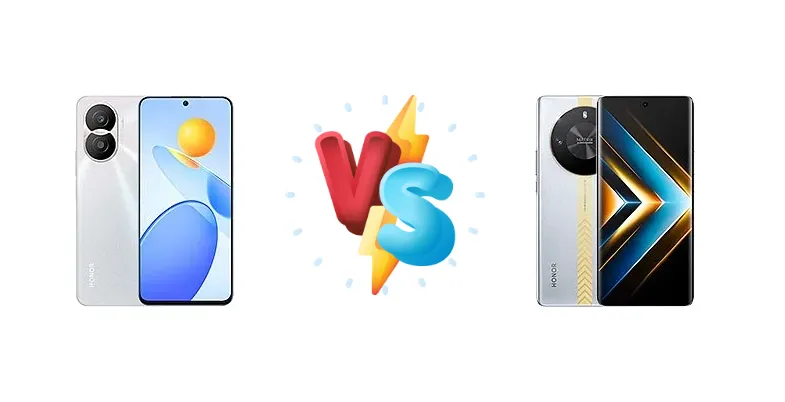
Honor's Play and X series represent distinct approaches to the mid-range market. The Play7T Pro focuses on delivering a balanced experience at an accessible price, while the X50 GT aims for near-flagship performance without the flagship price tag. This comparison dissects the core differences – a Mediatek Dimensity 6020 versus a Qualcomm Snapdragon 8+ Gen 1 – to determine which phone best suits your needs.
🏆 Quick Verdict
For users prioritizing raw performance and gaming capabilities, the Honor X50 GT is the clear winner. Its Snapdragon 8+ Gen 1 chipset offers a substantial leap in processing power. However, the Honor Play7T Pro provides a compelling value proposition for everyday tasks and moderate usage, benefiting from a more efficient chipset and respectable 40W charging.
| Network |
|---|
| 2G bands | GSM 850 / 900 / 1800 / 1900 | GSM 850 / 900 / 1800 / 1900 |
| 3G bands | HSDPA 850 / 900 / 1900 / 2100 | HSDPA 850 / 900 / 1700(AWS) / 1900 / 2100 |
| 4G bands | LTE | LTE |
| 5G bands | SA/NSA | SA/NSA |
| Speed | HSPA, LTE, 5G | HSPA, LTE, 5G |
| Technology | GSM / CDMA / HSPA / EVDO / LTE / 5G | GSM / CDMA / HSPA / CDMA2000 / LTE / 5G |
| | CDMA2000 1xEV-DO | - |
| Launch |
|---|
| Announced | 2023, March 28 | 2024, January 04 |
| Status | Available. Released 2023, April 06 | Available. Released 2024, January 09 |
| Body |
|---|
| Dimensions | 162.9 x 74.5 x 7.4 mm (6.41 x 2.93 x 0.29 in) | 163.6 x 75.5 x 8 mm (6.44 x 2.97 x 0.31 in) |
| SIM | Nano-SIM + Nano-SIM | Nano-SIM + Nano-SIM |
| Weight | 175 g (6.17 oz) | 192 g (6.77 oz) |
| Display |
|---|
| Resolution | 1080 x 2388 pixels (~391 ppi density) | 1220 x 2652 pixels, 19.5:9 ratio (~431 ppi density) |
| Size | 6.7 inches, 108.7 cm2 (~89.6% screen-to-body ratio) | 6.78 inches, 112.6 cm2 (~91.2% screen-to-body ratio) |
| Type | IPS LCD, 90Hz | AMOLED, 1B colors, 120Hz |
| Platform |
|---|
| CPU | Octa-core (2x2.2 GHz Cortex-A76 & 6x2.0 GHz Cortex-A55) | Octa-core (1x3.0 GHz Cortex-X2 & 3x2.5 GHz Cortex-A710 & 4x1.80 GHz Cortex-A510) |
| Chipset | Mediatek Dimensity 6020 (7 nm) | Qualcomm SM8475 Snapdragon 8+ Gen 1 (4 nm) |
| GPU | Mali-G57 MC2 | Adreno 730 |
| OS | Android 12, Magic UI 6.1 | Android 13, MagicOS 7.2 |
| Memory |
|---|
| Card slot | No | No |
| Internal | 128GB 8GB RAM, 256GB 8GB RAM | 256GB 12GB RAM, 256GB 16GB RAM, 512GB 16GB RAM, 1TB 16GB RAM |
| Main Camera |
|---|
| Dual | 50 MP, f/1.8, (wide), PDAF
Auxiliary lens | 108 MP, f/1.8, (wide), 1/1.67", PDAF
Auxiliary lens |
| Features | LED flash, HDR, panorama | LED flash, panorama, HDR |
| Video | 1080p@30fps | 4K@30fps, 1080p@30fps |
| Selfie camera |
|---|
| Single | 8 MP, f/2.0, (wide) | 8 MP, f/2.0, (wide) |
| Video | 1080p@30fps | 1080p@30fps |
| Sound |
|---|
| 3.5mm jack | Yes | - |
| 35mm jack | Yes | No |
| Loudspeaker | Yes | Yes |
| Comms |
|---|
| Bluetooth | 5.1, A2DP, LE | 5.2, A2DP, LE, aptX HD |
| NFC | No | Yes |
| Positioning | GPS, GLONASS, BDS | GPS, GLONASS, GALILEO, BDS |
| Radio | No | No |
| USB | USB Type-C 2.0, OTG | USB Type-C 2.0, OTG |
| WLAN | Wi-Fi 802.11 a/b/g/n/ac, dual-band, Wi-Fi Direct | Wi-Fi 802.11 a/b/g/n/ac/6, dual-band, Wi-Fi Direct |
| Features |
|---|
| Sensors | Fingerprint (side-mounted), accelerometer, proximity, compass | Fingerprint (under display, optical), accelerometer, gyro, ultrasound proximity, compass |
| Battery |
|---|
| Charging | 40W wired | 35W wired
7.5W reverse wired |
| Type | Li-Po 4000 mAh | Li-Po 5800 mAh |
| Misc |
|---|
| Colors | Black, Dark Green, Silver | Black, Silver |
| Models | DIO-AN00 | ALP-AN00 |
| Price | About 200 EUR | About 260 EUR |
Honor Play7T Pro
- More efficient chipset (Dimensity 6020)
- Faster 40W wired charging
- Potentially lower price point
- Significantly lower processing power
- Less capable camera system (likely)
- Limited gaming performance
Honor X50 GT
- Flagship-level Snapdragon 8+ Gen 1 performance
- Superior gaming capabilities
- 7.5W reverse wired charging
- Less battery efficient
- Slower 35W wired charging
- Likely higher price
Display Comparison
While display specifications are missing, we can infer differences based on the target market. The X50 GT, positioned higher, likely features a higher quality panel with potentially better color accuracy and peak brightness. The Play7T Pro will likely prioritize cost-effectiveness. Both are expected to be LCD panels given the price brackets. The absence of LTPO technology on either suggests neither will offer adaptive refresh rates for maximum battery savings.
Camera Comparison
Without detailed camera specs, it's difficult to make precise comparisons. However, the X50 GT’s higher positioning suggests a more capable camera system. We can expect a larger main sensor and potentially optical image stabilization (OIS), features likely absent on the Play7T Pro. Image processing will also differ; the Snapdragon’s ISP (Image Signal Processor) is generally more advanced, resulting in better dynamic range and low-light performance. The inclusion of a 2MP macro camera on either device is largely a marketing tactic and offers limited practical benefit.
Performance
The core differentiator is the chipset. The Snapdragon 8+ Gen 1 (4nm) in the X50 GT represents a significant upgrade over the Dimensity 6020 (7nm) in the Play7T Pro. The Snapdragon’s Cortex-X2 prime core, clocked at 3.0 GHz, provides a substantial performance boost for single-threaded tasks and gaming. The Dimensity 6020’s Cortex-A76 cores, while capable, are architecturally older and less efficient. The 4nm process node of the Snapdragon also contributes to better thermal efficiency, potentially mitigating throttling during extended gaming sessions. The X50 GT will demonstrably outperform the Play7T Pro in graphically intensive applications and multitasking.
Battery Life
Battery capacity is not specified, but the X50 GT’s more powerful chipset will consume more energy. The Play7T Pro’s 40W wired charging is slightly faster than the X50 GT’s 35W, potentially offsetting a smaller battery capacity. The X50 GT’s inclusion of 7.5W reverse wired charging is a useful feature for topping up accessories like earbuds, a capability absent on the Play7T Pro. Real-world battery life will depend heavily on usage patterns, but the Play7T Pro is likely to offer longer screen-on time for typical tasks.
Buying Guide
Buy the Honor Play7T Pro if you need a reliable daily driver for social media, browsing, and light gaming, and value battery efficiency and a lower price point. Buy the Honor X50 GT if you prioritize demanding mobile games, content creation, and a smoother overall experience, and are willing to trade some battery life for significantly increased performance.
Frequently Asked Questions
❓ Will the Snapdragon 8+ Gen 1 in the X50 GT overheat during prolonged gaming sessions?
While the Snapdragon 8+ Gen 1 is a powerful chip, its 4nm process node and Honor's thermal management system should mitigate significant overheating. However, some throttling is still possible during extended, graphically demanding games. Expect slightly reduced frame rates after 30-60 minutes of continuous play.
❓ Is the Dimensity 6020 in the Play7T Pro sufficient for playing popular games like PUBG Mobile or Call of Duty Mobile?
The Dimensity 6020 can run PUBG Mobile and Call of Duty Mobile, but you'll likely need to lower graphics settings to achieve a smooth frame rate. Don't expect to max out the settings or maintain consistently high frame rates during intense firefights. It's suitable for casual gaming, but not ideal for competitive play.
❓ Does the Honor X50 GT support high refresh rate gaming?
While the display specifications are unknown, the Snapdragon 8+ Gen 1 is capable of driving high refresh rate displays. Whether the X50 GT actually *has* a high refresh rate panel is unconfirmed, but the chipset can certainly support it. If it does, expect smoother visuals in compatible games.
❓ How much faster is the charging on the Play7T Pro compared to the X50 GT?
The Play7T Pro's 40W charging is 5W faster than the X50 GT's 35W. This translates to a slightly quicker 0-100% charge time, potentially saving you 10-15 minutes. However, the difference isn't dramatic and will depend on battery capacity.