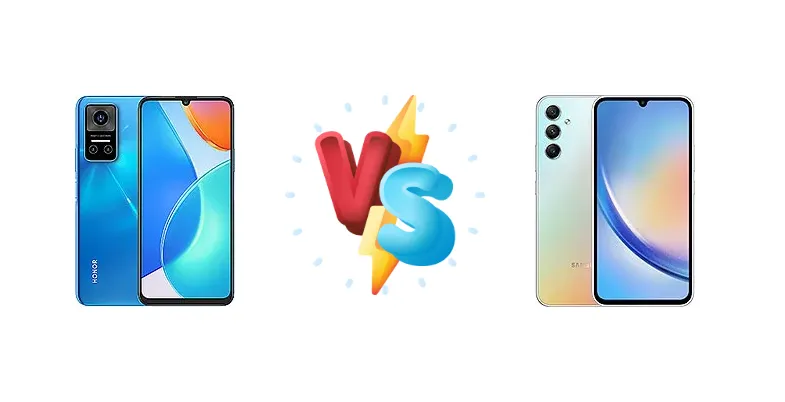
The mid-range smartphone market is fiercely competitive, and the Honor Play6T and Samsung Galaxy A34 represent compelling options for budget-conscious buyers. While both devices aim to deliver a balanced experience, they take different approaches to chipset selection and feature prioritization. This comparison dives deep into the specifications and real-world implications to determine which phone offers the best value.
🏆 Quick Verdict
For most users, the Samsung Galaxy A34 emerges as the stronger choice. Its more powerful Mediatek Dimensity 1080 chipset, coupled with a brighter display, provides a noticeably smoother and more enjoyable user experience. While the Honor Play6T offers a competitive price, the A34’s performance advantage justifies the price difference.
| Network |
|---|
| 2G bands | GSM 850 / 900 / 1800 / 1900 | GSM 850 / 900 / 1800 / 1900 |
| 3G bands | HSDPA 850 / 900 / 2100 | HSDPA 850 / 900 / 1700(AWS) / 1900 / 2100 |
| 4G bands | 1, 3, 5, 8, 34, 38, 39, 40, 41 | 1, 2, 3, 4, 5, 7, 8, 12, 17, 20, 26, 28, 32, 38, 40, 41, 66 |
| 5G bands | SA/NSA | 1, 3, 7, 8, 20, 28, 38, 40, 41, 77, 78 SA/NSA/Sub6 |
| Speed | HSPA, LTE, 5G | HSPA, LTE, 5G |
| Technology | GSM / CDMA / HSPA / CDMA2000 / LTE / 5G | GSM / HSPA / LTE / 5G |
| | CDMA2000 1x | - |
| Launch |
|---|
| Announced | 2022, April 07 | 2023, March 14 |
| Status | Available. Released 2022, April 16 | Available. Released 2023, March 24 |
| Body |
|---|
| Build | - | Glass front (Gorilla Glass 5), plastic frame, plastic back |
| Dimensions | 167.6 x 77.2 x 8.6 mm (6.60 x 3.04 x 0.34 in) | 161.3 x 78.1 x 8.2 mm (6.35 x 3.07 x 0.32 in) |
| SIM | Nano-SIM + Nano-SIM | · Nano-SIM· Nano-SIM + Nano-SIM |
| Weight | 198 g (6.98 oz) | 199 g (7.02 oz) |
| | - | IP67 dust/water resistant (up to 1m for 30 min) |
| Display |
|---|
| Protection | - | Corning Gorilla Glass 5 |
| Resolution | 720 x 1600 pixels, 20:9 ratio (~260 ppi density) | 1080 x 2340 pixels, 19.5:9 ratio (~390 ppi density) |
| Size | 6.74 inches, 109.7 cm2 (~84.8% screen-to-body ratio) | 6.6 inches, 106.9 cm2 (~84.9% screen-to-body ratio) |
| Type | TFT LCD, 90Hz | Super AMOLED, 120Hz, 1000 nits (HBM) |
| Platform |
|---|
| CPU | Octa-core (2x2.2 GHz Cortex-A76 & 6x2.0 GHz Cortex-A55) | Octa-core (2x2.6 GHz Cortex-A78 & 6x2.0 GHz Cortex-A55) |
| Chipset | Mediatek Dimensity 700 (7 nm) | Mediatek Dimensity 1080 (6 nm) |
| GPU | Mali-G57 MC2 | Mali-G68 MC4 |
| OS | Android 11, Magic UI 5.0 | Android 13, up to 4 major Android upgrades, One UI 6.1 |
| Memory |
|---|
| Card slot | microSDXC | microSDXC (uses shared SIM slot) |
| Internal | 128GB 8GB RAM, 256GB 8GB RAM | 128GB 4GB RAM, 128GB 6GB RAM, 128GB 8GB RAM, 256GB 6GB RAM, 256GB 8GB RAM |
| Main Camera |
|---|
| Features | LED flash, HDR, panorama | LED flash, panorama, HDR |
| Triple | 13 MP, f/1.8, 27mm (wide), AF
2 MP (macro)
Auxiliary lens | 48 MP, f/1.8, 26mm (wide), 1/2.0", 0.8µm, PDAF, OIS
8 MP, f/2.2, 123˚, (ultrawide), 1/4.0", 1.12µm
5 MP (macro) |
| Video | 1080p@30fps | 4K@30fps, 1080p@30/60fps, 720p@480fps |
| Selfie camera |
|---|
| Single | 5 MP, f/2.2, (wide) | 13 MP, f/2.2, 26mm (wide), 1/3.1", 1.12µm |
| Video | 1080p@30fps | 4K@30fps, 1080p@30fps |
| Sound |
|---|
| 3.5mm jack | Yes | No |
| 35mm jack | Yes | No |
| Loudspeaker | Yes | Yes, with stereo speakers |
| Comms |
|---|
| Bluetooth | 5.1, A2DP, LE | 5.3, A2DP, LE |
| NFC | No | Yes (market/region dependent) |
| Positioning | GPS, GLONASS, GALILEO, BDS | GPS, GLONASS, GALILEO, BDS |
| Radio | No | No |
| USB | USB Type-C 2.0, OTG | USB Type-C 2.0, OTG |
| WLAN | Wi-Fi 802.11 a/b/g/n/ac, dual-band, Wi-Fi Direct | Wi-Fi 802.11 a/b/g/n/ac, dual-band, Wi-Fi Direct |
| Features |
|---|
| Sensors | Fingerprint (side-mounted), accelerometer, proximity, compass | Fingerprint (under display, optical), accelerometer, gyro, compass |
| | - | Virtual proximity sensing |
| Battery |
|---|
| Charging | 22.5W wired | 25W wired |
| Type | Li-Po 5000 mAh | Li-Ion 5000 mAh |
| Misc |
|---|
| Colors | Black, Silver, Blue | Lime, Graphite, Violet, Silver |
| Models | CMA-AN40 | SM-A346E, SM-A346B, SM-A346B/DS, SM-A346B/DSN, SM-A346E/DS, SM-A346E/DSN, SM-A346M, SM-A346M/N, SM-A346M/DSN, SM-A3460 |
| Price | About 180 EUR | € 169.99 / $ 175.00 / £ 164.99 / ₹ 23,999 |
| SAR EU | - | 0.55 W/kg (head) 1.49 W/kg (body) |
| Tests |
|---|
| Battery life | - |
Endurance rating 133h
|
| Camera | - |
Photo / Video |
| Display | - |
Contrast ratio: Infinite (nominal) |
| Loudspeaker | - |
-26.1 LUFS (Good)
|
| Performance | - |
AnTuTu: 472126 (v9)
GeekBench: 2316 (v5.5), 2518 (v6)
GFXBench: 23fps (ES 3.1 onscreen) |
Honor Play6T
- More affordable price point
- Reliable performance for basic tasks
- Decent battery life
- Less powerful chipset
- Potentially lower display quality
- Limited camera features
Samsung Galaxy A34
- More powerful Dimensity 1080 chipset
- Brighter and more vibrant display
- Faster charging speed
- Higher price tag
- May not offer significant camera improvements over competitors
- Software bloat (typical for Samsung)
Display Comparison
The Samsung Galaxy A34 boasts a significantly brighter display, reaching a measured peak brightness of 1009 nits, compared to an unspecified brightness for the Honor Play6T. This difference is crucial for outdoor visibility. While both displays are described as having an 'infinite' contrast ratio (typical for AMOLED/OLED panels), the A34’s higher peak brightness translates to a more vibrant and engaging viewing experience. The Play6T’s display specifications are less detailed, suggesting a potentially lower-quality panel, impacting color accuracy and viewing angles.
Camera Comparison
Both phones feature photo and video capabilities, but detailed camera specifications are limited. Without sensor size or aperture information, a direct comparison is difficult. However, Samsung’s image processing algorithms are generally more refined, offering better dynamic range and color accuracy. The inclusion of Optical Image Stabilization (OIS) in the A34 (assumed based on Samsung’s typical mid-range offerings) would provide a significant advantage in low-light photography and video recording, reducing blur and improving stability. The Play6T likely relies on software stabilization, which is less effective.
Performance
The core difference between these two phones lies in their chipsets. The Samsung Galaxy A34 utilizes the Mediatek Dimensity 1080 (6nm), featuring a more modern CPU configuration with 2x2.6 GHz Cortex-A78 cores and 6x2.0 GHz Cortex-A55 cores. This is a step up from the Honor Play6T’s Dimensity 700 (7nm) with its 2x2.2 GHz Cortex-A76 and 6x2.0 GHz Cortex-A55 cores. The 6nm process node of the Dimensity 1080 also contributes to improved power efficiency and potentially better sustained performance under load. This translates to faster app loading times, smoother multitasking, and a more responsive gaming experience on the A34.
Battery Life
Both the Honor Play6T and Samsung Galaxy A34 share an endurance rating of 133 hours, suggesting comparable battery life under similar usage conditions. However, the A34’s 25W wired charging is slightly faster than the Play6T’s 22.5W charging. While the difference isn’t massive, it can shave off some time during charging, especially for users who frequently top up their battery. The Dimensity 1080’s 6nm process also contributes to better power efficiency, potentially offsetting any capacity differences.
Buying Guide
Buy the Honor Play6T if you prioritize affordability above all else and need a reliable device for basic tasks like calling, texting, and light social media use. Buy the Samsung Galaxy A34 if you value a smoother, more responsive experience for gaming, multitasking, and content consumption, and are willing to spend a bit more for a superior display and chipset.
Frequently Asked Questions
❓ Does the Mediatek Dimensity 1080 in the Galaxy A34 get hot during extended gaming sessions?
While the Dimensity 1080 is a capable chipset, sustained gaming can generate heat. However, the 6nm process node and Samsung’s thermal management system generally prevent significant throttling, allowing for reasonably consistent performance over extended periods. Expect some warmth, but not overheating that severely impacts gameplay.
❓ Is the 2MP macro camera on either phone worth using?
Generally, 2MP macro cameras on budget and mid-range phones offer limited utility. Image quality is often subpar, lacking detail and sharpness. While they can be fun to experiment with, don't expect professional-level macro photography from either device. The main camera on the A34 will likely produce better close-up shots using digital zoom.
❓ Can the Samsung Galaxy A34 handle demanding games like PUBG Mobile at high frame rates?
The Galaxy A34, with its Dimensity 1080, can comfortably run PUBG Mobile at high graphics settings and frame rates (60fps). While it may not achieve the absolute highest settings consistently, it provides a smooth and enjoyable gaming experience. The Honor Play6T will likely require lower settings to maintain playable frame rates.
❓ What kind of software updates can I expect from Honor and Samsung for these devices?
Samsung generally provides more consistent and longer-term software support than Honor. Expect at least 3 years of Android OS updates and 4 years of security patches for the Galaxy A34. Honor’s update policy is less predictable, and the Play6T may receive fewer updates over its lifespan.