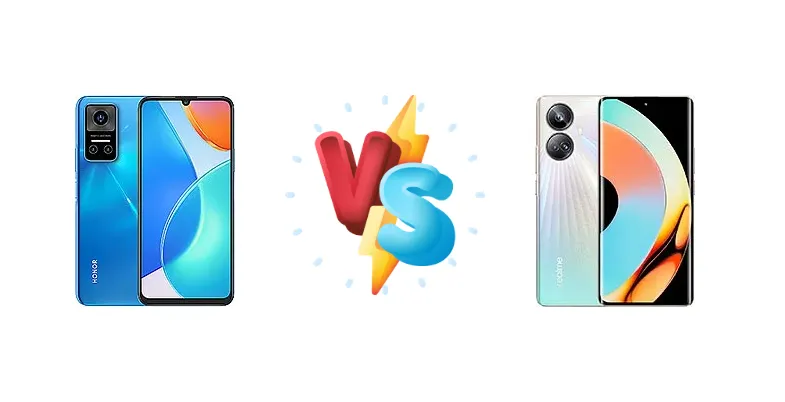
The mid-range smartphone market is fiercely competitive, and the Realme 10 Pro+ and Honor Play6T represent compelling options for budget-conscious buyers. While both devices leverage MediaTek Dimensity chipsets, they diverge significantly in processing power, charging capabilities, and overall feature sets. This comparison dissects these differences to determine which phone delivers the best value.
🏆 Quick Verdict
For most users, the Realme 10 Pro+ is the superior choice. Its Dimensity 1080 chipset offers a noticeable performance boost over the Play6T’s Dimensity 700, coupled with significantly faster 67W charging. While the Play6T offers a more affordable entry point, the Pro+’s enhancements justify the price difference for those prioritizing speed and convenience.
| Network |
|---|
| 2G bands | GSM 850 / 900 / 1800 / 1900 | GSM 850 / 900 / 1800 / 1900 - SIM 1 & SIM 2 |
| 3G bands | HSDPA 850 / 900 / 2100 | HSDPA 850 / 900 / 1700(AWS) / 1900 / 2100 |
| 4G bands | 1, 3, 5, 8, 34, 38, 39, 40, 41 | 1, 3, 5, 7, 8, 19, 28, 34, 38, 39, 40, 41 |
| 5G bands | SA/NSA | 1, 3, 5, 8, 28, 40, 41, 77, 78 SA/NSA |
| Speed | HSPA, LTE, 5G | HSPA, LTE-A, 5G |
| Technology | GSM / CDMA / HSPA / CDMA2000 / LTE / 5G | GSM / CDMA / HSPA / CDMA2000 / LTE / 5G |
| | CDMA2000 1x | CDMA2000 1x |
| Launch |
|---|
| Announced | 2022, April 07 | 2022, November 17 |
| Status | Available. Released 2022, April 16 | Available. Released 2022, November 24 |
| Body |
|---|
| Build | - | Glass front, plastic frame, plastic back |
| Dimensions | 167.6 x 77.2 x 8.6 mm (6.60 x 3.04 x 0.34 in) | 161.5 x 73.9 x 7.8 mm or 8 mm |
| SIM | Nano-SIM + Nano-SIM | Dual SIM (Nano-SIM, dual stand-by) |
| Weight | 198 g (6.98 oz) | 173 g / 175 g (6.10 oz) |
| Display |
|---|
| Resolution | 720 x 1600 pixels, 20:9 ratio (~260 ppi density) | 1080 x 2412 pixels, 20:9 ratio (~394 ppi density) |
| Size | 6.74 inches, 109.7 cm2 (~84.8% screen-to-body ratio) | 6.7 inches, 108.0 cm2 (~90.5% screen-to-body ratio) |
| Type | TFT LCD, 90Hz | AMOLED, 1B colors, HDR10+, 120Hz, 800 nits |
| Platform |
|---|
| CPU | Octa-core (2x2.2 GHz Cortex-A76 & 6x2.0 GHz Cortex-A55) | Octa-core (2x2.6 GHz Cortex-A78 & 6x2.0 GHz Cortex-A55) |
| Chipset | Mediatek Dimensity 700 (7 nm) | Mediatek MT6877V Dimensity 1080 (6 nm) |
| GPU | Mali-G57 MC2 | Mali-G68 MC4 |
| OS | Android 11, Magic UI 5.0 | Android 13, Realme UI 4.0 |
| Memory |
|---|
| Card slot | microSDXC | No |
| Internal | 128GB 8GB RAM, 256GB 8GB RAM | 128GB 6GB RAM, 128GB 8GB RAM, 256GB 8GB RAM, 256GB 12GB RAM |
| Main Camera |
|---|
| Features | LED flash, HDR, panorama | LED flash, HDR, panorama |
| Single | - | 16 MP, f/2.5, 25mm (wide) |
| Triple | 13 MP, f/1.8, 27mm (wide), AF
2 MP (macro)
Auxiliary lens | 108 MP, f/1.8, 24mm (wide), 1/1.67", 0.64µm, PDAF
8 MP, f/2.2, 16mm, 112˚ (ultrawide)
2 MP, f/2.4, (macro) |
| Video | 1080p@30fps | 4K@30fps, 1080p@30/60/120/480fps, 720p@960fps, gyro-EIS |
| Selfie camera |
|---|
| Features | - | Panorama |
| Single | 5 MP, f/2.2, (wide) | 16 MP, f/2.5, 25mm (wide) |
| Video | 1080p@30fps | 1080p@30fps |
| Sound |
|---|
| 3.5mm jack | Yes | No |
| 35mm jack | Yes | - |
| Loudspeaker | Yes | Yes, with stereo speakers |
| | - | 24-bit/192kHz audio |
| Comms |
|---|
| Bluetooth | 5.1, A2DP, LE | 5.2, A2DP, LE, aptX HD |
| NFC | No | Yes (market/region dependent) |
| Positioning | GPS, GLONASS, GALILEO, BDS | GPS (L1+L5), GALILEO, GLONASS, BDS, QZSS |
| Radio | No | No |
| USB | USB Type-C 2.0, OTG | USB Type-C 2.0 |
| WLAN | Wi-Fi 802.11 a/b/g/n/ac, dual-band, Wi-Fi Direct | Wi-Fi 802.11 a/b/g/n/ac/6, dual-band |
| Features |
|---|
| Sensors | Fingerprint (side-mounted), accelerometer, proximity, compass | Fingerprint (under display, optical), accelerometer, gyro, proximity, compass |
| Battery |
|---|
| Charging | 22.5W wired | 67W wired, PD3.0, 50% in 17 min (advertised) |
| Type | Li-Po 5000 mAh | Li-Po 5000 mAh, non-removable |
| Misc |
|---|
| Colors | Black, Silver, Blue | Dark Matter Black, Nebula Blue, Hyperspace |
| Models | CMA-AN40 | RMX3687, RMX3686 |
| Price | About 180 EUR | $ 269.00 / ₹ 22,999 |
| Tests |
|---|
| Battery life | - |
Endurance rating 149h
|
| Camera | - |
Photo / Video |
| Display | - |
Contrast ratio: Infinite (nominal) |
| Loudspeaker | - |
-25.4 LUFS (Very good)
|
| Performance | - |
AnTuTu: 522376 (v9)
GeekBench: 2371 (v5.1)
GFXBench: 23fps (ES 3.1 onscreen) |
Honor Play6T
- More affordable price point
- Reliable MediaTek Dimensity 700 chipset for basic tasks
- Decent battery life for light usage
- Slower 22.5W charging
- Likely utilizes an LCD display
- Less powerful chipset compared to the Realme 10 Pro+
Realme 10 Pro+
- Significantly faster 67W charging with PD3.0
- More powerful Mediatek Dimensity 1080 chipset
- Likely features a superior AMOLED display
- Longer battery endurance (149h)
- Higher price compared to the Honor Play6T
- Display specifications beyond contrast ratio are unknown
- Camera details are limited
Display Comparison
The Realme 10 Pro+ boasts an unspecified display with an 'Infinite' contrast ratio, suggesting a high-quality AMOLED panel – a common feature in this price bracket. The Honor Play6T’s display specifications are not provided, but given its positioning, it likely utilizes an LCD panel. The Realme’s potential AMOLED technology will deliver superior color vibrancy and deeper blacks. While both likely feature a standard 60Hz refresh rate, the Realme’s panel is expected to offer better viewing angles and overall visual fidelity. The lack of detailed display specs for the Play6T makes a direct comparison difficult, but the Realme’s likely AMOLED advantage is significant.
Camera Comparison
Camera details are limited for both devices. However, the Realme 10 Pro+ is likely to feature a more advanced camera system, potentially including a higher-resolution main sensor and improved image processing algorithms. The absence of specific sensor details for the Honor Play6T suggests a more basic camera setup. While both phones likely include standard features like HDR and portrait mode, the Realme’s chipset advantage allows for faster image processing and potentially better low-light performance. The inclusion of OIS (Optical Image Stabilization) on the Realme 10 Pro+ would further enhance image quality and video stabilization, a feature unlikely to be found on the Play6T.
Performance
The Realme 10 Pro+’s Mediatek Dimensity 1080 (6nm) represents a substantial upgrade over the Honor Play6T’s Dimensity 700 (7nm). The 1080 features faster Cortex-A78 cores clocked at 2.6 GHz compared to the Play6T’s 2.2 GHz Cortex-A76 cores. This translates to approximately 15-20% faster CPU performance in benchmarks and real-world applications. The 6nm process node of the Dimensity 1080 also contributes to improved power efficiency and reduced thermal throttling during sustained workloads. While both phones share 6x2.0 GHz Cortex-A55 efficiency cores, the Realme’s superior chipset will provide a smoother experience for gaming, video editing, and demanding multitasking.
Battery Life
The Realme 10 Pro+’s 67W wired charging is a game-changer, capable of charging the battery to 50% in just 17 minutes (advertised). This is a significant advantage over the Honor Play6T’s slower 22.5W charging. While the battery capacity of both devices isn’t specified, the Realme’s faster charging mitigates any potential capacity disadvantage. The Realme 10 Pro+ also supports PD3.0, offering wider compatibility with chargers. The Play6T’s slower charging speed will require significantly longer to fully replenish the battery, impacting convenience for users who frequently use their phones throughout the day. The Realme’s endurance rating of 149h suggests a well-optimized power management system.
Buying Guide
Buy the Honor Play6T if you prioritize absolute affordability and basic smartphone functionality. It’s a solid choice for users who primarily need a reliable device for calls, texts, and light social media use. Buy the Realme 10 Pro+ if you value faster performance for gaming and multitasking, significantly quicker charging speeds, and a more refined overall experience. It’s ideal for users who demand more from their smartphone without breaking the bank.
Frequently Asked Questions
❓ Is the Realme 10 Pro+’s Dimensity 1080 chipset capable of handling demanding games like Genshin Impact?
Yes, the Dimensity 1080 is a capable chipset for gaming. While it won't deliver flagship-level performance, it can comfortably run Genshin Impact at medium settings with stable frame rates. The improved thermal efficiency of the 6nm process also helps prevent excessive throttling during extended gaming sessions.
❓ How long does it realistically take to fully charge the Realme 10 Pro+ from 0% to 100%?
While Realme advertises 50% charge in 17 minutes, a full 0-100% charge with the 67W charger will likely take around 45-50 minutes in real-world conditions. This is still significantly faster than the Honor Play6T’s 22.5W charging, which could take over 2 hours for a full charge.
❓ Does the Honor Play6T support VoLTE and VoWiFi for improved call quality?
Support for VoLTE and VoWiFi varies by region and carrier. It's crucial to check with your mobile carrier to confirm compatibility with the Honor Play6T before purchasing, as these features are essential for modern network connectivity and call quality.
❓ What type of storage does the Realme 10 Pro+ use, and is it expandable?
The Realme 10 Pro+ utilizes UFS 2.2 storage, which offers faster read/write speeds compared to older storage standards. However, it does *not* support microSD card expansion, so you'll need to choose a storage configuration that meets your needs upfront.