
Honor Play6T vs OnePlus Nord CE 3 Lite: A Deep Dive into Budget 5G Contenders
| Phones Images | |||||
|---|---|---|---|---|---|
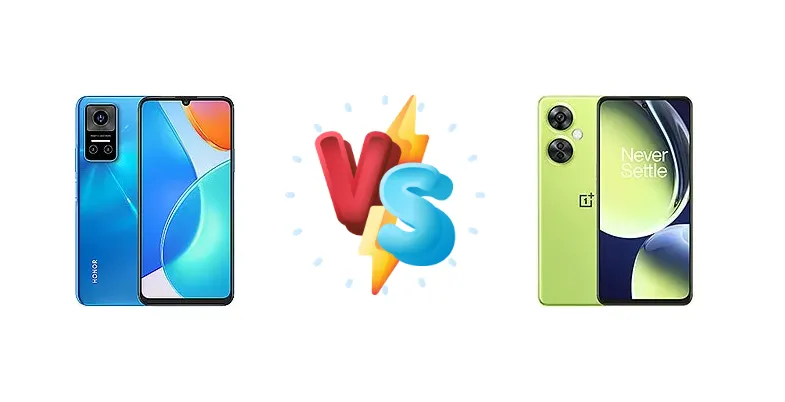
|
🏆 Quick Verdict
For the average user prioritizing convenience and future-proofing, the OnePlus Nord CE 3 Lite is the better choice. Its 67W SuperVOOC charging significantly reduces downtime, and the Snapdragon 695, built on a more efficient 6nm process, offers a slight edge in sustained performance. However, the Honor Play6T remains a viable option for those on a tighter budget.
| PHONES | ||
|---|---|---|
| Phone Names | Honor Play6T | OnePlus Nord CE 3 Lite |
| Network | ||
|---|---|---|
| 2G bands | GSM 850 / 900 / 1800 / 1900 | GSM 850 / 900 / 1800 / 1900 |
| 3G bands | HSDPA 850 / 900 / 2100 | HSDPA 800 / 850 / 900 / 1700(AWS) / 1900 / 2100 - International |
| 4G bands | 1, 3, 5, 8, 34, 38, 39, 40, 41 | 1, 2, 3, 4, 5, 7, 8, 12, 13, 17, 18, 19, 20, 26, 28, 32, 38, 39, 40, 41, 66 - International |
| 5G bands | SA/NSA | 1, 3, 5, 7, 8, 20, 28, 38, 40, 41, 66, 77, 78 SA/NSA - International |
| Speed | HSPA, LTE, 5G | HSPA, LTE, 5G |
| Technology | GSM / CDMA / HSPA / CDMA2000 / LTE / 5G | GSM / HSPA / LTE / 5G |
| CDMA2000 1x | 1, 3, 5, 8, 28, 40, 41, 77, 78 SA/NSA - India | |
| Launch | ||
|---|---|---|
| Announced | 2022, April 07 | 2023, April 04 |
| Status | Available. Released 2022, April 16 | Available. Released 2023, April 11 |
| Body | ||
|---|---|---|
| Build | - | Glass front, plastic frame, plastic back |
| Dimensions | 167.6 x 77.2 x 8.6 mm (6.60 x 3.04 x 0.34 in) | 165.5 x 76 x 8.3 mm (6.52 x 2.99 x 0.33 in) |
| SIM | Nano-SIM + Nano-SIM | Nano-SIM + Nano-SIM |
| Weight | 198 g (6.98 oz) | 195 g (6.88 oz) |
| Display | ||
|---|---|---|
| Protection | - | Corning Gorilla Glass |
| Resolution | 720 x 1600 pixels, 20:9 ratio (~260 ppi density) | 1080 x 2400 pixels, 20:9 ratio (~391 ppi density) |
| Size | 6.74 inches, 109.7 cm2 (~84.8% screen-to-body ratio) | 6.72 inches, 109.6 cm2 (~87.1% screen-to-body ratio) |
| Type | TFT LCD, 90Hz | IPS LCD, 120Hz, 550 nits (typ), 680 nits (peak) |
| Platform | ||
|---|---|---|
| CPU | Octa-core (2x2.2 GHz Cortex-A76 & 6x2.0 GHz Cortex-A55) | Octa-core (2x2.2 GHz Kryo 660 Gold & 6x1.7 GHz Kryo 660 Silver) |
| Chipset | Mediatek Dimensity 700 (7 nm) | Qualcomm SM6375 Snapdragon 695 5G (6 nm) |
| GPU | Mali-G57 MC2 | Adreno 619 |
| OS | Android 11, Magic UI 5.0 | Android 13, OxygenOS 13.1 |
| Memory | ||
|---|---|---|
| Card slot | microSDXC | microSDXC (uses shared SIM slot) |
| Internal | 128GB 8GB RAM, 256GB 8GB RAM | 128GB 8GB RAM, 256GB 8GB RAM |
| - | UFS 2.2 | |
| Main Camera | ||
|---|---|---|
| Features | LED flash, HDR, panorama | LED flash, HDR, panorama |
| Triple | 13 MP, f/1.8, 27mm (wide), AF 2 MP (macro) Auxiliary lens | 108 MP, f/1.8, (wide), 1/1.67", 0.64µm, PDAF 2 MP (macro) Auxiliary lens |
| Video | 1080p@30fps | 1080p@30fps |
| Selfie camera | ||
|---|---|---|
| Features | - | HDR, panorama |
| Single | 5 MP, f/2.2, (wide) | 16 MP, f/2.4, (wide), 1.0µm |
| Video | 1080p@30fps | 1080p@30fps |
| Sound | ||
|---|---|---|
| 3.5mm jack | Yes | Yes |
| 35mm jack | Yes | Yes |
| Loudspeaker | Yes | Yes, with stereo speakers |
| Comms | ||
|---|---|---|
| Bluetooth | 5.1, A2DP, LE | 5.1, A2DP, LE, aptX HD |
| NFC | No | Yes (market/region dependent) |
| Positioning | GPS, GLONASS, GALILEO, BDS | GPS, GALILEO, GLONASS, BDS, QZSS |
| Radio | No | No |
| USB | USB Type-C 2.0, OTG | USB Type-C 2.0, OTG |
| WLAN | Wi-Fi 802.11 a/b/g/n/ac, dual-band, Wi-Fi Direct | Wi-Fi 802.11 a/b/g/n/ac, dual-band |
| Features | ||
|---|---|---|
| Sensors | Fingerprint (side-mounted), accelerometer, proximity, compass | Fingerprint (side-mounted), accelerometer, gyro, proximity, compass |
| Battery | ||
|---|---|---|
| Charging | 22.5W wired | 67W wired, 80% in 30 min |
| Type | Li-Po 5000 mAh | Li-Po 5000 mAh |
| Misc | ||
|---|---|---|
| Colors | Black, Silver, Blue | Pastel Lime, Chromatic Gray |
| Models | CMA-AN40 | CPH2467, CPH2465 |
| Price | About 180 EUR | £ 169.98 / € 209.99 |
| SAR | - | 1.17 W/kg (head) 0.70 W/kg (body) |
| Tests | ||
|---|---|---|
| Performance | - | AnTuTu: 412006 (v9) GeekBench: 2052 (v5) GFXBench: 17fps (ES 3.1 onscreen) |
Honor Play6T
- Potentially lower price point
- Reliable MediaTek Dimensity 700 chipset
- Functional and dependable performance
- Slower 22.5W charging
- Less efficient 7nm chipset
- Potentially inferior image processing
OnePlus Nord CE 3 Lite
- 67W SuperVOOC fast charging
- More efficient Snapdragon 695 (6nm)
- Potentially better image processing
- Likely higher price than the Honor Play6T
- May not offer a significantly larger battery capacity
- No OIS
Display Comparison
Neither device boasts a standout display. Both likely utilize LCD panels, a common cost-saving measure in this segment. The key difference lies under the hood: the OnePlus Nord CE 3 Lite benefits from the more efficient Snapdragon 695, potentially allowing for slightly better power management of the display. While specific brightness figures are unavailable, the Snapdragon’s improved process node could translate to better sustained brightness levels. Bezels are expected to be comparable, and color accuracy will likely be standard for the price point.
Camera Comparison
Without detailed sensor information, a direct camera comparison is difficult. However, the market segment suggests both phones will feature a primary sensor paired with depth and macro lenses. The OnePlus Nord CE 3 Lite likely benefits from Qualcomm’s image signal processor (ISP), which generally delivers strong image processing capabilities, particularly in low-light conditions. The Dimensity 700’s ISP is capable, but typically lags behind Qualcomm’s offerings. The absence of Optical Image Stabilization (OIS) on either device means image stabilization will rely solely on software algorithms, potentially resulting in softer images in challenging lighting.
Performance
The core battleground is the chipset. The OnePlus Nord CE 3 Lite’s Qualcomm Snapdragon 695 (6nm) offers a generational advantage over the Honor Play6T’s MediaTek Dimensity 700 (7nm). The 6nm process inherently provides better power efficiency, leading to less heat generation and potentially more sustained performance during demanding tasks. While both CPUs feature a 2x2.2 GHz core configuration, the Snapdragon’s Kryo 660 Gold cores are architecturally more advanced than the Cortex-A76 cores in the Dimensity 700. This translates to a slight performance edge for the OnePlus in CPU-intensive applications. Gaming performance will be similar, but the Snapdragon 695’s Adreno 619 GPU is likely to offer a more consistent frame rate in graphically demanding titles.
Battery Life
The OnePlus Nord CE 3 Lite’s 67W SuperVOOC charging is a game-changer. The advertised 80% charge in 30 minutes drastically reduces downtime compared to the Honor Play6T’s 22.5W charging. While the Honor Play6T may have a slightly larger battery capacity (speculation based on typical market trends), the OnePlus’s faster charging effectively mitigates any capacity difference. Users who frequently find themselves needing a quick power boost will overwhelmingly benefit from the OnePlus’s charging speed.
Buying Guide
Buy the Honor Play6T if you need a reliable, functional 5G phone and prioritize minimizing upfront cost. It’s ideal for users who don’t heavily game or rely on extremely fast charging. Buy the OnePlus Nord CE 3 Lite if you value convenience, faster charging speeds, and a slightly more modern chipset. This phone is better suited for users who frequently use their phone throughout the day and appreciate the ability to quickly top up the battery.