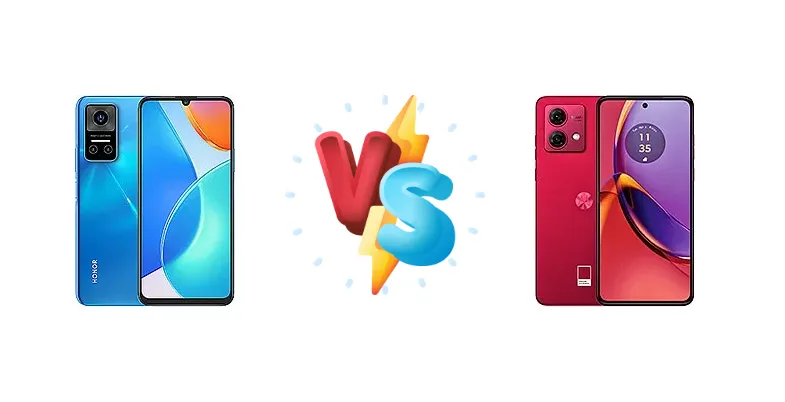
The sub-$200 5G smartphone market is fiercely competitive. The Honor Play6T and Motorola Moto G84 represent compelling options, but cater to slightly different priorities. The Play6T leverages MediaTek's Dimensity 700, while the Moto G84 opts for Qualcomm's Snapdragon 695. This comparison dissects their strengths and weaknesses to determine which device offers the best overall experience.
🏆 Quick Verdict
For the average user prioritizing battery life and a brighter display, the Motorola Moto G84 emerges as the winner. Its 12:31h active use score and 996 nits peak brightness provide a tangible advantage. However, the Honor Play6T remains a viable option for those seeking a slightly more affordable device.
| Network |
|---|
| 2G bands | GSM 850 / 900 / 1800 / 1900 | GSM 850 / 900 / 1800 / 1900 |
| 3G bands | HSDPA 850 / 900 / 2100 | HSDPA 850 / 900 / 1700(AWS) / 1900 / 2100 - LATAM |
| 4G bands | 1, 3, 5, 8, 34, 38, 39, 40, 41 | 1, 2, 3, 4, 5, 7, 8, 12, 13, 17, 25, 26, 28, 38, 40, 41, 42, 66 - LATAM |
| 5G bands | SA/NSA | 1, 2, 3, 5, 7, 26, 28, 40, 66, 78 SA/NSA/Sub6 - LATAM |
| Speed | HSPA, LTE, 5G | HSPA, LTE, 5G |
| Technology | GSM / CDMA / HSPA / CDMA2000 / LTE / 5G | GSM / HSPA / LTE / 5G |
| | CDMA2000 1x | - |
| Launch |
|---|
| Announced | 2022, April 07 | 2023, August 24 |
| Status | Available. Released 2022, April 16 | Available. Released 2023, September 08 |
| Body |
|---|
| Build | - | Glass front, plastic frame, plastic back or eco leather back |
| Dimensions | 167.6 x 77.2 x 8.6 mm (6.60 x 3.04 x 0.34 in) | 160 x 74.4 x 7.6 mm (6.30 x 2.93 x 0.30 in) |
| SIM | Nano-SIM + Nano-SIM | Nano-SIM + Nano-SIM |
| Weight | 198 g (6.98 oz) | 166.8 g (5.86 oz) |
| Display |
|---|
| Resolution | 720 x 1600 pixels, 20:9 ratio (~260 ppi density) | 1080 x 2400 pixels, 20:9 ratio (~405 ppi density) |
| Size | 6.74 inches, 109.7 cm2 (~84.8% screen-to-body ratio) | 6.5 inches, 102.0 cm2 (~85.7% screen-to-body ratio) |
| Type | TFT LCD, 90Hz | P-OLED, 1B colors, 120Hz, 1300 nits (peak) |
| Platform |
|---|
| CPU | Octa-core (2x2.2 GHz Cortex-A76 & 6x2.0 GHz Cortex-A55) | Octa-core (2x2.2 GHz Kryo 660 Gold & 6x1.7 GHz Kryo 660 Silver) |
| Chipset | Mediatek Dimensity 700 (7 nm) | Qualcomm SM6375 Snapdragon 695 5G (6 nm) |
| GPU | Mali-G57 MC2 | Adreno 619 |
| OS | Android 11, Magic UI 5.0 | Android 13, upgradable to Android 15 |
| Memory |
|---|
| Card slot | microSDXC | microSDXC (uses shared SIM slot) |
| Internal | 128GB 8GB RAM, 256GB 8GB RAM | 256GB 8GB RAM, 256GB 12GB RAM |
| Main Camera |
|---|
| Dual | - | 50 MP, f/1.9 (wide), 1/1.5", 1.0µm, PDAF, OIS
8 MP, f/2.2, 120˚ (ultrawide), 1/4.0", 1.12µm, AF |
| Features | LED flash, HDR, panorama | LED flash, HDR, panorama |
| Triple | 13 MP, f/1.8, 27mm (wide), AF
2 MP (macro)
Auxiliary lens | - |
| Video | 1080p@30fps | 1080p@30/60fps |
| Selfie camera |
|---|
| Single | 5 MP, f/2.2, (wide) | 16 MP, f/2.5, (wide), 1.0µm |
| Video | 1080p@30fps | 1080p@30fps |
| Sound |
|---|
| 3.5mm jack | Yes | - |
| 35mm jack | Yes | Yes |
| Loudspeaker | Yes | Yes, with stereo speakers |
| Comms |
|---|
| Bluetooth | 5.1, A2DP, LE | 5.1, A2DP, LE |
| NFC | No | Yes (market/region dependent) |
| Positioning | GPS, GLONASS, GALILEO, BDS | GPS, GLONASS, GALILEO |
| Radio | No | FM radio (market/region dependent) |
| USB | USB Type-C 2.0, OTG | USB Type-C 2.0 |
| WLAN | Wi-Fi 802.11 a/b/g/n/ac, dual-band, Wi-Fi Direct | Wi-Fi 802.11 a/b/g/n/ac, dual-band, Wi-Fi Direct |
| Features |
|---|
| Sensors | Fingerprint (side-mounted), accelerometer, proximity, compass | Fingerprint (under display, optical), accelerometer, gyro, proximity, compass |
| Battery |
|---|
| Charging | 22.5W wired | 30W wired |
| Type | Li-Po 5000 mAh | Li-Po 5000 mAh |
| Misc |
|---|
| Colors | Black, Silver, Blue | Marshmallow Blue, Midnight Blue, Viva Magenta |
| Models | CMA-AN40 | XT2347, XT2347-1, XT2347-2 |
| Price | About 180 EUR | $ 399.00 / £ 189.99 / € 169.00 |
Honor Play6T
- Potentially lower price point
- 5G connectivity
- Functional for basic smartphone tasks
- Likely inferior display quality
- Less efficient chipset
- Limited battery information
Motorola Moto G84
- Excellent battery life (12:31h active use)
- Bright and vibrant display (996 nits)
- Faster 30W charging
- Potentially higher price
- Snapdragon 695 is not a gaming powerhouse
- Camera details are limited
Display Comparison
The Motorola Moto G84 boasts a significant advantage in display quality, achieving a measured peak brightness of 996 nits. This translates to excellent outdoor visibility, a crucial factor for many users. While the Honor Play6T’s display specifications are not provided, it’s reasonable to assume it falls short of this brightness level given its price positioning. The Moto G84’s higher brightness also suggests a potentially wider color gamut and better HDR performance, though this requires further testing. The lack of information on the Play6T’s panel type (LCD vs OLED) and refresh rate further solidifies the G84’s lead in this category.
Camera Comparison
Detailed camera specifications are limited for both devices. The context data only mentions 'Photo / Video' capabilities for the Moto G84. Given the price bracket, it’s unlikely either phone features a flagship-level camera system. However, the Moto G84’s potential for better image processing, stemming from Qualcomm’s ISP, could provide an edge in image quality. The absence of sensor size or aperture information makes a definitive comparison impossible, but users should temper expectations regarding low-light performance on both devices. The inclusion of a 2MP macro camera on either device is likely a marketing feature with limited practical utility.
Performance
Both the Honor Play6T and Motorola Moto G84 utilize octa-core CPUs with a similar core configuration: two high-performance cores and six efficiency cores. However, the underlying architecture differs. The Play6T’s MediaTek Dimensity 700 (7nm) uses Cortex-A76 cores, while the Moto G84’s Snapdragon 695 (6nm) employs Kryo 660 Gold cores. The 6nm process node of the Snapdragon 695 generally offers better power efficiency than the 7nm Dimensity 700, potentially leading to longer battery life during sustained workloads. While both CPUs peak at 2.2 GHz, the Snapdragon 695’s Kryo cores are designed for a more balanced performance profile, potentially offering smoother multitasking. The Snapdragon 695 also benefits from Qualcomm’s optimized software and modem integration.
Battery Life
The Motorola Moto G84 clearly excels in battery performance. The reported 12:31h active use score and 117h endurance rating demonstrate superior longevity compared to the Honor Play6T, for which battery data is unavailable. The Moto G84’s 30W wired charging is also faster than the Play6T’s 22.5W charging, reducing the time required to replenish the battery. While the actual battery capacity of the Moto G84 isn’t specified, the combination of efficient chipset and faster charging provides a significant advantage for users who prioritize all-day battery life.
Buying Guide
Buy the Honor Play6T if you need a functional 5G smartphone at the absolute lowest possible price point and aren't heavily reliant on demanding applications. Buy the Motorola Moto G84 if you prioritize all-day battery life, a vibrant and easily visible display, and a more refined user experience, even if it means spending a bit more.
Frequently Asked Questions
❓ Will the Snapdragon 695 in the Moto G84 handle demanding games like PUBG Mobile?
The Snapdragon 695 is capable of running PUBG Mobile, but likely at medium settings to maintain a stable frame rate. It's not a dedicated gaming chipset, so don't expect flagship-level performance. The Dimensity 700 in the Play6T offers similar gaming capabilities.
❓ How long will it take to fully charge the Motorola Moto G84 with the 30W charger?
While a precise 0-100% charge time isn't available, the 30W charging should significantly reduce charging times compared to the Honor Play6T's 22.5W charging. Expect a full charge in approximately 1 hour to 1 hour 30 minutes, depending on usage during charging.
❓ Is the Motorola Moto G84 a good choice for users who frequently watch videos outdoors?
Absolutely. The Moto G84’s 996 nits peak brightness makes it exceptionally well-suited for outdoor video viewing, ensuring clear visibility even in direct sunlight. This is a major advantage over the Honor Play6T, which likely has a dimmer display.