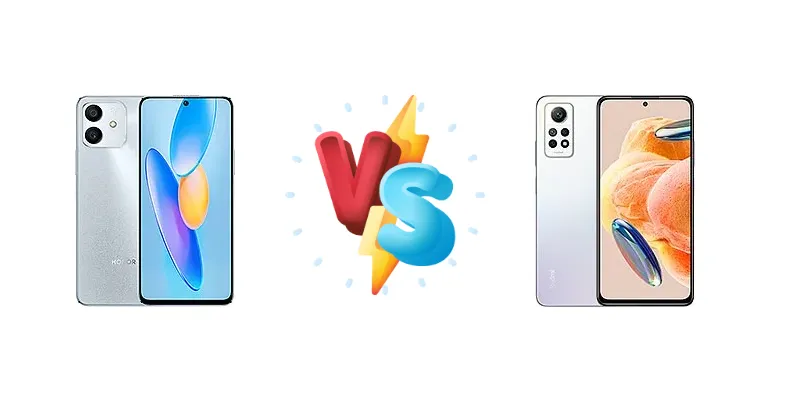
The Honor Play6T Pro and Xiaomi Redmi Note 12 Pro 4G represent compelling options in the increasingly competitive mid-range smartphone market. Both aim to deliver a balanced experience, but they diverge significantly in their core processing power and charging capabilities. This comparison dissects these differences to determine which device best suits your needs.
🏆 Quick Verdict
For the average user prioritizing fast charging and potentially smoother everyday performance, the Xiaomi Redmi Note 12 Pro 4G emerges as the better choice. Its 67W charging significantly reduces downtime, and the Snapdragon 732G, while older, is well-optimized for consistent performance.
| Network |
|---|
| 2G bands | GSM 850 / 900 / 1800 / 1900 | GSM 850 / 900 / 1800 / 1900 |
| 3G bands | HSDPA 850 / 900 / 2100 | HSDPA 850 / 900 / 1700(AWS) / 1900 / 2100 |
| 4G bands | 1, 3, 5, 8, 34, 38, 39, 40, 41 | 1, 2, 3, 4, 5, 7, 8, 20, 28, 38, 40, 41, 66 |
| 5G bands | SA/NSA | - |
| Speed | HSPA, LTE, 5G | HSPA, LTE |
| Technology | GSM / CDMA / HSPA / CDMA2000 / LTE / 5G | GSM / HSPA / LTE |
| | CDMA2000 1x | - |
| Launch |
|---|
| Announced | 2022, April 07 | 2023, March 03 |
| Status | Available. Released 2022, April 13 | Available. Released 2023, April 11 |
| Body |
|---|
| Dimensions | 163.4 x 74.7 x 7.5 mm (6.43 x 2.94 x 0.30 in) | 164.2 x 76.1 x 8.1 mm (6.46 x 3.00 x 0.32 in) |
| SIM | Nano-SIM + Nano-SIM | Nano-SIM + Nano-SIM |
| Weight | 175 g (6.17 oz) | 201.8 g (7.13 oz) |
| Display |
|---|
| Resolution | 1080 x 2388 pixels (~391 ppi density) | 1080 x 2400 pixels, 20:9 ratio (~395 ppi density) |
| Size | 6.7 inches, 108.7 cm2 (~89.1% screen-to-body ratio) | 6.67 inches, 107.4 cm2 (~86.0% screen-to-body ratio) |
| Type | IPS LCD, 90Hz | AMOLED, 120Hz, Dolby Vision, 700 nits (HBM), 1100 nits (peak) |
| Platform |
|---|
| CPU | Octa-core (2x2.4 GHz Cortex-A76 & 6x2.0 GHz Cortex-A55) | Octa-core (2x2.2 GHz Kryo 470 Gold & 6x1.8 GHz Kryo 470 Silver) |
| Chipset | Mediatek Dimensity 810 (6 nm) | Qualcomm SM7150 Snapdragon 732G (8 nm) |
| GPU | Mali-G57 MC2 | Adreno 618 |
| OS | Android 11, Magic UI 5.0 | Android 11, MIUI 13 |
| Memory |
|---|
| Card slot | No | microSDXC (uses shared SIM slot) |
| Internal | 128GB 8GB RAM, 256GB 8GB RAM | 128GB 6GB RAM, 128GB 8GB RAM, 256GB 8GB RAM |
| | - | UFS 2.2 |
| Main Camera |
|---|
| Dual | 48 MP, f/1.8, (wide), PDAF
Auxiliary lens | - |
| Features | LED flash, HDR, panorama | LED flash, HDR, panorama |
| Quad | - | 108 MP, f/1.9, (wide), 1/1.52", 0.7µm, PDAF
8 MP, 120˚, (ultrawide)
2 MP (macro)
Auxiliary lens |
| Single | 8 MP, f/2.0, (wide) | - |
| Video | 1080p@30fps | 4K@30fps, 1080p@30/60fps |
| Selfie camera |
|---|
| Single | 8 MP, f/2.0, (wide) | 16 MP, f/2.4, (wide) |
| Video | 1080p@30fps | 1080p@30fps |
| Sound |
|---|
| 3.5mm jack | Yes | Yes |
| 35mm jack | Yes | Yes |
| Loudspeaker | Yes | Yes, with stereo speakers |
| Comms |
|---|
| Bluetooth | 5.1, A2DP, LE | 5.0, A2DP, LE |
| Infrared port | - | Yes |
| NFC | No | Yes (market/region dependent) |
| Positioning | GPS, GLONASS, BDS | GPS, GLONASS, GALILEO, BDS |
| Radio | No | Unspecified |
| USB | USB Type-C 2.0, OTG | USB Type-C 2.0, OTG |
| WLAN | Wi-Fi 802.11 a/b/g/n/ac, dual-band, Wi-Fi Direct | Wi-Fi 802.11 a/b/g/n/ac, dual-band |
| Features |
|---|
| Sensors | Fingerprint (side-mounted), accelerometer, proximity, compass | Fingerprint (side-mounted), accelerometer, gyro, compass |
| Battery |
|---|
| Charging | 44W wired | 67W wired |
| Type | Li-Po 4000 mAh | Li-Po 5000 mAh |
| Misc |
|---|
| Colors | Black, Silver, Gold | Star Blue, Graphite Gray, Polar White, Ice blue |
| Models | TFY-AN40 | 2209116AG, 2209116AG |
| Price | About 200 EUR | About 150 EUR |
Honor Play6T Pro
- Newer chipset architecture (Dimensity 810)
- Potentially better multitasking performance
- May receive longer software support
- Slower 44W charging
- Dimensity 810 may run hotter under sustained load
- Potentially less optimized software
Xiaomi Redmi Note 12 Pro 4G
- Faster 67W charging
- Well-optimized Snapdragon 732G chipset
- Generally smoother user experience
- Older chipset architecture
- May not receive as many future software updates
- Potentially less powerful GPU
Display Comparison
Neither device's display specifications are provided, so a direct comparison is limited. However, given their price points, both likely feature LCD panels with 60Hz refresh rates. The Redmi Note series historically prioritizes larger displays, while Honor often focuses on a more compact form factor. Color accuracy and peak brightness will likely be similar, with neither expected to challenge flagship-level displays.
Camera Comparison
Without detailed camera specifications, a comprehensive comparison is impossible. However, both phones likely feature a multi-camera setup with a primary sensor, ultrawide, and potentially a macro lens. The image processing style will differ – Xiaomi typically leans towards vibrant, saturated colors, while Honor often aims for a more natural look. Sensor size and aperture are critical factors, but absent that data, we can only speculate. The Redmi Note series often includes larger sensors, potentially giving it an edge in low-light photography.
Performance
The core difference lies in the chipsets. The Honor Play6T Pro utilizes the Mediatek Dimensity 810 (6nm), featuring an octa-core configuration with 2x2.4 GHz Cortex-A76 and 6x2.0 GHz Cortex-A55 cores. The Xiaomi Redmi Note 12 Pro 4G employs the Qualcomm Snapdragon 732G (8nm) with 2x2.2 GHz Kryo 470 Gold and 6x1.8 GHz Kryo 470 Silver cores. The 8nm process of the Snapdragon 732G generally offers better power efficiency than the 6nm Dimensity 810, potentially leading to longer battery life under similar workloads. While the Dimensity 810's Cortex-A76 cores have a slightly higher clock speed, the Snapdragon 732G benefits from Qualcomm’s optimized software and GPU, resulting in a more consistent gaming experience. The Snapdragon 732G’s Adreno 618 GPU is a known performer in this segment.
Battery Life
The Redmi Note 12 Pro 4G’s 67W wired charging is a significant advantage over the Honor Play6T Pro’s 44W charging. This translates to substantially faster charging times – potentially topping up from 0-100% in under 45 minutes compared to potentially over an hour for the Honor. While battery capacity isn’t specified, the faster charging speed mitigates any potential disadvantage from a slightly smaller battery. The Snapdragon 732G’s power efficiency further contributes to longer battery life, complementing the fast charging.
Buying Guide
Buy the Honor Play6T Pro if you prioritize a newer chipset architecture and are comfortable with slightly slower charging speeds. This phone is ideal for users who frequently multitask and appreciate the potential for future software optimizations leveraging the Dimensity 810. Buy the Xiaomi Redmi Note 12 Pro 4G if you value rapid charging, a proven and stable chipset, and a generally smoother user experience, especially for everyday tasks and moderate gaming.
Frequently Asked Questions
❓ Will the Dimensity 810 in the Honor Play6T Pro overheat during prolonged gaming sessions?
The Dimensity 810, while capable, is a mid-range chipset. While it can handle most games, sustained high-performance gaming may lead to thermal throttling, reducing frame rates over time. The 6nm process helps, but the Snapdragon 732G’s optimization often results in better sustained performance.
❓ How much faster is the 67W charging on the Redmi Note 12 Pro 4G compared to the 44W charging on the Honor Play6T Pro?
The 67W charging on the Redmi Note 12 Pro 4G can typically charge a phone from 0-100% in around 40-45 minutes, while the 44W charging on the Honor Play6T Pro will likely take over an hour. This difference is significant for users who frequently need to quickly top up their battery.
❓ Is the Snapdragon 732G still a relevant chipset in 2024?
Yes, the Snapdragon 732G remains a very capable chipset for everyday tasks and moderate gaming. It's well-optimized and provides a smooth, reliable experience, even compared to newer, less-optimized chipsets. It's a testament to Qualcomm's software support.