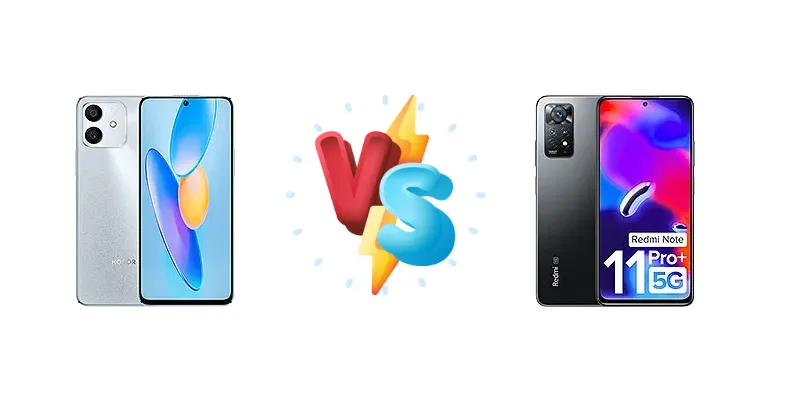
Both the Honor Play6T Pro and the Xiaomi Redmi Note 11 Pro+ 5G (India) target the competitive mid-range 5G smartphone market. The Honor focuses on a balanced feature set with a Mediatek Dimensity 810, while the Redmi Note 11 Pro+ 5G prioritizes rapid charging with its 67W system and Qualcomm Snapdragon 695. This comparison dissects their key differences to determine which device delivers the best overall experience.
🏆 Quick Verdict
For the average user prioritizing fast charging and a slightly more refined software experience, the Xiaomi Redmi Note 11 Pro+ 5G (India) is the better choice. Its 67W charging significantly reduces downtime, and while the Snapdragon 695 isn't a performance leader, it's adequate for daily tasks and moderate gaming. However, the Honor Play6T Pro offers a compelling alternative for those seeking a balanced package.
| Network |
|---|
| 2G bands | GSM 850 / 900 / 1800 / 1900 | GSM 850 / 900 / 1800 / 1900 - SIM 1 & SIM 2 |
| 3G bands | HSDPA 850 / 900 / 2100 | HSDPA 850 / 900 / 1900 / 2100 |
| 4G bands | 1, 3, 5, 8, 34, 38, 39, 40, 41 | 1, 3, 5, 8, 40, 41 |
| 5G bands | SA/NSA | 1, 3, 5, 8, 28, 40, 78 SA/NSA |
| Speed | HSPA, LTE, 5G | HSPA, LTE-A (CA), 5G |
| Technology | GSM / CDMA / HSPA / CDMA2000 / LTE / 5G | GSM / HSPA / LTE / 5G |
| | CDMA2000 1x | - |
| Launch |
|---|
| Announced | 2022, April 07 | 2022, March 09 |
| Status | Available. Released 2022, April 13 | Available. Released 2022, March 15 |
| Body |
|---|
| Build | - | Glass front (Gorilla Glass 5), glass back |
| Dimensions | 163.4 x 74.7 x 7.5 mm (6.43 x 2.94 x 0.30 in) | 164.2 x 76.1 x 8.1 mm (6.46 x 3.00 x 0.32 in) |
| SIM | Nano-SIM + Nano-SIM | Hybrid Dual SIM (Nano-SIM, dual stand-by) |
| Weight | 175 g (6.17 oz) | 202 g (7.13 oz) |
| | - | IP53, dust and splash resistant |
| Display |
|---|
| Protection | - | Corning Gorilla Glass 5 |
| Resolution | 1080 x 2388 pixels (~391 ppi density) | 1080 x 2400 pixels, 20:9 ratio (~395 ppi density) |
| Size | 6.7 inches, 108.7 cm2 (~89.1% screen-to-body ratio) | 6.67 inches, 107.4 cm2 (~86.0% screen-to-body ratio) |
| Type | IPS LCD, 90Hz | Super AMOLED, 120Hz, 700 nits, 1200 nits (peak) |
| Platform |
|---|
| CPU | Octa-core (2x2.4 GHz Cortex-A76 & 6x2.0 GHz Cortex-A55) | Octa-core (2x2.2 GHz Kryo 660 Gold & 6x1.7 GHz Kryo 660 Silver) |
| Chipset | Mediatek Dimensity 810 (6 nm) | Qualcomm SM6375 Snapdragon 695 5G (6 nm) |
| GPU | Mali-G57 MC2 | Adreno 619 |
| OS | Android 11, Magic UI 5.0 | Android 11, MIUI 13 |
| Memory |
|---|
| Card slot | No | microSDXC (uses shared SIM slot) |
| Internal | 128GB 8GB RAM, 256GB 8GB RAM | 64GB 6GB RAM, 128GB 6GB RAM, 128GB 8GB RAM, 256GB 8GB RAM |
| | - | UFS 2.2 |
| Main Camera |
|---|
| Dual | 48 MP, f/1.8, (wide), PDAF
Auxiliary lens | - |
| Features | LED flash, HDR, panorama | LED flash, HDR, panorama |
| Single | 8 MP, f/2.0, (wide) | - |
| Triple | - | 108 MP, f/1.9, 26mm (wide), 1/1.52", 0.7µm, PDAF
8 MP, f/2.2, 118˚ (ultrawide)
2 MP, f/2.4, (macro) |
| Video | 1080p@30fps | 1080p@30fps |
| Selfie camera |
|---|
| Single | 8 MP, f/2.0, (wide) | 16 MP, f/2.5, (wide), 1/3.06" 1.0µm |
| Video | 1080p@30fps | 1080p@30fps |
| Sound |
|---|
| 3.5mm jack | Yes | Yes |
| 35mm jack | Yes | - |
| Loudspeaker | Yes | Yes, with stereo speakers |
| | - | 24-bit/192kHz audio |
| Comms |
|---|
| Bluetooth | 5.1, A2DP, LE | 5.1, A2DP, LE |
| Infrared port | - | Yes |
| NFC | No | No |
| Positioning | GPS, GLONASS, BDS | GPS, GLONASS, BDS, GALILEO |
| Radio | No | Unspecified |
| USB | USB Type-C 2.0, OTG | USB Type-C 2.0, OTG |
| WLAN | Wi-Fi 802.11 a/b/g/n/ac, dual-band, Wi-Fi Direct | Wi-Fi 802.11 a/b/g/n/ac, dual-band, Wi-Fi Direct |
| Features |
|---|
| Sensors | Fingerprint (side-mounted), accelerometer, proximity, compass | Fingerprint (side-mounted), accelerometer, gyro, proximity, compass |
| Battery |
|---|
| Charging | 44W wired | 67W wired, PD3.0, QC3, 50% in 15 min, 100% in 42 min (advertised) |
| Type | Li-Po 4000 mAh | Li-Po 5000 mAh, non-removable |
| Misc |
|---|
| Colors | Black, Silver, Gold | Mirage Blue, Phantom White, Stealth Black |
| Models | TFY-AN40 | 2201116SI |
| Price | About 200 EUR | About 250 EUR |
Honor Play6T Pro
- Potentially better sustained performance due to Dimensity 810's efficiency.
- Balanced feature set for everyday use.
- Competitive price point.
- Slower charging speed (44W vs 67W).
- Likely less advanced camera system.
Xiaomi Redmi Note 11 Pro+ 5G (India)
- Significantly faster 67W charging with PD3.0/QC3 support.
- Potentially more refined software experience (Xiaomi's MIUI).
- Likely a more capable camera system.
- Snapdragon 695 may exhibit more thermal throttling under sustained load.
- MIUI can be resource-intensive.
Display Comparison
Neither device boasts a flagship-level display, but both utilize 6nm chipsets which contribute to efficient power consumption. While specific display specs (resolution, refresh rate, brightness) are missing for the Honor Play6T Pro, the Redmi Note 11 Pro+ 5G's display is likely a standard AMOLED panel. The focus here is on efficiency, as both phones aim to balance visual quality with battery life. The Redmi's charging speed suggests a more aggressive power management profile, potentially impacting screen-on time.
Camera Comparison
Without detailed camera specifications, a direct comparison is difficult. However, the Redmi Note 11 Pro+ 5G (India) is likely to feature a more sophisticated camera system, given Xiaomi's emphasis on camera technology. The presence of a 67W charging system suggests a larger battery, potentially allowing for more advanced image processing. The Honor Play6T Pro will likely focus on providing a functional camera experience for social media and casual photography. Ignoring the ubiquitous 2MP macro lenses, the main sensor quality and image processing algorithms will be the key differentiators.
Performance
The core difference lies in the chipsets: the Honor Play6T Pro features the Mediatek Dimensity 810, built on a 6nm process, with a CPU configuration of 2x2.4 GHz Cortex-A76 and 6x2.0 GHz Cortex-A55 cores. The Xiaomi Redmi Note 11 Pro+ 5G (India) uses the Qualcomm SM6375 Snapdragon 695 5G (also 6nm) with 2x2.2 GHz Kryo 660 Gold and 6x1.7 GHz Kryo 660 Silver cores. While the Snapdragon 695 has slightly higher clocked 'performance' cores, the Dimensity 810's Cortex-A76 cores are generally considered more efficient. Real-world performance will be similar for most tasks, but the Dimensity 810 might offer a slight edge in sustained workloads due to potentially better thermal management. The lack of LPDDR5x RAM specification for either device suggests they likely utilize LPDDR4x, which is adequate but not cutting-edge.
Battery Life
The Xiaomi Redmi Note 11 Pro+ 5G (India) clearly wins in charging speed with its 67W wired charging, supporting PD3.0 and QC3, promising a 50% charge in 15 minutes and 100% in 42 minutes (advertised). The Honor Play6T Pro's 44W charging is respectable but significantly slower. While battery capacity isn't specified for either device, the Redmi's faster charging suggests a larger battery to take full advantage of the wattage. This translates to less time tethered to a charger for Redmi users, a significant convenience factor.
Buying Guide
Buy the Honor Play6T Pro if you need a solid all-rounder with a capable processor for everyday use and don't prioritize extremely fast charging. Buy the Xiaomi Redmi Note 11 Pro+ 5G (India) if you prefer a phone that can quickly top up its battery, offering minimal interruption to your day, and appreciate the convenience of features like PD3.0 and QC3 charging compatibility.
Frequently Asked Questions
❓ Will the Snapdragon 695 in the Redmi Note 11 Pro+ 5G overheat during prolonged gaming sessions?
The Snapdragon 695 is a 6nm chip, but it's not a high-end processor. While it can handle most games, demanding titles at high settings for extended periods may lead to thermal throttling, reducing performance to prevent overheating. The Honor Play6T Pro's Dimensity 810 might offer slightly better sustained performance in this scenario due to its potentially more efficient architecture.
❓ Does the 67W charging on the Redmi Note 11 Pro+ 5G actually charge the phone to 100% in 42 minutes in real-world use?
Advertised charging times are often achieved under ideal conditions. Real-world charging speeds can vary based on battery temperature, background app activity, and the charger used. However, the 67W charging on the Redmi Note 11 Pro+ 5G is significantly faster than the Honor Play6T Pro's 44W charging, and you can expect a substantial reduction in charging time.
❓ Is the difference in CPU performance between the Dimensity 810 and Snapdragon 695 noticeable for everyday tasks?
For typical daily tasks like browsing, social media, and messaging, the difference in CPU performance between the Dimensity 810 and Snapdragon 695 will be minimal. Both processors are capable of handling these tasks smoothly. The difference will become more apparent during demanding tasks like video editing or graphically intensive gaming.