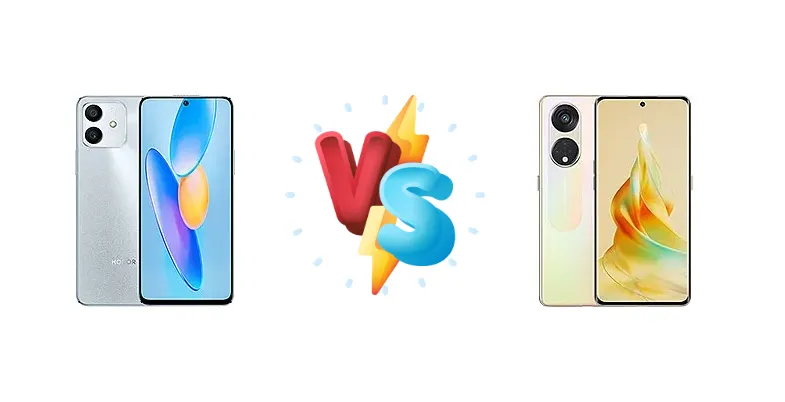
The mid-range 5G smartphone market is fiercely competitive, and the Honor Play6T Pro and Oppo Reno8 T 5G represent compelling options for budget-conscious buyers. Both devices aim to deliver a smooth experience without breaking the bank, but they take different approaches to achieving this. The Honor prioritizes a strong core CPU performance, while the Oppo focuses on faster charging and a more refined user experience.
🏆 Quick Verdict
For the average user prioritizing fast charging and a slightly more polished software experience, the Oppo Reno8 T 5G is the better choice. Its 67W charging significantly reduces downtime. However, the Honor Play6T Pro offers a competitive CPU performance for the price, making it a viable option for those prioritizing raw processing power.
| Network |
|---|
| 2G bands | GSM 850 / 900 / 1800 / 1900 | GSM 850 / 900 / 1800 / 1900 |
| 3G bands | HSDPA 850 / 900 / 2100 | HSDPA 800 / 850 / 900 / 1700(AWS) / 1900 / 2100 |
| 4G bands | 1, 3, 5, 8, 34, 38, 39, 40, 41 | 1, 2, 3, 4, 5, 7, 8, 12, 17, 18, 19, 20, 26, 28, 38, 39, 40, 41, 66 |
| 5G bands | SA/NSA | 1, 3, 5, 7, 8, 20, 28, 38, 40, 41, 66, 77, 78 SA/NSA |
| Speed | HSPA, LTE, 5G | HSPA, LTE, 5G |
| Technology | GSM / CDMA / HSPA / CDMA2000 / LTE / 5G | GSM / HSPA / LTE / 5G |
| | CDMA2000 1x | - |
| Launch |
|---|
| Announced | 2022, April 07 | 2023, February 01 |
| Status | Available. Released 2022, April 13 | Available. Released 2023, February 10 |
| Body |
|---|
| Dimensions | 163.4 x 74.7 x 7.5 mm (6.43 x 2.94 x 0.30 in) | 162.3 x 74.3 x 7.7 mm (6.39 x 2.93 x 0.30 in) |
| SIM | Nano-SIM + Nano-SIM | Nano-SIM + Nano-SIM |
| Weight | 175 g (6.17 oz) | 171 g (6.03 oz) |
| Display |
|---|
| Protection | - | Asahi Glass AGC DT-Star2 |
| Resolution | 1080 x 2388 pixels (~391 ppi density) | 1080 x 2412 pixels, 20:9 ratio (~394 ppi density) |
| Size | 6.7 inches, 108.7 cm2 (~89.1% screen-to-body ratio) | 6.7 inches, 108.0 cm2 (~89.6% screen-to-body ratio) |
| Type | IPS LCD, 90Hz | AMOLED, 1B colors, 120Hz, 500 nits (typ), 800 nits (HBM), 950 nits (peak) |
| Platform |
|---|
| CPU | Octa-core (2x2.4 GHz Cortex-A76 & 6x2.0 GHz Cortex-A55) | Octa-core (2x2.2 GHz Kryo 660 Gold & 6x1.7 GHz Kryo 660 Silver) |
| Chipset | Mediatek Dimensity 810 (6 nm) | Qualcomm SM6375 Snapdragon 695 5G (6 nm) |
| GPU | Mali-G57 MC2 | Adreno 619 |
| OS | Android 11, Magic UI 5.0 | Android 13, upgradable to Android 14, ColorOS 14 |
| Memory |
|---|
| Card slot | No | microSDXC (uses shared SIM slot) |
| Internal | 128GB 8GB RAM, 256GB 8GB RAM | 128GB 8GB RAM, 256GB 8GB RAM |
| | - | UFS 2.2 |
| Main Camera |
|---|
| Dual | 48 MP, f/1.8, (wide), PDAF
Auxiliary lens | 108 MP, f/1.7, 24mm (wide), 1/1.67", 0.64µm, AF
2 MP, f/3.3, 34mm (microscope)
2 MP, f/2.4, (depth) |
| Features | LED flash, HDR, panorama | LED flash, HDR, panorama |
| Single | 8 MP, f/2.0, (wide) | 32 MP, f/2.4, 22mm (wide) |
| Triple | - | 108 MP, f/1.7, 24mm (wide), 1/1.67", 0.64µm, AF
2 MP, f/3.3, 34mm (microscope)
Auxiliary lens |
| Video | 1080p@30fps | 1080p@30fps |
| Selfie camera |
|---|
| Features | - | HDR, panorama |
| Single | 8 MP, f/2.0, (wide) | 32 MP, f/2.4, 22mm (wide) |
| Video | 1080p@30fps | 1080p@30fps |
| Sound |
|---|
| 3.5mm jack | Yes | No |
| 35mm jack | Yes | No |
| Loudspeaker | Yes | Yes, with stereo speakers |
| Comms |
|---|
| Bluetooth | 5.1, A2DP, LE | 5.1, A2DP, LE, aptX HD |
| NFC | No | Yes |
| Positioning | GPS, GLONASS, BDS | GPS, GALILEO, GLONASS, BDS, QZSS |
| Radio | No | No |
| USB | USB Type-C 2.0, OTG | USB Type-C 2.0, OTG |
| WLAN | Wi-Fi 802.11 a/b/g/n/ac, dual-band, Wi-Fi Direct | Wi-Fi 802.11 a/b/g/n/ac, dual-band |
| Features |
|---|
| Sensors | Fingerprint (side-mounted), accelerometer, proximity, compass | Fingerprint (under display, optical), accelerometer, gyro, proximity, compass |
| Battery |
|---|
| Charging | 44W wired | 67W wired, PD, 100% in 44 min
Reverse wired |
| Type | Li-Po 4000 mAh | Li-Po 4800 mAh |
| Misc |
|---|
| Colors | Black, Silver, Gold | Black Starlight (Midnight Black), Dawn Gold (Sunrise Gold) |
| Models | TFY-AN40 | CPH2505 |
| Price | About 200 EUR | About 340 EUR |
Honor Play6T Pro
- Potentially stronger CPU performance for multitasking.
- Competitive price point.
- 6nm chipset offers good power efficiency.
- Slower charging speed compared to the Oppo.
- Likely less refined camera processing.
- GPU performance may lag behind the Snapdragon 695.
Oppo Reno8 T 5G
- Significantly faster 67W charging with PD.
- Reverse wired charging capability.
- Potentially better sustained performance due to Qualcomm’s thermal management.
- CPU performance may be slightly lower than the Dimensity 810.
- May be slightly more expensive than the Honor.
- Software experience can be polarizing (ColorOS).
Display Comparison
Neither device boasts a standout display. Both utilize 6nm chipsets, suggesting similar power efficiency and potential for display brightness. Without specific display specs (resolution, panel type, peak brightness), it's difficult to definitively declare a winner. However, Oppo's brand history suggests a greater emphasis on display calibration and color accuracy, potentially offering a slightly more visually pleasing experience. The absence of high refresh rate information on both devices indicates a focus on battery life over visual fluidity.
Camera Comparison
Without detailed camera specifications beyond the presence of cameras, a direct comparison is limited. Oppo is known for its image processing algorithms, often prioritizing vibrant and shareable photos. Honor, while improving, typically leans towards a more natural color profile. The absence of information regarding sensor size and OIS is critical; a larger sensor generally captures more light, resulting in better low-light performance. The inclusion of a 2MP macro camera on either device is likely a marketing tactic, offering limited practical benefit due to the small sensor size and lack of optical image stabilization.
Performance
The core of the difference lies in the chipsets. The Honor Play6T Pro’s Mediatek Dimensity 810 features a dual-cluster configuration with 2x 2.4 GHz Cortex-A76 cores, designed for peak performance, paired with 6x 2.0 GHz Cortex-A55 cores for efficiency. The Oppo Reno8 T 5G utilizes the Qualcomm Snapdragon 695 5G, with 2x 2.2 GHz Kryo 660 Gold cores and 6x 1.7 GHz Kryo 660 Silver cores. While clock speeds are comparable, the Cortex-A76 architecture in the Dimensity 810 generally offers a performance edge in CPU-intensive tasks. However, the Snapdragon 695 often demonstrates better sustained performance due to Qualcomm’s thermal management optimizations. The 6nm fabrication process is shared, minimizing differences in power consumption. The Reno8 T 5G's Adreno 619 GPU is likely to provide a smoother gaming experience than the Mali-G57 MC2 in the Play6T Pro, especially in graphically demanding titles.
Battery Life
The Oppo Reno8 T 5G’s 67W wired charging is a significant advantage. Oppo claims a 100% charge in just 44 minutes, a substantial improvement over the Honor Play6T Pro’s 44W charging. While the Honor’s charging isn’t slow, the Reno8 T 5G’s faster charging minimizes downtime. The inclusion of PD (Power Delivery) on the Oppo also adds versatility. The Reno8 T 5G also supports reverse wired charging, allowing it to act as a power bank for other devices – a feature absent on the Honor.
Buying Guide
Buy the Honor Play6T Pro if you need a phone that can handle demanding multitasking and light gaming without significant slowdown, and you're willing to trade off charging speed. Buy the Oppo Reno8 T 5G if you prefer a phone that spends less time plugged into the wall, offers a more streamlined user experience, and benefits from Oppo’s established camera algorithms.
Frequently Asked Questions
❓ Will the Dimensity 810 in the Honor Play6T Pro struggle with graphically intensive games like Genshin Impact?
While the Dimensity 810 can run Genshin Impact, you'll likely need to lower the graphics settings to medium or low to maintain a stable frame rate. The Mali-G57 MC2 GPU isn't as powerful as the Adreno 619 in the Oppo Reno8 T 5G, which will provide a smoother experience at higher settings.
❓ How much faster is the 67W charging on the Oppo Reno8 T 5G compared to the 44W charging on the Honor Play6T Pro in real-world use?
The Oppo Reno8 T 5G can realistically charge from 0% to 100% in around 44 minutes, as advertised. The Honor Play6T Pro will likely take closer to 70-80 minutes for a full charge. This difference is significant for users who frequently need to top up their battery quickly.
❓ Does the Snapdragon 695 in the Oppo Reno8 T 5G overheat during prolonged gaming sessions?
The Snapdragon 695 is generally well-optimized for thermal management. While some heat is inevitable during extended gaming, it's less prone to significant throttling compared to some other mid-range chipsets. Oppo's software also likely includes thermal management features to mitigate overheating.