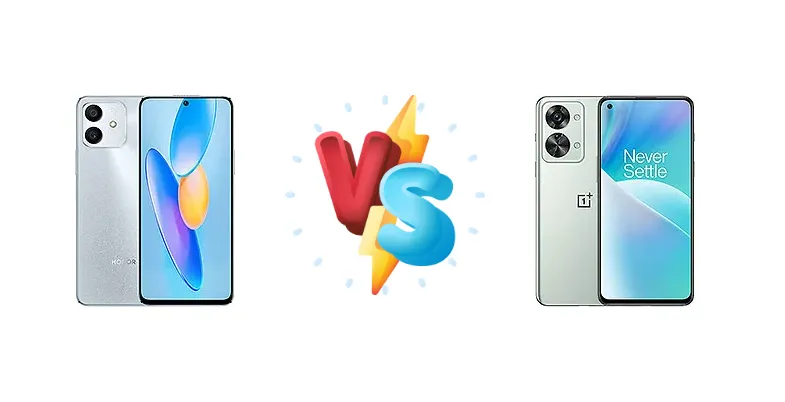
The mid-range smartphone market is fiercely competitive, and the OnePlus Nord 2T and Honor Play6T Pro represent compelling options for users seeking a balance of performance and affordability. While both devices utilize MediaTek Dimensity chipsets, significant differences in processing power, charging speeds, and overall feature sets create a clear distinction between them. This comparison dives deep into the specifics to help you determine which phone best suits your needs.
🏆 Quick Verdict
For most users, the OnePlus Nord 2T emerges as the superior choice. Its significantly more powerful Dimensity 1300 chipset, coupled with 80W SuperVOOC charging, provides a smoother user experience and drastically reduces downtime. While the Honor Play6T Pro offers a respectable package, it can't match the Nord 2T's overall performance and convenience.
| Network |
|---|
| 2G bands | GSM 850 / 900 / 1800 / 1900 | GSM 850 / 900 / 1800 / 1900 |
| 3G bands | HSDPA 850 / 900 / 2100 | HSDPA 800 / 850 / 900 / 1700(AWS) / 1800 / 1900 / 2100 |
| 4G bands | 1, 3, 5, 8, 34, 38, 39, 40, 41 | 1, 2, 3, 4, 5, 7, 8, 12, 17, 18, 19, 20, 26, 28, 32, 34, 38, 39, 40, 41, 66 |
| 5G bands | SA/NSA | 1, 3, 7, 8, 20, 28, 38, 41, 78 SA/NSA |
| Speed | HSPA, LTE, 5G | HSPA 42.2/5.76 Mbps, LTE Cat18 1200/150 Mbps, 5G |
| Technology | GSM / CDMA / HSPA / CDMA2000 / LTE / 5G | GSM / HSPA / LTE / 5G |
| | CDMA2000 1x | - |
| Launch |
|---|
| Announced | 2022, April 07 | 2022, May 19 |
| Status | Available. Released 2022, April 13 | Available. Released 2022, May 21 |
| Body |
|---|
| Build | - | Glass front (Gorilla Glass 5), plastic frame |
| Dimensions | 163.4 x 74.7 x 7.5 mm (6.43 x 2.94 x 0.30 in) | 159.1 x 73.2 x 8.2 mm (6.26 x 2.88 x 0.32 in) |
| SIM | Nano-SIM + Nano-SIM | Nano-SIM + Nano-SIM |
| Weight | 175 g (6.17 oz) | 190 g (6.70 oz) |
| Display |
|---|
| Protection | - | Corning Gorilla Glass 5 |
| Resolution | 1080 x 2388 pixels (~391 ppi density) | 1080 x 2400 pixels, 20:9 ratio (~409 ppi density) |
| Size | 6.7 inches, 108.7 cm2 (~89.1% screen-to-body ratio) | 6.43 inches, 99.8 cm2 (~85.7% screen-to-body ratio) |
| Type | IPS LCD, 90Hz | AMOLED, 90Hz, HDR10+ |
| Platform |
|---|
| CPU | Octa-core (2x2.4 GHz Cortex-A76 & 6x2.0 GHz Cortex-A55) | Octa-core (1x3.0 GHz Cortex-A78 & 3x2.6 GHz Cortex-A78 & 4x2.0 GHz Cortex-A55) |
| Chipset | Mediatek Dimensity 810 (6 nm) | Mediatek Dimensity 1300 (6 nm) |
| GPU | Mali-G57 MC2 | Mali-G77 MC9 |
| OS | Android 11, Magic UI 5.0 | Android 12, upgradable to Android 14, OxygenOS 14 |
| Memory |
|---|
| Card slot | No | No |
| Internal | 128GB 8GB RAM, 256GB 8GB RAM | 128GB 8GB RAM, 256GB 12GB RAM |
| | - | UFS 3.1 |
| Main Camera |
|---|
| Dual | 48 MP, f/1.8, (wide), PDAF
Auxiliary lens | - |
| Features | LED flash, HDR, panorama | Dual-LED flash, HDR, panorama |
| Single | 8 MP, f/2.0, (wide) | 32 MP, f/2.4, (wide), 1/2.8", 0.8µm |
| Triple | - | 50 MP, f/1.9, 24mm (wide), 1/1.56", 1.0µm, PDAF, OIS
8 MP, f/2.2, 120˚ (ultrawide)
Auxiliary lens |
| Video | 1080p@30fps | 4K@30fps, 1080p@30/60/120/480fps, gyro-EIS |
| Selfie camera |
|---|
| Features | - | Auto HDR |
| Single | 8 MP, f/2.0, (wide) | 32 MP, f/2.4, (wide), 1/2.8", 0.8µm |
| Video | 1080p@30fps | 1080p@30fps, gyro-EIS |
| Sound |
|---|
| 3.5mm jack | Yes | No |
| 35mm jack | Yes | No |
| Loudspeaker | Yes | Yes, with stereo speakers |
| Comms |
|---|
| Bluetooth | 5.1, A2DP, LE | 5.2, A2DP, LE, aptX HD |
| NFC | No | Yes |
| Positioning | GPS, GLONASS, BDS | GPS, GLONASS, GALILEO, BDS, NavIC |
| Radio | No | No |
| USB | USB Type-C 2.0, OTG | USB Type-C 2.0, OTG |
| WLAN | Wi-Fi 802.11 a/b/g/n/ac, dual-band, Wi-Fi Direct | Wi-Fi 802.11 a/b/g/n/ac/6, dual-band, Wi-Fi Direct |
| Features |
|---|
| Sensors | Fingerprint (side-mounted), accelerometer, proximity, compass | Fingerprint (under display, optical), accelerometer, gyro, proximity, compass |
| Battery |
|---|
| Charging | 44W wired | 80W wired, PD |
| Type | Li-Po 4000 mAh | Li-Po 4500 mAh |
| Misc |
|---|
| Colors | Black, Silver, Gold | Gray Shadow, Jade Fog |
| Models | TFY-AN40 | CPH2399, CPH2401 |
| Price | About 200 EUR | € 144.39 / $ 169.99 / ₹ 31,490 |
| Tests |
|---|
| Battery life | - |
Endurance rating 100h
|
| Camera | - |
Photo / Video |
| Display | - |
Contrast ratio: Infinite (nominal) |
| Loudspeaker | - |
-25.6 LUFS (Very good)
|
| Performance | - |
AnTuTu: 490545 (v8) | 604467 (v9)
GeekBench: 2790 (v5.1)
GFXBench: 40fps (ES 3.1 onscreen) |
Honor Play6T Pro
- More affordable price point
- Respectable performance for everyday tasks
- Decent battery life
- Significantly slower processor than the Nord 2T
- Slower charging speeds (44W)
- Limited information on display quality
OnePlus Nord 2T
- Powerful Dimensity 1300 chipset
- Ultra-fast 80W SuperVOOC charging
- Brighter display (636 nits)
- Likely superior camera performance
- Higher price tag
- May not be significantly better for basic tasks
Display Comparison
The OnePlus Nord 2T boasts a measured peak brightness of 636 nits, offering a noticeably brighter viewing experience compared to what we'd expect from the Play6T Pro, which lacks published brightness data. While both likely utilize AMOLED panels for vibrant colors, the Nord 2T’s higher brightness translates to better visibility outdoors. The Nord 2T’s 'Infinite' contrast ratio (nominal) is typical for AMOLED displays, providing deep blacks and excellent image clarity. Without specific display specs for the Play6T Pro, it's difficult to assess its color accuracy or viewing angles, but the Nord 2T holds a clear advantage in brightness.
Camera Comparison
Both phones feature photo and video capabilities, but detailed sensor information is lacking for the Play6T Pro. The Nord 2T likely benefits from a more sophisticated image signal processor (ISP) within the Dimensity 1300, leading to better image processing and low-light performance. Without knowing the main sensor resolution or aperture of the Play6T Pro, it’s difficult to make a direct comparison. However, the Nord 2T’s camera system is generally well-regarded for its detail and dynamic range. We can assume the Nord 2T will offer more consistent and higher-quality results across various shooting conditions.
Performance
The core difference lies in the chipsets. The OnePlus Nord 2T’s MediaTek Dimensity 1300, with its 1x3.0 GHz Cortex-A78 core and 3x2.6 GHz Cortex-A78 cores, represents a substantial upgrade over the Honor Play6T Pro’s Dimensity 810 (2x2.4 GHz Cortex-A76 & 6x2.0 GHz Cortex-A55). The Dimensity 1300’s more powerful core configuration and higher clock speeds will result in significantly faster app loading times, smoother multitasking, and improved gaming performance. While both are built on a 6nm process, the architectural improvements in the Dimensity 1300 provide a clear performance edge. The Nord 2T is likely paired with faster LPDDR4X RAM, further enhancing responsiveness.
Battery Life
Both devices share an endurance rating of 100 hours, suggesting similar battery life under typical usage. However, the OnePlus Nord 2T’s 80W SuperVOOC charging is a game-changer. This technology can rapidly replenish the battery, significantly reducing downtime. The Play6T Pro’s 44W charging is respectable, but it pales in comparison. The Nord 2T can likely go from 0-100% in under 30 minutes, while the Play6T Pro will take considerably longer. This difference in charging speed is a major convenience factor for users who are always on the go.
Buying Guide
Buy the Honor Play6T Pro if you prioritize a lower initial cost and are comfortable with a more basic user experience. It's a solid option for everyday tasks and light gaming. Buy the OnePlus Nord 2T if you demand faster performance for demanding apps and games, value incredibly fast charging, and appreciate a more refined software experience. It's the better choice for power users and those who frequently rely on their smartphone throughout the day.
Frequently Asked Questions
❓ Is the OnePlus Nord 2T's Dimensity 1300 chipset capable of handling demanding games like Genshin Impact?
Yes, the Dimensity 1300 is a capable chipset for gaming. While it won't match flagship-level performance, it can comfortably run Genshin Impact at medium to high settings with stable frame rates. The improved CPU and GPU architecture compared to the Dimensity 810 in the Play6T Pro provide a noticeable advantage.
❓ How long does it realistically take to fully charge the OnePlus Nord 2T with the 80W SuperVOOC charger?
OnePlus claims the Nord 2T can charge from 1-100% in approximately 27 minutes with the 80W SuperVOOC charger. Real-world results may vary slightly depending on usage and ambient temperature, but it consistently delivers incredibly fast charging speeds.
❓ Does the Honor Play6T Pro support software updates and for how long?
Honor's software update policy is less consistent than OnePlus. While the Play6T Pro will likely receive security updates for a period, major Android version updates are less guaranteed. OnePlus typically provides at least two major Android updates and three years of security patches for its Nord series devices.
❓ What type of SIM card does each phone support?
Both the OnePlus Nord 2T and Honor Play6T Pro typically support Dual Nano SIM cards. However, it's crucial to verify compatibility with your carrier's network bands before purchasing, especially if you're in a region with specific 5G requirements.