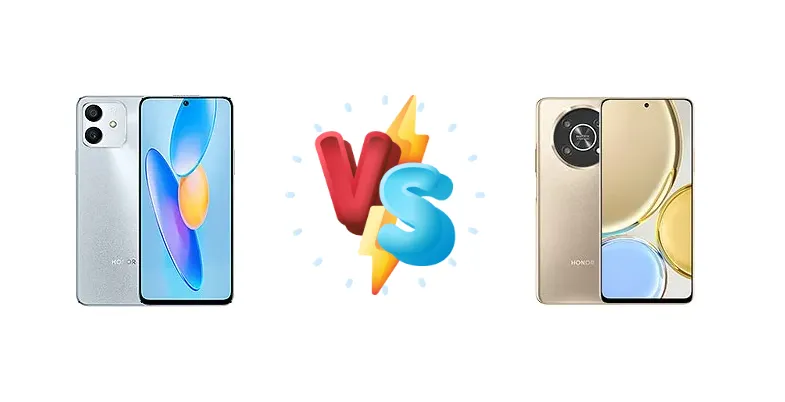
Honor's Play and X series represent compelling value in the mid-range smartphone market. The Play6T Pro and X30 both offer 5G connectivity, but diverge in their core processing power and charging capabilities. This comparison dissects the differences between the Mediatek Dimensity 810 and Qualcomm Snapdragon 695, helping you determine which device best suits your needs.
🏆 Quick Verdict
For the average user prioritizing fast charging and a slightly more refined user experience, the Honor X30 emerges as the winner. Its 66W charging significantly reduces downtime, and the Snapdragon 695 offers a balanced performance profile. However, the Play6T Pro remains a strong contender for those seeking a more affordable option.
| Network |
|---|
| 2G bands | GSM 850 / 900 / 1800 / 1900 | GSM 850 / 900 / 1800 / 1900 |
| 3G bands | HSDPA 850 / 900 / 2100 | HSDPA 850 / 900 / 1700(AWS) / 1900 / 2100 |
| 4G bands | 1, 3, 5, 8, 34, 38, 39, 40, 41 | LTE |
| 5G bands | SA/NSA | SA/NSA |
| Speed | HSPA, LTE, 5G | HSPA, LTE, 5G |
| Technology | GSM / CDMA / HSPA / CDMA2000 / LTE / 5G | GSM / CDMA / HSPA / CDMA2000 / LTE / 5G |
| | CDMA2000 1x | CDMA2000 1x |
| Launch |
|---|
| Announced | 2022, April 07 | 2021, December 16 |
| Status | Available. Released 2022, April 13 | Available. Released 2021, December 25 |
| Body |
|---|
| Dimensions | 163.4 x 74.7 x 7.5 mm (6.43 x 2.94 x 0.30 in) | 166.1 x 75.8 x 8.1 mm (6.54 x 2.98 x 0.32 in) |
| SIM | Nano-SIM + Nano-SIM | Nano-SIM + Nano-SIM |
| Weight | 175 g (6.17 oz) | 189 g (6.67 oz) |
| Display |
|---|
| Resolution | 1080 x 2388 pixels (~391 ppi density) | 1080 x 2388 pixels (~385 ppi density) |
| Size | 6.7 inches, 108.7 cm2 (~89.1% screen-to-body ratio) | 6.81 inches, 112.3 cm2 (~89.2% screen-to-body ratio) |
| Type | IPS LCD, 90Hz | IPS LCD, 120Hz |
| Platform |
|---|
| CPU | Octa-core (2x2.4 GHz Cortex-A76 & 6x2.0 GHz Cortex-A55) | Octa-core (2x2.2 GHz Kryo 660 Gold & 6x1.7 GHz Kryo 660 Silver) |
| Chipset | Mediatek Dimensity 810 (6 nm) | Qualcomm SM6375 Snapdragon 695 5G (6 nm) |
| GPU | Mali-G57 MC2 | Adreno 619 |
| OS | Android 11, Magic UI 5.0 | Android 11, Magic UI 5.0 |
| Memory |
|---|
| Card slot | No | No |
| Internal | 128GB 8GB RAM, 256GB 8GB RAM | 128GB 6GB RAM, 128GB 8GB RAM, 256GB 8GB RAM, 256GB 12GB RAM |
| Main Camera |
|---|
| Dual | 48 MP, f/1.8, (wide), PDAF
Auxiliary lens | - |
| Features | LED flash, HDR, panorama | LED flash, panorama, HDR |
| Single | 8 MP, f/2.0, (wide) | 16 MP, f/2.5 |
| Triple | - | 48 MP, f/1.8, 26mm (wide), PDAF
2 MP (macro)
Auxiliary lens |
| Video | 1080p@30fps | 1080p@30fps |
| Selfie camera |
|---|
| Single | 8 MP, f/2.0, (wide) | 16 MP, f/2.5 |
| Video | 1080p@30fps | 1080p@30fps |
| Sound |
|---|
| 3.5mm jack | Yes | No |
| 35mm jack | Yes | No |
| Loudspeaker | Yes | Yes |
| Comms |
|---|
| Bluetooth | 5.1, A2DP, LE | 5.1, A2DP, LE |
| NFC | No | No |
| Positioning | GPS, GLONASS, BDS | GPS, GLONASS, BDS |
| Radio | No | No |
| USB | USB Type-C 2.0, OTG | USB Type-C 2.0, OTG |
| WLAN | Wi-Fi 802.11 a/b/g/n/ac, dual-band, Wi-Fi Direct | Wi-Fi 802.11 a/b/g/n/ac, dual-band, Wi-Fi Direct |
| Features |
|---|
| Sensors | Fingerprint (side-mounted), accelerometer, proximity, compass | Fingerprint (side-mounted), accelerometer, gyro, proximity, compass |
| Battery |
|---|
| Charging | 44W wired | 66W wired, 80% in 30 min |
| Type | Li-Po 4000 mAh | Li-Po 4800 mAh |
| Misc |
|---|
| Colors | Black, Silver, Gold | Black, Blue, Silver, Gold |
| Models | TFY-AN40 | ANY-AN00 |
| Price | About 200 EUR | About 210 EUR |
Honor Play6T Pro
- Potentially higher single-core CPU performance
- More affordable price point
- Decent 5G connectivity
- Slower charging speeds (44W)
- Less efficient chipset for sustained tasks
- Potentially inferior image processing
Honor X30
- Faster 66W charging with 30-minute 80% claim
- More efficient Snapdragon 695 chipset
- Superior GPU performance for gaming
- Slightly higher price
- Lower peak CPU clock speeds
- May not offer significant camera improvements
Display Comparison
Neither Honor provides display specs beyond resolution in their marketing materials. Assuming both utilize IPS LCD panels common in this price bracket, the display experience will likely be similar. The absence of high refresh rates or advanced features like LTPO suggests neither phone is geared towards visually demanding users. Bezels are likely comparable, focusing on maximizing screen real estate within their respective budgets.
Camera Comparison
Without detailed sensor information, a direct camera comparison is difficult. However, the Snapdragon 695’s integrated ISP generally provides superior image processing capabilities, potentially leading to better dynamic range and noise reduction in the X30’s photos. Both phones likely feature a multi-camera setup, but the quality of the secondary sensors (often 2MP macro or depth sensors) is unlikely to be significant. The X30’s image signal processor will likely offer more advanced features like better HDR and night mode performance.
Performance
The core difference lies in the chipsets. The Honor Play6T Pro’s Mediatek Dimensity 810, built on a 6nm process, features a dual-core configuration with 2x2.4 GHz Cortex-A76 cores, suggesting strong single-core performance. The Honor X30’s Snapdragon 695 (also 6nm) utilizes 2x2.2 GHz Kryo 660 Gold cores. While the Dimensity 810 boasts higher clock speeds on its prime cores, the Snapdragon 695 benefits from Qualcomm’s optimized architecture and ISP. This translates to potentially better sustained performance and image processing. The Snapdragon 695’s Adreno 619 GPU is also generally considered more capable than the Dimensity 810’s Mali-G52 MC2, offering a slight edge in gaming. RAM configurations are not specified, but LPDDR4X is likely used in both, limiting memory bandwidth.
Battery Life
The Honor X30’s 66W wired charging is a significant advantage, promising an 80% charge in just 30 minutes. The Play6T Pro’s 44W charging is respectable, but noticeably slower. While battery capacity isn’t specified, the faster charging of the X30 mitigates any potential disadvantage from a slightly smaller battery. Users who frequently top up their phones will greatly benefit from the X30’s charging speed.
Buying Guide
Buy the Honor Play6T Pro if you need a highly affordable 5G phone and prioritize a slightly more powerful CPU core configuration for tasks like video encoding. Buy the Honor X30 if you prefer faster charging speeds, a more efficient chipset for sustained performance, and a generally smoother software experience, even if it comes at a small price premium.
Frequently Asked Questions
❓ Will the Snapdragon 695 in the Honor X30 struggle with demanding games like PUBG or Genshin Impact?
While the Snapdragon 695 isn't a flagship chipset, it's capable of running PUBG Mobile at medium settings with stable frame rates. Genshin Impact may require lower settings to maintain smooth gameplay. The Adreno 619 GPU provides a slight advantage over the Dimensity 810's Mali-G52 MC2, but don't expect a high-end gaming experience.
❓ How much faster is the 66W charging on the Honor X30 compared to the 44W charging on the Play6T Pro in real-world use?
Honor claims the X30 reaches 80% charge in 30 minutes. The Play6T Pro will likely take around 45-60 minutes to reach the same charge level. This difference is significant for users who need a quick power boost before leaving the house or during a busy day.
❓ Is the difference in CPU performance between the Dimensity 810 and Snapdragon 695 noticeable for everyday tasks like browsing and social media?
For typical daily usage, the difference in CPU performance will be minimal. Both chipsets are more than capable of handling browsing, social media, and video playback. The Snapdragon 695's efficiency may result in slightly better battery life during these tasks.