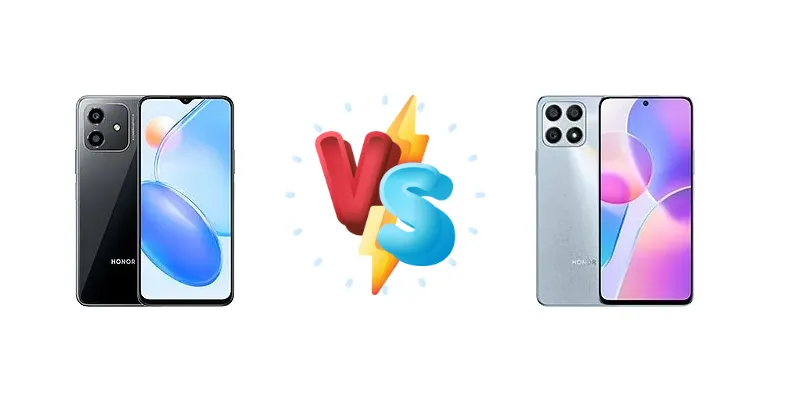
Honor's Play6C and X30i represent compelling options in the increasingly competitive budget 5G smartphone market. While both aim to deliver connectivity and functionality at an accessible price point, they diverge significantly in their core hardware. The Play6C leverages Qualcomm's Snapdragon 480+ 5G, while the X30i opts for MediaTek's Dimensity 810. This comparison dissects these key differences to determine which device offers the best overall experience.
🏆 Quick Verdict
For most users, the Honor X30i emerges as the stronger choice. Its Dimensity 810 chipset provides a noticeable performance uplift over the Snapdragon 480+ in the Play6C, translating to smoother multitasking and a more responsive gaming experience. While both share the same 22.5W charging, the X30i’s superior processing power justifies its slightly higher price.
| Network |
|---|
| 2G bands | GSM 850 / 900 / 1800 / 1900 | GSM 850 / 900 / 1800 / 1900 |
| 3G bands | HSDPA 850 / 900 / 1900 / 2100 | HSDPA 850 / 900 / 1700(AWS) / 1900 / 2100 |
| 4G bands | LTE | LTE |
| 5G bands | - | SA/NSA |
| Speed | HSPA, LTE | HSPA, LTE, 5G |
| Technology | GSM / CDMA / HSPA / CDMA2000 / LTE | GSM / CDMA / HSPA / CDMA2000 / LTE / 5G |
| | CDMA2000 1x | CDMA2000 1x |
| Launch |
|---|
| Announced | 2022, October 13 | 2021, October 28 |
| Status | Available. Released 2022, October 15 | Available. Released 2021, November 02 |
| Body |
|---|
| Build | - | Glass front, plastic frame, plastic back |
| Dimensions | 163.7 x 75.1 x 8.7 mm (6.44 x 2.96 x 0.34 in) | 163.4 x 74.7 x 7.5 mm (6.43 x 2.94 x 0.30 in) |
| SIM | Nano-SIM + Nano-SIM | Nano-SIM + Nano-SIM |
| Weight | 194 g (6.84 oz) | 175 g (6.17 oz) |
| Display |
|---|
| Resolution | 720 x 1600 pixels, 20:9 ratio (~270 ppi density) | 1080 x 2388 pixels (~391 ppi density) |
| Size | 6.5 inches, 102.0 cm2 (~83.0% screen-to-body ratio) | 6.7 inches, 108.7 cm2 (~89.1% screen-to-body ratio) |
| Type | TFT LCD | IPS LCD, 90Hz |
| Platform |
|---|
| CPU | Octa-core (2x2.2 GHz Kryo 460 & 6x1.9 GHz Kryo 460) | Octa-core (2x2.4 GHz Cortex-A76 & 6x2.0 GHz Cortex-A55) |
| Chipset | Qualcomm SM4350-AC Snapdragon 480+ 5G (8 nm) | Mediatek Dimensity 810 (6 nm) |
| GPU | Adreno 619 | Mali-G57 MC2 |
| OS | Android 11, Magic UI 5 | Android 11, Magic UI 5.0 |
| Memory |
|---|
| Card slot | microSDXC (uses shared SIM slot) | No |
| Internal | 128GB 6GB RAM, 128GB 8GB RAM | 128GB 6GB RAM, 128GB 8GB RAM, 256GB 8GB RAM |
| Main Camera |
|---|
| Dual | 13 MP, f/1.8, (wide), PDAF
Auxiliary lens | - |
| Features | LED flash, HDR, panorama | LED flash, panorama, HDR |
| Single | 5 MP, f/2.2, (wide) | 8 MP, f/2.0 |
| Triple | - | 48 MP, f/1.8, 26mm (wide), PDAF
2 MP (macro)
Auxiliary lens |
| Video | 1080p@30fps | 1080p@30fps |
| Selfie camera |
|---|
| Single | 5 MP, f/2.2, (wide) | 8 MP, f/2.0 |
| Video | 1080p@30fps | 1080p@30fps |
| Sound |
|---|
| 3.5mm jack | Yes | Yes |
| 35mm jack | Yes | Yes |
| Loudspeaker | Yes | Yes, with dual speakers |
| Comms |
|---|
| Bluetooth | 5.1, A2DP, LE | 5.1, A2DP, LE |
| NFC | No | No |
| Positioning | GPS, GLONASS, GALILEO, BDS | GPS, GLONASS, BDS |
| Radio | Unspecified | No |
| USB | USB Type-C 2.0 | USB Type-C 2.0, OTG |
| WLAN | Wi-Fi 802.11 a/b/g/n/ac, dual-band, Wi-Fi Direct | Wi-Fi 802.11 a/b/g/n/ac, dual-band, Wi-Fi Direct |
| Features |
|---|
| Sensors | Fingerprint (side-mounted), accelerometer, proximity, compass | Fingerprint (side-mounted), accelerometer, compass |
| Battery |
|---|
| Charging | 22.5W wired | 22.5W wired |
| Type | Li-Po 5000 mAh | Li-Po 4000 mAh |
| Misc |
|---|
| Colors | Black, Blue, Silver | Black, Blue, Silver, Rose Gold |
| Models | VNE-AN40 | TFY-AN00 |
| Price | About 150 EUR | About 190 EUR |
Honor Play6C
- Lower price point makes it very accessible.
- 5G connectivity for future-proofed data speeds.
- Qualcomm chipset offers reliable performance for basic tasks.
- Snapdragon 480+ is noticeably slower than the Dimensity 810.
- May struggle with demanding games and applications.
Honor X30i
- Dimensity 810 provides significantly better performance.
- More efficient chipset potentially leads to longer battery life.
- Improved image processing capabilities.
- Slightly higher price compared to the Play6C.
- May not offer a dramatically different camera experience without detailed sensor specs.
Display Comparison
Neither Honor provides detailed display specifications beyond resolution. However, the display quality is likely similar, focusing on cost-effectiveness. The absence of high refresh rates (90Hz or 120Hz) is typical for this price bracket. The real difference lies in the processing power driving the UI, which impacts perceived smoothness. Expect both to utilize LCD panels, prioritizing affordability over advanced technologies like OLED.
Camera Comparison
Without detailed camera specs, it's difficult to make a definitive judgment. Both phones likely feature a primary camera and depth/macro sensors. However, the image signal processor (ISP) within the Dimensity 810 generally offers more advanced image processing capabilities than the ISP in the Snapdragon 480+. This could result in better dynamic range, noise reduction, and overall image quality on the X30i, even with similar sensor hardware. The 2MP macro cameras found on many phones in this segment are typically of limited utility.
Performance
The core distinction between these phones is their chipsets. The Honor X30i’s MediaTek Dimensity 810 (6nm) boasts a more advanced architecture than the Qualcomm Snapdragon 480+ (8nm) in the Play6C. The Dimensity 810’s Cortex-A76 cores, clocked at 2.4 GHz, offer a substantial performance advantage over the Kryo 460 cores (2.2 GHz) in the Snapdragon 480+. This translates to faster app loading times, smoother multitasking, and improved gaming performance. The 6nm process node of the Dimensity 810 also contributes to better power efficiency, potentially leading to longer battery life under load. While both are octa-core CPUs, the architectural differences are significant.
Battery Life
Both the Honor Play6C and X30i support 22.5W wired charging, suggesting similar charging speeds – approximately 1.5 to 2 hours for a full charge. Battery capacity is not specified, but given the target market, both are likely in the 4000-5000 mAh range. The Dimensity 810’s improved power efficiency could offset a potentially smaller battery capacity in the X30i, resulting in comparable or even slightly better real-world battery life, especially during demanding tasks.
Buying Guide
Buy the Honor Play6C if you prioritize a lower upfront cost and primarily need a phone for basic tasks like calling, texting, and light social media browsing. Its Snapdragon 480+ is sufficient for these everyday activities. Buy the Honor X30i if you value performance for gaming, streaming, or running demanding applications. The Dimensity 810 offers a significant step up in processing power, making it a better long-term investment for users who push their phones harder.
Frequently Asked Questions
❓ Will the Dimensity 810 in the Honor X30i get uncomfortably hot during extended gaming sessions?
While the Dimensity 810 is more powerful, it's also more efficient than the Snapdragon 480+. Honor's thermal management implementation will be key, but the 6nm process node generally results in lower heat generation compared to the 8nm node of the Snapdragon. Expect some warmth, but likely not to the point of significant throttling.
❓ Is the 5G connectivity on both phones compatible with all 5G networks?
Both phones support 5G, but compatibility depends on your carrier and region. They likely support sub-6GHz 5G bands, which are widely deployed. However, support for mmWave 5G (faster but shorter range) is less common in this price segment and may not be present on either device. Check with your carrier for specific band compatibility.
❓ How much storage and RAM does each phone offer, and is it expandable?
Storage and RAM configurations are not specified in the provided data. However, budget phones typically offer 4GB or 6GB of RAM and 64GB or 128GB of storage. MicroSD card support for storage expansion is common in this segment, but it's not guaranteed. Check the product specifications before purchasing.