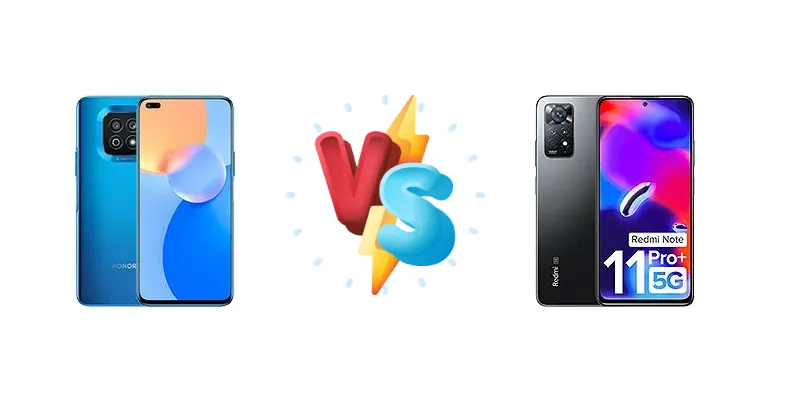
The Honor Play5 Youth and Xiaomi Redmi Note 11 Pro+ 5G (India) represent compelling options in the increasingly competitive mid-range 5G smartphone market. Both devices aim to deliver a balance of performance and features without breaking the bank, but they achieve this through different approaches to chipset selection and charging technology. This comparison dives deep into the specifics to determine which phone offers the best value.
🏆 Quick Verdict
For the average user prioritizing raw processing power and slightly faster charging, the Honor Play5 Youth emerges as the winner. Its Mediatek Dimensity 900 chipset offers a performance edge over the Snapdragon 695, making it better suited for demanding tasks and gaming. However, the Redmi Note 11 Pro+ 5G remains a strong contender, particularly for those heavily invested in the Xiaomi ecosystem.
| Network |
|---|
| 2G bands | GSM 850 / 900 / 1800 / 1900 | GSM 850 / 900 / 1800 / 1900 - SIM 1 & SIM 2 |
| 3G bands | HSDPA 850 / 900 / 2100 | HSDPA 850 / 900 / 1900 / 2100 |
| 4G bands | 1, 3, 5, 8, 34, 38, 39, 40, 41 | 1, 3, 5, 8, 40, 41 |
| 5G bands | 1, 41, 78 SA/NSA | 1, 3, 5, 8, 28, 40, 78 SA/NSA |
| Speed | HSPA, LTE, 5G | HSPA, LTE-A (CA), 5G |
| Technology | GSM / CDMA / HSPA / CDMA2000 / LTE / 5G | GSM / HSPA / LTE / 5G |
| | CDMA2000 1x | - |
| Launch |
|---|
| Announced | 2021, October 25 | 2022, March 09 |
| Status | Available. Released 2021, November 02 | Available. Released 2022, March 15 |
| Body |
|---|
| Build | - | Glass front (Gorilla Glass 5), glass back |
| Dimensions | 161.8 x 74.7 x 8.5 mm (6.37 x 2.94 x 0.33 in) | 164.2 x 76.1 x 8.1 mm (6.46 x 3.00 x 0.32 in) |
| SIM | Nano-SIM + Nano-SIM | Hybrid Dual SIM (Nano-SIM, dual stand-by) |
| Weight | 192 g (6.77 oz) | 202 g (7.13 oz) |
| | - | IP53, dust and splash resistant |
| Display |
|---|
| Protection | - | Corning Gorilla Glass 5 |
| Resolution | 1080 x 2376 pixels (~391 ppi density) | 1080 x 2400 pixels, 20:9 ratio (~395 ppi density) |
| Size | 6.67 inches, 108.1 cm2 (~89.5% screen-to-body ratio) | 6.67 inches, 107.4 cm2 (~86.0% screen-to-body ratio) |
| Type | IPS LCD, 120Hz | Super AMOLED, 120Hz, 700 nits, 1200 nits (peak) |
| Platform |
|---|
| CPU | Octa-core (2x2.4 GHz Cortex-A78 & 6x2.0 GHz Cortex-A55) | Octa-core (2x2.2 GHz Kryo 660 Gold & 6x1.7 GHz Kryo 660 Silver) |
| Chipset | Mediatek Dimensity 900 (6 nm) | Qualcomm SM6375 Snapdragon 695 5G (6 nm) |
| GPU | Mali-G68 MC4 | Adreno 619 |
| OS | Android 11, Magic UI 4.2 | Android 11, MIUI 13 |
| Memory |
|---|
| Card slot | No | microSDXC (uses shared SIM slot) |
| Internal | 128GB 8GB RAM, 256GB 8GB RAM | 64GB 6GB RAM, 128GB 6GB RAM, 128GB 8GB RAM, 256GB 8GB RAM |
| | - | UFS 2.2 |
| Main Camera |
|---|
| Dual | 64 MP, f/1.9, 26mm (wide), PDAF
Auxiliary lens | - |
| Features | LED flash, HDR, panorama | LED flash, HDR, panorama |
| Single | 16 MP, f/2.0, (wide) | - |
| Triple | - | 108 MP, f/1.9, 26mm (wide), 1/1.52", 0.7µm, PDAF
8 MP, f/2.2, 118˚ (ultrawide)
2 MP, f/2.4, (macro) |
| Video | 4K@30fps, 1080p@30fps, gyro-EIS | 1080p@30fps |
| Selfie camera |
|---|
| Single | 16 MP, f/2.0, (wide) | 16 MP, f/2.5, (wide), 1/3.06" 1.0µm |
| Video | 1080p@30fps | 1080p@30fps |
| Sound |
|---|
| 3.5mm jack | Yes | Yes |
| 35mm jack | Yes | - |
| Loudspeaker | Yes | Yes, with stereo speakers |
| | - | 24-bit/192kHz audio |
| Comms |
|---|
| Bluetooth | 5.1, A2DP, LE | 5.1, A2DP, LE |
| Infrared port | - | Yes |
| NFC | No | No |
| Positioning | GPS, GLONASS, BDS | GPS, GLONASS, BDS, GALILEO |
| Radio | No | Unspecified |
| USB | USB Type-C 2.0, OTG | USB Type-C 2.0, OTG |
| WLAN | Wi-Fi 802.11 a/b/g/n/ac, dual-band, Wi-Fi Direct | Wi-Fi 802.11 a/b/g/n/ac, dual-band, Wi-Fi Direct |
| Features |
|---|
| Sensors | Fingerprint (side-mounted), accelerometer, gyro, proximity, compass | Fingerprint (side-mounted), accelerometer, gyro, proximity, compass |
| Battery |
|---|
| Charging | 66W wired, 50% in 15 min, 100% in 40 min | 67W wired, PD3.0, QC3, 50% in 15 min, 100% in 42 min (advertised) |
| Type | Li-Po 4300 mAh | Li-Po 5000 mAh, non-removable |
| Misc |
|---|
| Colors | Black, Blue | Mirage Blue, Phantom White, Stealth Black |
| Models | NEW-AN90 | 2201116SI |
| Price | About 240 EUR | About 250 EUR |
Honor Play5 Youth
- More powerful CPU for better performance
- Slightly faster charging speed (advertised)
- Potentially better image processing due to Dimensity 900 ISP
- Software experience may not be as refined as MIUI
- Limited brand recognition compared to Xiaomi
Xiaomi Redmi Note 11 Pro+ 5G (India)
- MIUI software with extensive customization options
- Wider accessory ecosystem within the Xiaomi brand
- PD3.0 and QC3 fast charging compatibility
- Less powerful CPU compared to the Dimensity 900
- Potentially more bloatware pre-installed
Display Comparison
While both phones likely feature LCD panels given their price points, specific display details are absent. However, the focus should be on the processing power driving the display. The chipset's ISP will impact image processing and color accuracy. Bezels are likely comparable, typical of this segment. Without specific brightness or color gamut data, it's difficult to declare a clear winner; the display experience will largely depend on software calibration.
Camera Comparison
Without detailed camera specs beyond the chipsets' ISP capabilities, a direct comparison is limited. Both phones likely employ similar sensor configurations targeting the mid-range market. The Dimensity 900’s ISP supports higher resolution sensors and more advanced image processing algorithms, potentially giving the Honor Play5 Youth an edge in image quality, particularly in challenging lighting conditions. However, software processing plays a significant role, and Xiaomi’s image processing is generally well-regarded. The absence of information regarding OIS or sensor size makes a definitive judgment impossible.
Performance
The core difference lies in the chipsets. The Honor Play5 Youth’s Mediatek Dimensity 900, built on a 6nm process, features a more powerful CPU configuration with 2x2.4 GHz Cortex-A78 cores compared to the Xiaomi’s Snapdragon 695’s 2x2.2 GHz Kryo 660 Gold cores. This translates to a noticeable advantage in CPU-intensive tasks and potentially smoother multitasking. While both are 6nm chips, the Cortex-A78 architecture generally outperforms the Kryo 660 Gold. The Snapdragon 695’s strength lies in its 5G modem integration, but the Dimensity 900 is no slouch in this area. The Redmi Note 11 Pro+ 5G may benefit from Qualcomm’s software optimizations, but the raw CPU power favors the Honor.
Battery Life
Both devices offer remarkably similar charging speeds, with the Honor Play5 Youth at 66W and the Redmi Note 11 Pro+ 5G at 67W, both claiming 50% charge in 15 minutes and full charge in around 40-42 minutes. The slight difference in advertised full charge time is negligible. The actual battery capacity is not provided, but the charging speeds suggest both phones prioritize quick top-ups over exceptionally long battery life. The inclusion of PD3.0 and QC3 support on the Redmi Note 11 Pro+ 5G offers broader compatibility with various chargers.
Buying Guide
Buy the Honor Play5 Youth if you need a phone that can handle multitasking and gaming with relative ease, and if you value a slightly quicker charging experience. Buy the Xiaomi Redmi Note 11 Pro+ 5G (India) if you prefer the MIUI software experience, potentially benefit from Xiaomi’s broader accessory ecosystem, and prioritize a slightly more refined software experience, even if it means a small performance trade-off.
Frequently Asked Questions
❓ Will the Snapdragon 695 in the Redmi Note 11 Pro+ 5G struggle with graphically demanding games like Genshin Impact?
The Snapdragon 695 is capable of running Genshin Impact, but you'll likely need to lower the graphics settings to medium or low to maintain a stable frame rate. The Dimensity 900 in the Honor Play5 Youth offers a more comfortable gaming experience at higher settings due to its more powerful CPU and GPU.
❓ Does the Honor Play5 Youth support widevine L1 certification for HD streaming on platforms like Netflix and Amazon Prime Video?
While not explicitly stated, Honor devices typically include Widevine L1 certification for HD streaming. However, it's always best to verify this information through user reports or Honor's official documentation before purchasing if HD streaming is a priority.
❓ How does the software update policy differ between Honor and Xiaomi for these devices?
Xiaomi generally offers more consistent and frequent software updates for its devices, including MIUI feature drops and security patches. Honor's update policy has historically been less predictable, though they are improving. Expect the Redmi Note 11 Pro+ 5G to receive updates for a longer period.