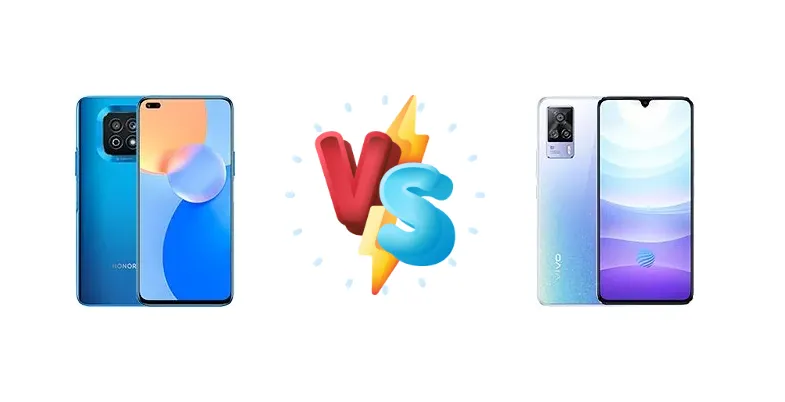
The Honor Play5 Youth and vivo S9e represent compelling options in the increasingly competitive mid-range smartphone market. Both leverage Mediatek's Dimensity series, but with different approaches to processing power and charging technology. This comparison dissects the key differences to help you determine which device best aligns with your needs, particularly focusing on performance for the price and how quickly you can get back to full power.
🏆 Quick Verdict
For the average user prioritizing sustained performance and rapid charging, the Honor Play5 Youth emerges as the stronger contender. Its Dimensity 900 chipset, built on a more efficient 6nm process, coupled with 66W charging, offers a noticeable advantage over the vivo S9e's Dimensity 820 and 33W charging, making it ideal for gamers and power users.
| Network |
|---|
| 2G bands | GSM 850 / 900 / 1800 / 1900 | GSM 850 / 900 / 1800 / 1900 |
| 3G bands | HSDPA 850 / 900 / 2100 | HSDPA 850 / 900 / 1700(AWS) / 2100 |
| 4G bands | 1, 3, 5, 8, 34, 38, 39, 40, 41 | 1, 3, 4, 5, 8, 19, 28, 34, 38, 39, 40, 41 |
| 5G bands | 1, 41, 78 SA/NSA | 1, 28, 41, 77, 78 SA/NSA |
| Speed | HSPA, LTE, 5G | HSPA, LTE, 5G |
| Technology | GSM / CDMA / HSPA / CDMA2000 / LTE / 5G | GSM / CDMA / HSPA / CDMA2000 / LTE / 5G |
| | CDMA2000 1x | CDMA2000 1x |
| Launch |
|---|
| Announced | 2021, October 25 | 2021, March 03 |
| Status | Available. Released 2021, November 02 | Available. Released 2021, March 27 |
| Body |
|---|
| Dimensions | 161.8 x 74.7 x 8.5 mm (6.37 x 2.94 x 0.33 in) | 159.3 x 74.3 x 7.3 mm / 7.4 mm |
| SIM | Nano-SIM + Nano-SIM | Nano-SIM + Nano-SIM |
| Weight | 192 g (6.77 oz) | 168.8 / 171.5 g (5.96 oz) |
| Display |
|---|
| Resolution | 1080 x 2376 pixels (~391 ppi density) | 1080 x 2404 pixels, 20:9 ratio (~409 ppi density) |
| Size | 6.67 inches, 108.1 cm2 (~89.5% screen-to-body ratio) | 6.44 inches, 100.0 cm2 (~84.5% screen-to-body ratio) |
| Type | IPS LCD, 120Hz | AMOLED, 90Hz, HDR10+ |
| Platform |
|---|
| CPU | Octa-core (2x2.4 GHz Cortex-A78 & 6x2.0 GHz Cortex-A55) | Octa-core (4x2.6 GHz Cortex-A76 & 4x2.0 GHz Cortex-A55) |
| Chipset | Mediatek Dimensity 900 (6 nm) | Mediatek Dimensity 820 (7 nm) |
| GPU | Mali-G68 MC4 | Mali-G57 MC5 |
| OS | Android 11, Magic UI 4.2 | Android 11, OriginOS 1.0 |
| Memory |
|---|
| Card slot | No | No |
| Internal | 128GB 8GB RAM, 256GB 8GB RAM | 128GB 8GB RAM, 256GB 8GB RAM |
| | - | UFS 2.1 |
| Main Camera |
|---|
| Dual | 64 MP, f/1.9, 26mm (wide), PDAF
Auxiliary lens | - |
| Features | LED flash, HDR, panorama | Dual-LED dual-tone flash, HDR, panorama |
| Single | 16 MP, f/2.0, (wide) | 32 MP, f/2.0, (wide), 1/2.8", 0.8µm |
| Triple | - | 64 MP, f/1.8, 26mm (wide), 1/1.72", 0.8µm, PDAF, OIS
8 MP, f/2.2, 120˚, 16mm (ultrawide), 1/4.0", 1.12µm
Auxiliary lens |
| Video | 4K@30fps, 1080p@30fps, gyro-EIS | 4K@30fps, 1080p@30fps, gyro-EIS |
| Selfie camera |
|---|
| Features | - | HDR |
| Single | 16 MP, f/2.0, (wide) | 32 MP, f/2.0, (wide), 1/2.8", 0.8µm |
| Video | 1080p@30fps | 1080p@30fps |
| Sound |
|---|
| 3.5mm jack | Yes | No |
| 35mm jack | Yes | No |
| Loudspeaker | Yes | Yes |
| Comms |
|---|
| Bluetooth | 5.1, A2DP, LE | 5.1, A2DP, LE, aptX |
| NFC | No | No |
| Positioning | GPS, GLONASS, BDS | GPS, GLONASS, GALILEO, BDS |
| Radio | No | No |
| USB | USB Type-C 2.0, OTG | USB Type-C, OTG |
| WLAN | Wi-Fi 802.11 a/b/g/n/ac, dual-band, Wi-Fi Direct | Wi-Fi 802.11 a/b/g/n/ac, dual-band, Wi-Fi Direct |
| Features |
|---|
| Sensors | Fingerprint (side-mounted), accelerometer, gyro, proximity, compass | Fingerprint (under display, optical), accelerometer, gyro, proximity, compass |
| Battery |
|---|
| Charging | 66W wired, 50% in 15 min, 100% in 40 min | 33W wired |
| Type | Li-Po 4300 mAh | 4100 mAh |
| Misc |
|---|
| Colors | Black, Blue | Black, White, Starry Blue |
| Models | NEW-AN90 | V2048A |
| Price | About 240 EUR | About 310 EUR |
Honor Play5 Youth
- Faster 66W charging significantly reduces downtime.
- More efficient Dimensity 900 (6nm) chipset for better thermal management.
- Potentially better CPU performance with Cortex-A78 cores.
- Software experience may not be as refined as vivo’s Funtouch OS.
- Display specifications are unknown, potentially lagging behind competitors.
vivo S9e
- Potentially more polished software experience with Funtouch OS.
- Slightly higher CPU clock speeds on the primary cores.
- May have a more aesthetically pleasing design.
- Slower 33W charging.
- Less efficient Dimensity 820 (7nm) chipset may lead to more throttling.
Display Comparison
Neither device’s display specifications are provided, so a direct comparison is limited. However, considering the market segment, both likely feature LCD panels with 60Hz refresh rates. The vivo S9e, given vivo’s design focus, may have slightly slimmer bezels. Without specific data on brightness or color accuracy, it’s difficult to declare a clear winner; however, the S9e’s brand positioning suggests a greater emphasis on aesthetic appeal, potentially translating to a more visually refined display.
Camera Comparison
Without detailed camera specifications, a comprehensive comparison is impossible. However, both phones likely feature a multi-camera setup geared towards social media sharing. Given the price point, expect a primary sensor around 48MP-64MP on both devices. The Dimensity 900’s ISP (Image Signal Processor) may offer slightly improved image processing capabilities, but the real-world difference will depend heavily on software tuning. The absence of information regarding OIS (Optical Image Stabilization) suggests neither phone prioritizes low-light photography.
Performance
The Honor Play5 Youth’s Mediatek Dimensity 900 (6nm) and the vivo S9e’s Dimensity 820 (7nm) represent a key difference. While the Dimensity 820 boasts a slightly higher peak clock speed for its Cortex-A76 cores (2.6 GHz vs 2.4 GHz), the Dimensity 900’s more advanced 6nm fabrication process provides superior power efficiency. This translates to better thermal management under sustained load, reducing the likelihood of performance throttling during extended gaming sessions. The Play5 Youth’s Cortex-A78 cores also offer a performance uplift over the S9e’s A76 cores. This benefits users engaged in CPU-intensive tasks like video editing or multitasking.
Battery Life
The Honor Play5 Youth’s 66W wired charging is a significant advantage over the vivo S9e’s 33W charging. Honor claims a 50% charge in 15 minutes and 100% in 40 minutes, drastically reducing downtime. While battery capacity isn’t specified for either device, the Dimensity 900’s 6nm efficiency should contribute to better battery life despite potentially having a similar capacity to the S9e. The faster charging speed of the Play5 Youth is particularly beneficial for users who frequently find themselves needing a quick power boost.
Buying Guide
Buy the Honor Play5 Youth if you need a phone that can handle demanding tasks like gaming and video editing without significant throttling, and if minimizing charging downtime is a priority. Its faster processor and charging capabilities cater to users who actively push their devices. Buy the vivo S9e if you prioritize a potentially more refined software experience (based on vivo’s historical software polish) and are less concerned with maximizing raw performance or charging speed. It’s a solid all-rounder for everyday tasks.
Frequently Asked Questions
❓ Will the Honor Play5 Youth get noticeably warmer than the vivo S9e during prolonged gaming sessions?
Yes, the vivo S9e is more likely to experience thermal throttling during extended gaming. The Dimensity 820’s 7nm process generates more heat than the Honor Play5 Youth’s Dimensity 900 (6nm), and without advanced cooling solutions, the S9e will likely reduce performance to manage temperatures.
❓ How much faster is the 66W charging on the Honor Play5 Youth compared to the 33W charging on the vivo S9e in real-world use?
The Honor Play5 Youth’s 66W charging can add a significant amount of battery life in a short period. While the S9e will take over an hour to fully charge, the Play5 Youth can reach 100% in approximately 40 minutes, offering a substantial time saving for users who need a quick top-up.
❓ Does the Dimensity 900 in the Honor Play5 Youth support higher frame rates in demanding games like PUBG Mobile compared to the Dimensity 820 in the vivo S9e?
The Dimensity 900’s improved GPU and thermal efficiency *may* allow for slightly more consistent frame rates in demanding games like PUBG Mobile, especially at higher graphics settings. However, the actual performance will also depend on the game’s optimization and the phone’s software.