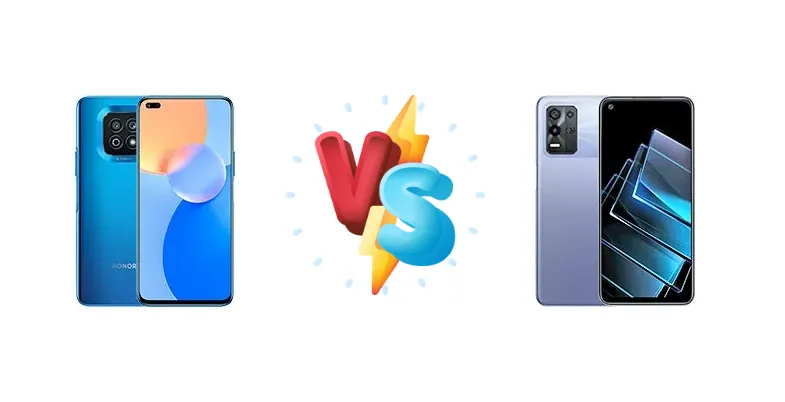
The Honor Play5 Youth and Oppo K9x represent compelling options in the increasingly competitive sub-$250 smartphone market. Both leverage Mediatek's Dimensity series, but with key differences in chipset and charging technology. This comparison dissects those differences to determine which phone delivers the best experience for your needs.
🏆 Quick Verdict
For users prioritizing raw performance and faster charging, the Honor Play5 Youth emerges as the stronger choice. Its Dimensity 900 chipset, featuring Cortex-A78 cores, offers a noticeable edge over the K9x’s Dimensity 810, and the 66W charging significantly reduces downtime. However, the K9x offers reverse wired charging, a feature absent on the Honor.
| Network |
|---|
| 2G bands | GSM 850 / 900 / 1800 / 1900 | GSM 850 / 900 / 1800 / 1900 |
| 3G bands | HSDPA 850 / 900 / 2100 | HSDPA 800 / 850 / 900 / 1700(AWS) / 1900 / 2100 |
| 4G bands | 1, 3, 5, 8, 34, 38, 39, 40, 41 | 1, 2, 3, 5, 7, 8, 28, 34, 38, 39, 40, 41 |
| 5G bands | 1, 41, 78 SA/NSA | 1, 28, 41, 77, 78 SA/NSA |
| Speed | HSPA, LTE, 5G | HSPA, LTE, 5G |
| Technology | GSM / CDMA / HSPA / CDMA2000 / LTE / 5G | GSM / CDMA / HSPA / CDMA2000 / LTE / 5G |
| | CDMA2000 1x | CDMA2000 1x |
| Launch |
|---|
| Announced | 2021, October 25 | 2021, December 23 |
| Status | Available. Released 2021, November 02 | Available. Released 2021, December 27 |
| Body |
|---|
| Dimensions | 161.8 x 74.7 x 8.5 mm (6.37 x 2.94 x 0.33 in) | 162.2 x 74.8 x 8.8 mm (6.39 x 2.94 x 0.35 in) |
| SIM | Nano-SIM + Nano-SIM | Nano-SIM + Nano-SIM |
| Weight | 192 g (6.77 oz) | 194 g (6.84 oz) |
| Display |
|---|
| Protection | - | Aluminosilicate glass |
| Resolution | 1080 x 2376 pixels (~391 ppi density) | 1080 x 2400 pixels, 20:9 ratio (~405 ppi density) |
| Size | 6.67 inches, 108.1 cm2 (~89.5% screen-to-body ratio) | 6.49 inches, 102.2 cm2 (~84.2% screen-to-body ratio) |
| Type | IPS LCD, 120Hz | IPS LCD, 90Hz, 480 nits (typ), 600 nits (HBM) |
| Platform |
|---|
| CPU | Octa-core (2x2.4 GHz Cortex-A78 & 6x2.0 GHz Cortex-A55) | Octa-core (2x2.4 GHz Cortex-A76 & 6x2.0 GHz Cortex-A55) |
| Chipset | Mediatek Dimensity 900 (6 nm) | Mediatek Dimensity 810 (6 nm) |
| GPU | Mali-G68 MC4 | Mali-G57 MC2 |
| OS | Android 11, Magic UI 4.2 | Android 11, ColorOS 11.1 |
| Memory |
|---|
| Card slot | No | microSDXC |
| Internal | 128GB 8GB RAM, 256GB 8GB RAM | 128GB 6GB RAM, 128GB 8GB RAM, 256GB 8GB RAM, 256GB 12GB RAM, 512GB 12GB RAM |
| | - | UFS 2.2 |
| Main Camera |
|---|
| Dual | 64 MP, f/1.9, 26mm (wide), PDAF
Auxiliary lens | - |
| Features | LED flash, HDR, panorama | LED flash, HDR, panorama |
| Single | 16 MP, f/2.0, (wide) | 16 MP, f/2.0, 26mm (wide), 1/3.0”, 1.0µm |
| Triple | - | 64 MP, f/1.7, 26mm (wide), 1/1.97”, 0.7µm, PDAF
2 MP (macro)
Auxiliary lens |
| Video | 4K@30fps, 1080p@30fps, gyro-EIS | 1080p@30fps, gyro-EIS |
| Selfie camera |
|---|
| Single | 16 MP, f/2.0, (wide) | 16 MP, f/2.0, 26mm (wide), 1/3.0”, 1.0µm |
| Video | 1080p@30fps | 1080p@30fps |
| Sound |
|---|
| 3.5mm jack | Yes | Yes |
| 35mm jack | Yes | Yes |
| Loudspeaker | Yes | Yes |
| Comms |
|---|
| Bluetooth | 5.1, A2DP, LE | 5.1, A2DP, LE, aptX |
| NFC | No | No |
| Positioning | GPS, GLONASS, BDS | GPS, GLONASS, GALILEO, BDS |
| Radio | No | No |
| USB | USB Type-C 2.0, OTG | USB Type-C 2.0, OTG |
| WLAN | Wi-Fi 802.11 a/b/g/n/ac, dual-band, Wi-Fi Direct | Wi-Fi 802.11 a/b/g/n/ac, dual-band, Wi-Fi Direct |
| Features |
|---|
| Sensors | Fingerprint (side-mounted), accelerometer, gyro, proximity, compass | Fingerprint (side-mounted), accelerometer, gyro, proximity, compass |
| Battery |
|---|
| Charging | 66W wired, 50% in 15 min, 100% in 40 min | 33W wired, 50% in 27 min
Reverse wired |
| Type | Li-Po 4300 mAh | Li-Po 5000 mAh |
| Misc |
|---|
| Colors | Black, Blue | Black, Blue |
| Models | NEW-AN90 | PGCM10 |
| Price | About 240 EUR | About 190 EUR |
Honor Play5 Youth
- Faster 66W charging significantly reduces downtime.
- Dimensity 900 chipset offers a performance edge.
- Potentially better multi-core performance due to Cortex-A78 cores.
- Lacks reverse wired charging functionality.
- Camera performance is unknown without detailed specs.
Oppo K9x
- Includes reverse wired charging for accessory top-ups.
- Potentially better sustained performance due to lower peak temperatures.
- Competitive price point.
- Slower 33W charging.
- Dimensity 810 chipset is less powerful than the Dimensity 900.
Display Comparison
Neither device's display specifications are provided, so a direct comparison is limited. However, given their price points, both likely utilize LCD panels with 60Hz refresh rates. The user experience will likely hinge on color calibration and peak brightness, areas where brand-specific tuning plays a significant role. Expect both to offer adequate, but not exceptional, viewing experiences.
Camera Comparison
Without detailed camera specifications, a comprehensive comparison is impossible. However, it’s reasonable to assume both phones feature a primary camera, an ultrawide, and potentially a depth or macro sensor. The image processing algorithms employed by Honor and Oppo will be crucial differentiators. Expect Oppo to lean towards vibrant, social media-ready images, while Honor might aim for a more natural look. Sensor size and aperture are key factors; a larger sensor with a wider aperture will perform better in low-light conditions. The absence of OIS on either device suggests reliance on software stabilization.
Performance
The core difference lies in the chipsets. The Honor Play5 Youth’s Mediatek Dimensity 900 utilizes two Cortex-A78 cores clocked at 2.4 GHz, alongside six Cortex-A55 cores. The Oppo K9x features the Dimensity 810, employing two Cortex-A76 cores at the same 2.4 GHz speed, and six Cortex-A55 cores. While both are 6nm chips, the A78 architecture generally offers a slight performance advantage over the A76, particularly in multi-core tasks. This translates to snappier app loading and smoother multitasking on the Honor. The K9x will still be capable, but the Play5 Youth has a theoretical edge. Both devices will likely pair this with 6GB or 8GB of RAM, impacting multitasking capabilities.
Battery Life
The Honor Play5 Youth’s 66W wired charging is a significant advantage, achieving 50% charge in just 15 minutes and a full charge in 40 minutes. The Oppo K9x’s 33W charging takes considerably longer, reaching 50% in 27 minutes. While battery capacity isn’t specified, the faster charging of the Honor Play5 Youth mitigates any potential disadvantage from a slightly smaller battery. The K9x’s inclusion of reverse wired charging is a unique feature, allowing it to function as a power bank for other devices, a benefit the Honor lacks.
Buying Guide
Buy the Honor Play5 Youth if you need a phone capable of handling demanding games and applications with greater fluidity, and if minimizing charging time is a priority. Buy the Oppo K9x if you value the convenience of reverse wired charging – allowing you to top up accessories – and prefer a slightly more conservative power profile that might translate to marginally better sustained performance under heavy load due to potentially lower peak temperatures.
Frequently Asked Questions
❓ Will the Honor Play5 Youth overheat during prolonged gaming sessions?
The Dimensity 900 is a 6nm chip, offering good thermal efficiency. However, sustained peak performance can generate heat. The Honor Play5 Youth’s thermal management system will be crucial. While it’s unlikely to overheat to the point of shutdown, some throttling may occur during extended gaming, potentially impacting frame rates over time.
❓ Is the reverse wired charging on the Oppo K9x useful for more than just phones?
Yes, the Oppo K9x’s reverse wired charging can be used to charge a variety of USB-C powered devices, including wireless earbuds, smartwatches, and even other smartphones. While the charging speed won’t be as fast as a dedicated charger, it’s a convenient feature for emergencies or when a wall outlet isn’t available.
❓ How much faster is the 66W charging on the Honor Play5 Youth compared to the 33W on the Oppo K9x in real-world use?
The difference is substantial. The Honor Play5 Youth can gain a significant charge during a short break – enough for several hours of use in just 15-20 minutes. The Oppo K9x requires considerably longer to achieve the same level of charge, making it less ideal for users who frequently need to top up their battery quickly.