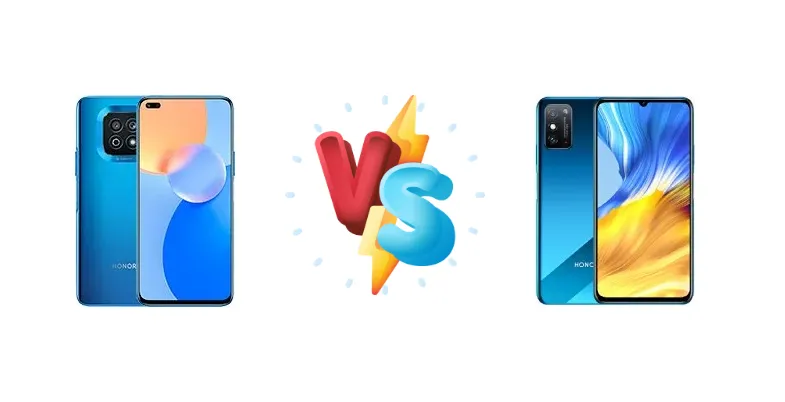
Honor's Play5 Youth and X10 Max 5G represent different approaches to the mid-range 5G market. The X10 Max 5G, released earlier, prioritized a large display and a more established design. The Play5 Youth, a later entrant, focuses on a more modern chipset and significantly faster charging, creating a compelling trade-off for performance-conscious buyers.
🏆 Quick Verdict
For most users, the Honor Play5 Youth is the better choice. Its Mediatek Dimensity 900 chipset, built on a 6nm process, offers a performance advantage over the X10 Max 5G’s Dimensity 800 (7nm), coupled with a dramatically faster 66W charging solution. While the X10 Max 5G offers a larger screen, the Play5 Youth’s efficiency and speed are more valuable.
| Network |
|---|
| 2G bands | GSM 850 / 900 / 1800 / 1900 | GSM 850 / 900 / 1800 / 1900 |
| 3G bands | HSDPA 850 / 900 / 2100 | HSDPA 800 / 850 / 900 / 1700(AWS) / 1900 / 2100 |
| 4G bands | 1, 3, 5, 8, 34, 38, 39, 40, 41 | 1, 2, 3, 4, 5, 8, 18, 19, 26, 34, 38, 39, 40, 41 |
| 5G bands | 1, 41, 78 SA/NSA | 1, 3, 38, 41, 77, 78, 79, 80, 84 SA/NSA |
| Speed | HSPA, LTE, 5G | HSPA, LTE, 5G |
| Technology | GSM / CDMA / HSPA / CDMA2000 / LTE / 5G | GSM / HSPA / LTE / 5G |
| | CDMA2000 1x | - |
| Launch |
|---|
| Announced | 2021, October 25 | 2020, July 02. Released 2020, July 03 |
| Status | Available. Released 2021, November 02 | Discontinued |
| Body |
|---|
| Dimensions | 161.8 x 74.7 x 8.5 mm (6.37 x 2.94 x 0.33 in) | 174.4 x 84.9 x 8.3 mm (6.87 x 3.34 x 0.33 in) |
| SIM | Nano-SIM + Nano-SIM | Nano-SIM + Nano-SIM |
| Weight | 192 g (6.77 oz) | 232 g (8.18 oz) |
| Display |
|---|
| Resolution | 1080 x 2376 pixels (~391 ppi density) | 1080 x 2280 pixels, 19:9 ratio (~356 ppi density) |
| Size | 6.67 inches, 108.1 cm2 (~89.5% screen-to-body ratio) | 7.09 inches, 125.5 cm2 (~84.7% screen-to-body ratio) |
| Type | IPS LCD, 120Hz | IPS LCD, HDR10 |
| Platform |
|---|
| CPU | Octa-core (2x2.4 GHz Cortex-A78 & 6x2.0 GHz Cortex-A55) | Octa-core (4x2.0 GHz Cortex-A76 & 4x2.0 GHz Cortex-A55) |
| Chipset | Mediatek Dimensity 900 (6 nm) | Mediatek Dimensity 800 (7 nm) |
| GPU | Mali-G68 MC4 | Mali-G57MP4 |
| OS | Android 11, Magic UI 4.2 | Android 10, Magic UI 3.1, no Google Play Services |
| Memory |
|---|
| Card slot | No | Nano Memory (uses shared SIM slot) |
| Internal | 128GB 8GB RAM, 256GB 8GB RAM | 64GB 6GB RAM, 128GB 6GB RAM, 128GB 8GB RAM |
| Main Camera |
|---|
| Dual | 64 MP, f/1.9, 26mm (wide), PDAF
Auxiliary lens | 48 MP, f/1.8, 26mm (wide), 1/2.0", 0.8µm, PDAF
Auxiliary lens |
| Features | LED flash, HDR, panorama | LED flash, panorama, HDR |
| Single | 16 MP, f/2.0, (wide) | - |
| Video | 4K@30fps, 1080p@30fps, gyro-EIS | 4K@30fps, 1080p@30fps, gyro-EIS |
| Selfie camera |
|---|
| Features | - | HDR |
| Single | 16 MP, f/2.0, (wide) | 8 MP |
| Video | 1080p@30fps | 1080p@30fps |
| Sound |
|---|
| 3.5mm jack | Yes | Yes |
| 35mm jack | Yes | Yes |
| Loudspeaker | Yes | Yes, with dual speakers |
| Comms |
|---|
| Bluetooth | 5.1, A2DP, LE | 5.1, A2DP, LE |
| NFC | No | Yes |
| Positioning | GPS, GLONASS, BDS | GPS, GLONASS, BDS |
| Radio | No | No |
| USB | USB Type-C 2.0, OTG | USB Type-C 2.0, OTG |
| WLAN | Wi-Fi 802.11 a/b/g/n/ac, dual-band, Wi-Fi Direct | Wi-Fi 802.11 a/b/g/n/ac, dual-band, Wi-Fi Direct |
| Features |
|---|
| Sensors | Fingerprint (side-mounted), accelerometer, gyro, proximity, compass | Fingerprint (side-mounted), accelerometer, gyro, proximity, compass |
| Battery |
|---|
| Charging | 66W wired, 50% in 15 min, 100% in 40 min | 22.5W wired |
| Type | Li-Po 4300 mAh | Li-Po 5000 mAh |
| Misc |
|---|
| Colors | Black, Blue | Black, Blue, Silver |
| Models | NEW-AN90 | KKG-AN00 |
| Price | About 240 EUR | About 240 EUR |
Honor Play5 Youth
- Faster charging (66W)
- More efficient chipset (Dimensity 900, 6nm)
- Superior CPU performance (Cortex-A78 cores)
- Potentially smaller display
- Unknown battery capacity
Honor X10 Max 5G
- Larger display size
- Potentially larger battery capacity
- More established design
- Slower charging (22.5W)
- Less efficient chipset (Dimensity 800, 7nm)
- Inferior CPU performance (Cortex-A76 cores)
Display Comparison
While specific display specs (resolution, panel type) are missing, the Honor X10 Max 5G’s key feature is its large size. The Play5 Youth likely features a more standard display size. The Dimensity 900’s improved ISP *could* translate to better image processing for photos taken on either device’s front-facing camera, assuming both have similar sensors. The X10 Max 5G’s larger screen will be preferable for video watching, but the Play5 Youth’s newer chipset may offer smoother scrolling and app loading.
Camera Comparison
Without detailed camera specifications, it’s difficult to make a definitive comparison. However, the Dimensity 900’s improved image signal processor (ISP) offers advantages in image processing speed and quality. Both phones likely feature multi-camera setups, but the Play5 Youth’s ISP could deliver better dynamic range and noise reduction. The X10 Max 5G may benefit from a larger sensor size due to its larger overall form factor, but this is speculative without concrete data.
Performance
The Mediatek Dimensity 900 in the Play5 Youth represents a significant step up from the Dimensity 800 in the X10 Max 5G. The 6nm process node of the Dimensity 900 is more efficient, leading to better thermal management and sustained performance. The Play5 Youth’s CPU configuration (2x2.4 GHz Cortex-A78 & 6x2.0 GHz Cortex-A55) offers a higher peak clock speed on its prime cores compared to the X10 Max 5G’s (4x2.0 GHz Cortex-A76 & 4x2.0 GHz Cortex-A55). This translates to faster single-core performance, beneficial for everyday tasks and less demanding games. The Cortex-A78 cores in the Play5 Youth are also architecturally superior to the A76 cores in the X10 Max 5G, providing improved IPC (Instructions Per Clock).
Battery Life
The Honor Play5 Youth’s 66W wired charging is a game-changer. Honor claims 50% charge in 15 minutes and 100% in 40 minutes, significantly faster than the X10 Max 5G’s 22.5W charging. While battery capacity isn’t specified, the Dimensity 900’s 6nm process contributes to better power efficiency, potentially offsetting a smaller battery size. The X10 Max 5G will likely require considerably longer to fully charge, making the Play5 Youth the clear winner for users who prioritize quick top-ups.
Buying Guide
Buy the Honor Play5 Youth if you prioritize performance, faster charging, and a more modern chipset for demanding tasks like gaming and multitasking. Buy the Honor X10 Max 5G if you specifically need a larger display and are less concerned with raw processing power or charging speed. The X10 Max 5G is a better fit for media consumption focused users.
Frequently Asked Questions
❓ Will the Dimensity 900 in the Play5 Youth handle demanding games like PUBG Mobile at high settings?
Yes, the Dimensity 900 is capable of running PUBG Mobile at high settings with smooth frame rates. The Cortex-A78 cores and improved GPU performance provide sufficient power for a good gaming experience. The 6nm process also helps to minimize thermal throttling during extended gaming sessions.
❓ How much faster is the 66W charging on the Play5 Youth compared to the 22.5W charging on the X10 Max 5G in real-world use?
The 66W charging on the Play5 Youth is significantly faster. Honor claims a full charge in 40 minutes, while the X10 Max 5G will likely take well over 90 minutes to reach 100%. This means you can quickly top up the Play5 Youth during short breaks, whereas the X10 Max 5G requires a longer charging period.
❓ Does the Honor Play5 Youth support 5G carrier aggregation, and will this improve my 5G speeds?
While specific carrier aggregation support isn't detailed, the Dimensity 900 *does* support 5G carrier aggregation. This allows the phone to combine multiple 5G channels for faster and more stable data speeds, provided your carrier supports it. This is a key benefit for users in areas with strong 5G coverage.