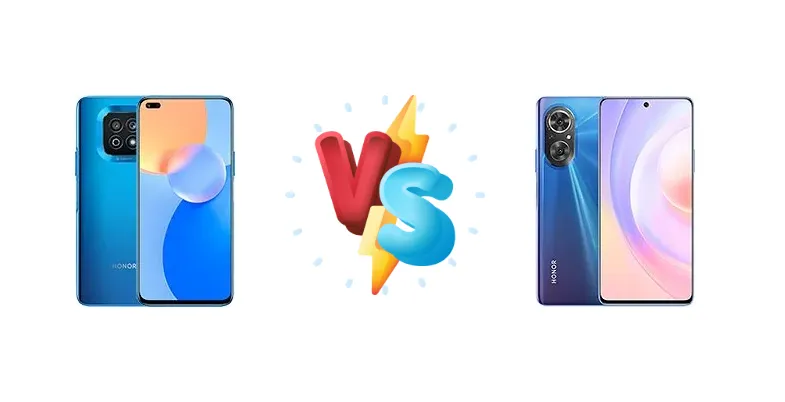
Honor's Play5 Youth and 50 SE both target the competitive mid-range market, powered by the same Mediatek Dimensity 900 chipset. This comparison dives deep into the nuances between these two devices, focusing on where their similarities end and their differences matter most, particularly concerning charging speed and overall user experience.
🏆 Quick Verdict
For most users, the Honor 50 SE emerges as the slightly better choice. While both phones share the same Dimensity 900 processor, the 50 SE’s significantly faster charging – reaching 75% in just 20 minutes – provides a tangible benefit for those prioritizing convenience and minimizing downtime. The Play5 Youth remains a solid option, but the charging advantage tips the scales.
| Network |
|---|
| 2G bands | GSM 850 / 900 / 1800 / 1900 | GSM 850 / 900 / 1800 / 1900 |
| 3G bands | HSDPA 850 / 900 / 2100 | HSDPA 800 / 850 / 900 / 1700(AWS) / 1900 / 2100 |
| 4G bands | 1, 3, 5, 8, 34, 38, 39, 40, 41 | 1, 2, 3, 4, 5, 8, 18, 19, 26, 34, 38, 39, 40, 41 |
| 5G bands | 1, 41, 78 SA/NSA | 1, 41, 77, 78 SA/NSA |
| Speed | HSPA, LTE, 5G | HSPA, LTE, 5G |
| Technology | GSM / CDMA / HSPA / CDMA2000 / LTE / 5G | GSM / CDMA / HSPA / CDMA2000 / LTE / 5G |
| | CDMA2000 1x | CDMA2000 1x |
| Launch |
|---|
| Announced | 2021, October 25 | 2021, June 16 |
| Status | Available. Released 2021, November 02 | Available. Released 2021, July 02 |
| Body |
|---|
| Dimensions | 161.8 x 74.7 x 8.5 mm (6.37 x 2.94 x 0.33 in) | 164.7 x 75.6 x 8 mm (6.48 x 2.98 x 0.31 in) |
| SIM | Nano-SIM + Nano-SIM | Nano-SIM + Nano-SIM |
| Weight | 192 g (6.77 oz) | 191 g (6.74 oz) |
| Display |
|---|
| Resolution | 1080 x 2376 pixels (~391 ppi density) | 1080 x 2388 pixels (~387 ppi density) |
| Size | 6.67 inches, 108.1 cm2 (~89.5% screen-to-body ratio) | 6.78 inches, 111.4 cm2 (~89.4% screen-to-body ratio) |
| Type | IPS LCD, 120Hz | IPS LCD, 120Hz |
| Platform |
|---|
| CPU | Octa-core (2x2.4 GHz Cortex-A78 & 6x2.0 GHz Cortex-A55) | Octa-core (2x2.4 GHz Cortex-A78 & 6x2.0 GHz Cortex-A55) |
| Chipset | Mediatek Dimensity 900 (6 nm) | Mediatek Dimensity 900 (6 nm) |
| GPU | Mali-G68 MC4 | Mali-G78 MC4 |
| OS | Android 11, Magic UI 4.2 | Android 11, Magic UI 4.2 |
| Memory |
|---|
| Card slot | No | No |
| Internal | 128GB 8GB RAM, 256GB 8GB RAM | 128GB 8GB RAM, 256GB 8GB RAM, 256GB 12GB RAM |
| Main Camera |
|---|
| Dual | 64 MP, f/1.9, 26mm (wide), PDAF
Auxiliary lens | - |
| Features | LED flash, HDR, panorama | LED flash, HDR, panorama |
| Single | 16 MP, f/2.0, (wide) | 16 MP, f/2.2, (wide) |
| Triple | - | 108 MP, f/1.9, (wide), 1/1.52", 0.7µm, PDAF
8 MP, f/2.2, 120˚, 17mm (ultrawide)
2 MP (macro) |
| Video | 4K@30fps, 1080p@30fps, gyro-EIS | 4K@30fps, 1080p@30/60fps, gyro-EIS |
| Selfie camera |
|---|
| Single | 16 MP, f/2.0, (wide) | 16 MP, f/2.2, (wide) |
| Video | 1080p@30fps | 1080p@30fps |
| Sound |
|---|
| 3.5mm jack | Yes | No |
| 35mm jack | Yes | No |
| Loudspeaker | Yes | Yes |
| Comms |
|---|
| Bluetooth | 5.1, A2DP, LE | 5.1, A2DP, LE |
| NFC | No | No |
| Positioning | GPS, GLONASS, BDS | GPS, GLONASS, BDS |
| Radio | No | No |
| USB | USB Type-C 2.0, OTG | USB Type-C 2.0, OTG |
| WLAN | Wi-Fi 802.11 a/b/g/n/ac, dual-band, Wi-Fi Direct | Wi-Fi 802.11 a/b/g/n/ac/6, dual-band, Wi-Fi Direct |
| Features |
|---|
| Sensors | Fingerprint (side-mounted), accelerometer, gyro, proximity, compass | Fingerprint (side-mounted), accelerometer, gyro, compass |
| | - | Virtual proximity sensing |
| Battery |
|---|
| Charging | 66W wired, 50% in 15 min, 100% in 40 min | 66W wired, 75% in 20 min |
| Type | Li-Po 4300 mAh | Li-Po 4000 mAh |
| Misc |
|---|
| Colors | Black, Blue | Black, Blue, Silver |
| Models | NEW-AN90 | JLH-AN00 |
| Price | About 240 EUR | About 310 EUR |
Honor Play5 Youth
- Potentially lower price point
- Reliable Mediatek Dimensity 900 performance
- 66W wired charging
- Slower charging speed compared to the 50 SE
- Likely standard LCD display
Honor 50 SE
- Significantly faster charging (75% in 20 mins)
- Reliable Mediatek Dimensity 900 performance
- 66W wired charging
- Potentially higher price point
- Likely standard LCD display
Display Comparison
Both the Honor Play5 Youth and 50 SE likely feature LCD panels, typical for this price bracket. Specific details like resolution and refresh rate are missing, but the focus here isn't display quality. The absence of LTPO technology means neither phone will offer adaptive refresh rates for power saving. Bezels are expected to be similar, prioritizing cost-effectiveness over ultra-slim designs. Color accuracy will likely be standard for the segment, leaning towards vibrant rather than color-accurate.
Camera Comparison
Camera details are sparse, but both phones likely feature a multi-camera setup. The primary sensor's quality will be the most significant differentiator. Without specific megapixel counts or sensor sizes, it's difficult to declare a clear winner. The inclusion of a 2MP macro camera on either device is largely a marketing tactic, offering limited practical benefit due to its low resolution and fixed focus. Image processing will likely prioritize vibrant colors and boosted contrast, common in this price range. OIS (Optical Image Stabilization) is unlikely on either model.
Performance
The core of both devices is the Mediatek Dimensity 900 (6nm). This chipset features an octa-core configuration with 2x2.4 GHz Cortex-A78 cores and 6x2.0 GHz Cortex-A55 cores, delivering comparable CPU performance. The 6nm process node ensures reasonable thermal efficiency, though sustained loads will still generate heat. RAM configuration is a key factor not specified, but LPDDR4X is probable in both, limiting bandwidth compared to LPDDR5. Real-world performance will be similar for most tasks, including social media, browsing, and moderate gaming.
Battery Life
The battery capacity isn't specified for either device, but both are expected to house batteries in the 4000-5000 mAh range. The key difference lies in charging speed. The Honor 50 SE boasts a significantly faster charging profile, reaching 75% charge in just 20 minutes with its 66W wired charging. The Play5 Youth, also with 66W charging, takes 40 minutes to reach 100%. This 55% difference in charging time to 75% is substantial, making the 50 SE more convenient for users who need a quick power boost.
Buying Guide
Buy the Honor Play5 Youth if you prioritize a potentially lower price point and are comfortable with a slightly slower charging experience. It's a good all-rounder for everyday tasks. Buy the Honor 50 SE if you value faster charging above all else, especially if you frequently find yourself needing to top up your battery quickly. It’s ideal for users with active lifestyles and limited charging windows.
Frequently Asked Questions
❓ Is the 66W charging on both phones compatible with Power Delivery (PD) chargers?
While both phones support 66W charging, it's unlikely they fully support the Power Delivery standard. Honor typically uses its own proprietary fast-charging protocol, meaning you'll get the fastest charging speeds with the included charger. Using a standard PD charger will still work, but at a slower rate.
❓ Will the Dimensity 900 handle demanding games like PUBG Mobile or Call of Duty Mobile smoothly?
The Dimensity 900 is capable of running PUBG Mobile and Call of Duty Mobile, but you'll likely need to lower the graphics settings to achieve consistently smooth frame rates. Expect playable performance at medium settings. Sustained gaming may lead to some thermal throttling, reducing performance over longer sessions.
❓ What type of storage does each phone use – UFS 2.1 or UFS 3.1?
Given the price point, both the Honor Play5 Youth and 50 SE likely utilize UFS 2.1 storage. While not as fast as UFS 3.1, UFS 2.1 still provides adequate read/write speeds for everyday tasks and app loading. This impacts app install times and file transfer speeds.