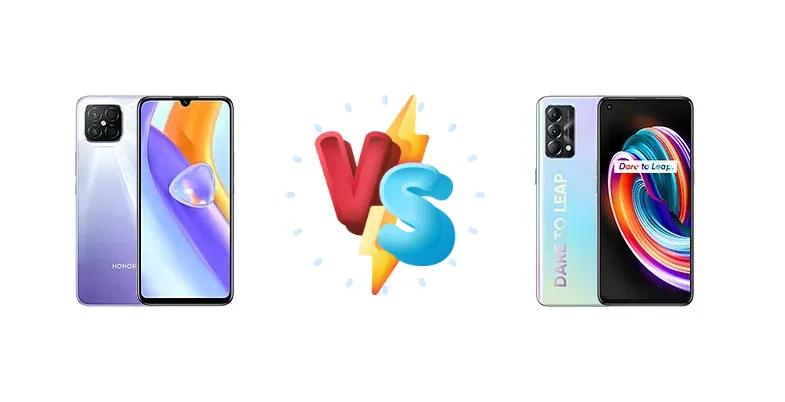
The Honor Play5 5G and Realme Q3 Pro Carnival represent compelling options in the increasingly competitive mid-range 5G smartphone market. Both aim to deliver a balance of performance and affordability, but they achieve this through different approaches to chipset selection and charging technology. This comparison dissects their key specifications to determine which device offers the most compelling package.
🏆 Quick Verdict
For the average user prioritizing raw processing power and slightly faster charging, the Realme Q3 Pro Carnival emerges as the winner. Its Snapdragon 768G chipset provides a noticeable performance edge, particularly in demanding applications. However, the Honor Play5 5G’s 66W charging is a strong counterpoint, making it a viable alternative for those who value rapid top-ups.
| Network |
|---|
| 2G bands | GSM 850 / 900 / 1800 / 1900 | GSM 850 / 900 / 1800 / 1900 |
| 3G bands | HSDPA 850 / 900 / 1700(AWS) / 1900 / 2100 | HSDPA 800 / 850 / 900 / 1700(AWS) / 1900 / 2100 |
| 4G bands | 1, 2, 3, 4, 5, 8, 18, 19, 26, 34, 38, 39, 40, 41 | LTE |
| 5G bands | 1, 28, 41, 77, 78 SA/NSA | SA/NSA |
| Speed | HSPA, LTE, 5G | HSPA, LTE, 5G |
| Technology | GSM / CDMA / HSPA / LTE / 5G | GSM / CDMA / HSPA / CDMA2000 / LTE / 5G |
| | CDMA 800 | CDMA2000 1x |
| Launch |
|---|
| Announced | 2021, May 18 | 2021, May 25 |
| Status | Available. Released 2021, May 26 | Available. Released 2021, June 06 |
| Body |
|---|
| Dimensions | 161.6 x 74.8 x 7.5 mm (6.36 x 2.94 x 0.30 in) | 7.9 mm thickness |
| SIM | Nano-SIM + Nano-SIM | Nano-SIM + Nano-SIM |
| Weight | 179 g (6.31 oz) | 174 g (6.14 oz) |
| Display |
|---|
| Protection | Schott Xensation Up | - |
| Resolution | 1080 x 2400 pixels, 20:9 ratio (~403 ppi density) | 1080 x 2400 pixels, 20:9 ratio (~409 ppi density) |
| Size | 6.53 inches, 102.9 cm2 (~85.2% screen-to-body ratio) | 6.43 inches, 99.8 cm2 |
| Type | OLED, HDR10 | Super AMOLED, 120Hz, 600 nits |
| Platform |
|---|
| CPU | Octa-core (2x2.4 GHz Cortex-A76 & 6x2.0 GHz Cortex-A55) | Octa-core (1x2.8 GHz Kryo 475 Prime & 1x2.4 GHz Kryo 475 Gold & 6x1.8 GHz Kryo 475 Silver) |
| Chipset | Mediatek Dimensity 800U (7 nm) | Qualcomm SM7250-AC Snapdragon 768G 5G (7 nm) |
| GPU | Mali-G57 MC3 | Adreno 620 |
| OS | Android 10, Magic UI 4.0, no Google Play Services | Android 11, Realme UI 2.0 |
| Memory |
|---|
| Card slot | Unspecified | No |
| Internal | 128GB 8GB RAM, 256GB 8GB RAM | 128GB 8GB RAM |
| | - | UFS 3.1 |
| Main Camera |
|---|
| Features | LED flash, HDR, panorama | LED flash, HDR, panorama |
| Quad | 64 MP, f/1.9, 26mm (wide), 1/1.72", 0.8µm, PDAF
8 MP, f/2.4, (ultrawide)
2 MP (macro)
Auxiliary lens | - |
| Single | 16 MP, f/2.0, (wide) | 32 MP, (wide), 1/2.74", 0.8µm |
| Triple | - | 64 MP, f/1.8, 26mm (wide), 1/1.73", 0.8µm, PDAF
8 MP, f/2.3, 16mm, 119˚ (ultrawide), 1/4.0", 1.12µm
2 MP (macro) |
| Video | 4K@30fps, 1080p@30fps, gyro-EIS | 4K@30/60fps, 1080p@30/60fps, gyro-EIS |
| Selfie camera |
|---|
| Features | - | HDR, panorama |
| Single | 16 MP, f/2.0, (wide) | 32 MP, (wide), 1/2.74", 0.8µm |
| Video | 1080p@30fps | 1080p@30fps |
| Sound |
|---|
| 3.5mm jack | No | Yes |
| 35mm jack | No | Yes |
| Loudspeaker | Yes | Yes, with stereo speakers |
| | - | 24-bit/192kHz audio |
| Comms |
|---|
| Bluetooth | 5.1, A2DP, LE | 5.1, A2DP, LE |
| NFC | Yes | No |
| Positioning | GPS, GLONASS, GALILEO, BDS | GPS, GLONASS, GALILEO, BDS, QZSS |
| Radio | No | No |
| USB | USB Type-C 2.0, OTG | USB Type-C 2.0 |
| WLAN | Wi-Fi 802.11 a/b/g/n/ac, dual-band, Wi-Fi Direct | Wi-Fi 802.11 a/b/g/n/ac/6, dual-band, Wi-Fi Direct |
| Features |
|---|
| Sensors | Fingerprint (under display, optical), accelerometer, proximity, compass | Fingerprint (under display, optical), accelerometer, gyro, proximity, compass |
| Battery |
|---|
| Charging | 66W wired, 60% in 15 min, 100% in 35 min | 50W wired, 100% in 45 min |
| Type | Li-Po 3800 mAh | 4500 mAh |
| Misc |
|---|
| Colors | Black, Violet, Light Blue | Black, Aurora |
| Models | HJC-AN90 | RMX3142 |
| Price | About 270 EUR | About 230 EUR |
Honor Play5 5G
- Significantly faster 66W charging
- Competitive performance for everyday tasks
- Likely more efficient power consumption due to Dimensity 800U
- Less powerful CPU and GPU compared to Snapdragon 768G
- Potentially limited gaming performance in demanding titles
Realme Q3 Pro Carnival
- More powerful Snapdragon 768G chipset
- Superior gaming performance
- Potentially wider 5G band support
- Slower 50W charging
- Potentially higher power consumption
Display Comparison
Neither device boasts a standout display. Both likely utilize IPS LCD panels, a common choice in this price bracket. While specific details like peak brightness and color gamut coverage are unavailable, the focus here is on functionality rather than visual fidelity. Bezels are expected to be moderate, prioritizing affordability over an immersive edge-to-edge experience. Color accuracy will likely be adequate for general use, but not geared towards professional content creation.
Camera Comparison
Without detailed camera specs, a direct comparison is difficult. However, both phones likely employ a multi-camera setup geared towards versatility. The Realme Q3 Pro Carnival, given its positioning, may feature a slightly larger main sensor, potentially capturing more detail in well-lit conditions. Image processing will likely differ, with Realme often favoring vibrant, saturated colors, while Honor tends towards a more natural look. The presence of Optical Image Stabilization (OIS) is uncertain for both, but its inclusion would significantly improve low-light performance and video stabilization. The 2MP macro cameras commonly found on phones in this segment offer limited practical benefit.
Performance
The core difference lies in the chipsets. The Realme Q3 Pro Carnival’s Snapdragon 768G (7nm) features a Kryo 475 Prime core clocked at 2.8 GHz, offering a significant advantage in single-core performance compared to the Honor Play5 5G’s Dimensity 800U. The Dimensity 800U, while still a capable 7nm chip, utilizes a more traditional octa-core configuration with a peak clock speed of 2.4 GHz. This translates to snappier app launches and smoother multitasking on the Realme. The Snapdragon 768G’s Adreno 620 GPU also provides a more robust graphics experience, beneficial for gaming. While both support 5G, the Snapdragon’s modem generally offers wider carrier compatibility. The Realme’s CPU architecture (1x2.8 GHz Kryo 475 Prime + 1x2.4 GHz Kryo 475 Gold + 6x1.8 GHz Kryo 475 Silver) is more hierarchical, prioritizing performance on demanding tasks.
Battery Life
The Honor Play5 5G’s 66W wired charging is a clear advantage, achieving a 60% charge in just 15 minutes and a full charge in 35 minutes. The Realme Q3 Pro Carnival’s 50W charging, while respectable, takes 45 minutes to reach 100%. While battery capacity isn’t specified, the faster charging of the Honor Play5 5G mitigates any potential disadvantage from a slightly smaller battery. This makes the Honor a better choice for users who frequently need to top up their phone quickly.
Buying Guide
Buy the Honor Play5 5G if you prioritize extremely fast charging and a consistently smooth user experience for everyday tasks. It’s ideal for users who frequently find themselves needing to quickly replenish their battery. Buy the Realme Q3 Pro Carnival if you’re a gamer or power user who demands more processing horsepower for demanding apps and games, and are willing to trade a bit of charging speed for that performance boost.
Frequently Asked Questions
❓ Will the Snapdragon 768G in the Realme Q3 Pro Carnival handle demanding games like Genshin Impact at high settings?
The Snapdragon 768G is capable of running Genshin Impact, but you'll likely need to compromise on graphics settings to maintain a stable frame rate. Expect playable performance at medium settings, potentially with some occasional frame drops during intense combat. The Dimensity 800U in the Honor Play5 5G will struggle more with this title.
❓ How much faster is the 66W charging on the Honor Play5 5G compared to the 50W charging on the Realme Q3 Pro Carnival in real-world use?
The 66W charging on the Honor Play5 5G provides a substantial time saving. You can expect to gain around 60% battery in just 15 minutes, while the Realme Q3 Pro Carnival will take closer to 30 minutes to achieve the same level. This difference is particularly noticeable for quick top-ups throughout the day.
❓ Does either phone support expandable storage via microSD card?
Information regarding microSD card support is not available in the provided context. However, phones in this price range often include a microSD card slot, but it's not guaranteed. Check the official specifications before purchasing if expandable storage is a priority.