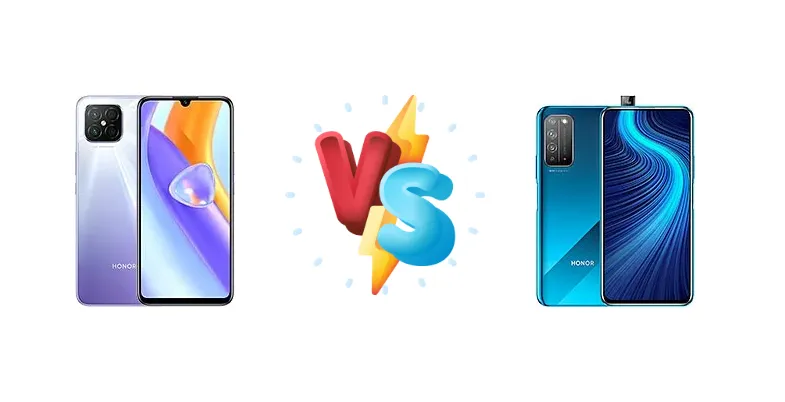
The Honor Play5 5G and X10 5G represent Honor's push into the competitive mid-range 5G market. While both aim to deliver a connected experience, they diverge significantly in their core components, particularly the chipset and charging capabilities. This comparison dissects these differences to determine which device offers the best value for your money.
🏆 Quick Verdict
For the average user prioritizing raw performance and a slightly more refined chipset, the Honor X10 5G emerges as the winner. Its Kirin 820 offers a noticeable advantage in CPU-intensive tasks. However, the Honor Play5 5G’s significantly faster 66W charging is a compelling counterpoint for those who value convenience and minimal downtime.
| Network |
|---|
| 2G bands | GSM 850 / 900 / 1800 / 1900 | GSM 850 / 900 / 1800 / 1900 |
| 3G bands | HSDPA 850 / 900 / 1700(AWS) / 1900 / 2100 | HSDPA 800 / 850 / 900 / 1700(AWS) / 1900 / 2100 |
| 4G bands | 1, 2, 3, 4, 5, 8, 18, 19, 26, 34, 38, 39, 40, 41 | 1, 2, 3, 4, 5, 8, 18, 19, 26, 34, 38, 39, 40, 41 |
| 5G bands | 1, 28, 41, 77, 78 SA/NSA | 1, 3, 38, 41, 77, 78, 79, 80, 84 SA/NSA |
| Speed | HSPA, LTE, 5G | HSPA 42.2/5.76 Mbps, LTE (4CA) Cat12 600/50 Mbps, 5G 2.3 Gbps DL |
| Technology | GSM / CDMA / HSPA / LTE / 5G | GSM / CDMA / HSPA / EVDO / LTE / 5G |
| | CDMA 800 | CDMA2000 1xEV-DO |
| Launch |
|---|
| Announced | 2021, May 18 | 2020, May 20. Released 2020, May 26 |
| Status | Available. Released 2021, May 26 | Discontinued |
| Body |
|---|
| Build | - | Glass front (Aluminosilicate glass) |
| Dimensions | 161.6 x 74.8 x 7.5 mm (6.36 x 2.94 x 0.30 in) | 163.7 x 76.5 x 8.8 mm (6.44 x 3.01 x 0.35 in) |
| SIM | Nano-SIM + Nano-SIM | Nano-SIM + Nano-SIM |
| Weight | 179 g (6.31 oz) | 203 g (7.16 oz) |
| Display |
|---|
| Protection | Schott Xensation Up | Aluminosilicate glass |
| Resolution | 1080 x 2400 pixels, 20:9 ratio (~403 ppi density) | 1080 x 2400 pixels, 20:9 ratio (~397 ppi density) |
| Size | 6.53 inches, 102.9 cm2 (~85.2% screen-to-body ratio) | 6.63 inches, 106.1 cm2 (~84.7% screen-to-body ratio) |
| Type | OLED, HDR10 | IPS LCD, 90Hz |
| Platform |
|---|
| CPU | Octa-core (2x2.4 GHz Cortex-A76 & 6x2.0 GHz Cortex-A55) | Octa-core (1x2.36 GHz Cortex-A76 & 3x2.22 GHz Cortex-A76 & 4x1.84 GHz Cortex-A55) |
| Chipset | Mediatek Dimensity 800U (7 nm) | Kirin 820 5G (7 nm) |
| GPU | Mali-G57 MC3 | Mali-G57 (6-core) |
| OS | Android 10, Magic UI 4.0, no Google Play Services | Android 10, Magic UI 3.1, no Google Play Services |
| Memory |
|---|
| Card slot | Unspecified | Nano Memory (uses shared SIM slot) |
| Internal | 128GB 8GB RAM, 256GB 8GB RAM | 64GB 6GB RAM, 128GB 6GB RAM, 128GB 8GB RAM |
| Main Camera |
|---|
| Features | LED flash, HDR, panorama | LED flash, panorama, HDR |
| Quad | 64 MP, f/1.9, 26mm (wide), 1/1.72", 0.8µm, PDAF
8 MP, f/2.4, (ultrawide)
2 MP (macro)
Auxiliary lens | - |
| Single | 16 MP, f/2.0, (wide) | - |
| Triple | - | 40 MP, f/1.8, 26mm (wide), 1/1.7", PDAF
8 MP, f/2.4, 17mm, 120˚ (ultrawide)
Auxiliary lens |
| Video | 4K@30fps, 1080p@30fps, gyro-EIS | 4K@30fps, 1080p@30fps, 720p@960fps, gyro-EIS |
| Selfie camera |
|---|
| Features | - | HDR |
| Single | 16 MP, f/2.0, (wide) | Motorized pop-up 16 MP, f/2.2, 24mm (wide), 1/3.06", 1.0µm |
| Video | 1080p@30fps | 1080p@30fps |
| Sound |
|---|
| 3.5mm jack | No | Yes |
| 35mm jack | No | Yes |
| Loudspeaker | Yes | Yes |
| Comms |
|---|
| Bluetooth | 5.1, A2DP, LE | 5.1, A2DP, LE |
| NFC | Yes | No |
| Positioning | GPS, GLONASS, GALILEO, BDS | GPS, GLONASS, BDS |
| Radio | No | No |
| USB | USB Type-C 2.0, OTG | USB Type-C 2.0, OTG |
| WLAN | Wi-Fi 802.11 a/b/g/n/ac, dual-band, Wi-Fi Direct | Wi-Fi 802.11 a/b/g/n/ac, dual-band, Wi-Fi Direct |
| Features |
|---|
| Sensors | Fingerprint (under display, optical), accelerometer, proximity, compass | Fingerprint (side-mounted), accelerometer, gyro, proximity, compass |
| Battery |
|---|
| Charging | 66W wired, 60% in 15 min, 100% in 35 min | 22.5W wired
5W reverse wired |
| Type | Li-Po 3800 mAh | Li-Po 4300 mAh |
| Misc |
|---|
| Colors | Black, Violet, Light Blue | Blue, Orange, Black, Silver |
| Models | HJC-AN90 | TEL-AN00, TEL-TN00, TEL-AN00a, TEL-AN10 |
| Price | About 270 EUR | About 250 EUR |
Honor Play5 5G
- Significantly faster 66W charging
- Competitive Dimensity 800U chipset for everyday tasks
- Potentially more affordable price point
- Less powerful CPU compared to the Kirin 820
- Likely less advanced image processing
Honor X10 5G
- More powerful Kirin 820 chipset for demanding tasks
- Superior image signal processing (ISP)
- 5W reverse wired charging
- Slower 22.5W charging
- Potentially higher price point
Display Comparison
Unfortunately, display specifications are not provided in the context data. However, given the market positioning, both likely feature LCD panels. The X10, being positioned slightly higher, *may* have a marginally better panel in terms of color accuracy. The absence of details like refresh rate or resolution makes a definitive comparison impossible, but the X10’s slightly higher price point suggests a potential edge in display quality.
Camera Comparison
Without detailed camera specifications beyond the chipsets, a precise comparison is limited. However, the Kirin 820 generally offers superior image signal processing (ISP) capabilities compared to the Dimensity 800U. This suggests the X10 5G will likely produce images with better dynamic range and detail, particularly in challenging lighting conditions. The absence of sensor size or aperture information prevents a deeper analysis, but the chipset advantage leans heavily in favor of the X10.
Performance
The core difference lies in the chipsets: the Honor Play5 5G utilizes the Mediatek Dimensity 800U, while the X10 5G boasts the Kirin 820 5G. The Kirin 820’s CPU configuration – featuring a 1x2.36 GHz Cortex-A76 and *three* additional Cortex-A76 cores at 2.22 GHz – provides a significant advantage in multi-core performance compared to the Play5’s 2x2.4 GHz Cortex-A76 and 6x2.0 GHz Cortex-A55 setup. This translates to smoother multitasking and faster processing of complex tasks. While both are 7nm chips, the Kirin 820’s architecture is demonstrably more powerful. The Play5’s Dimensity 800U is still capable, but the X10 will handle demanding games and applications with greater ease.
Battery Life
The Honor Play5 5G shines with its 66W wired charging, capable of reaching 60% in 15 minutes and 100% in 35 minutes. This is a substantial advantage over the Honor X10 5G’s slower 22.5W charging. While battery capacity isn’t specified, the faster charging of the Play5 mitigates any potential disadvantage from a smaller battery. The X10 also offers 5W reverse wired charging, a niche feature for topping up accessories, but the Play5’s speed is the more impactful benefit for most users.
Buying Guide
Buy the Honor Play5 5G if you need blazing-fast charging and prioritize getting back to 100% battery in under 40 minutes. It’s ideal for users constantly on the go. Buy the Honor X10 5G if you prefer a more powerful processor for demanding applications, gaming, and multitasking, and are willing to trade off charging speed for that performance boost.
Frequently Asked Questions
❓ Will the Kirin 820 in the X10 5G handle graphically intensive games like Genshin Impact at high settings?
The Kirin 820 is capable of running Genshin Impact, but expect to likely need to adjust settings to medium or high, rather than maxing everything out. The chipset’s GPU is powerful enough for a smooth experience, but sustained performance may be limited by thermal throttling, a common issue in this price segment.
❓ How much faster is the 66W charging on the Play5 5G compared to the 22.5W charging on the X10 5G in real-world use?
The 66W charging on the Play5 5G is dramatically faster. While the X10 5G will take well over an hour to fully charge, the Play5 5G can reach 100% in just 35 minutes. This difference is particularly noticeable for users who frequently need to top up their battery quickly.
❓ Does the Honor X10 5G support 5G carrier aggregation for faster download speeds?
Yes, the Kirin 820 chipset inherently supports 5G carrier aggregation. This allows the X10 5G to combine multiple 5G bands for potentially faster and more stable download speeds, provided your carrier supports it.
❓ Is the difference in CPU performance between the Dimensity 800U and Kirin 820 noticeable for everyday tasks like browsing and social media?
For basic tasks like browsing, social media, and email, the difference will be minimal. Both chipsets are more than capable of handling these workloads smoothly. The performance gap becomes more apparent when multitasking, editing photos/videos, or running demanding applications.