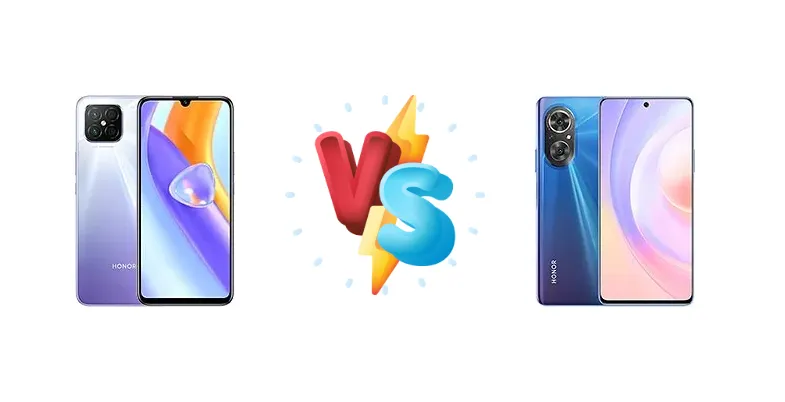
Honor's mid-range offerings, the Play5 5G and 50 SE, present a compelling choice for budget-conscious consumers seeking 5G connectivity and solid performance. While both devices share a similar price bracket, they diverge in their core processing power and charging implementations. This comparison dissects these differences to determine which phone delivers the best overall experience.
🏆 Quick Verdict
For most users, the Honor 50 SE emerges as the superior choice. Its Dimensity 900 chipset, built on a more efficient 6nm process, provides a noticeable performance edge over the Play5 5G’s Dimensity 800U. While both offer 66W fast charging, the 50 SE reaches 75% charge in 20 minutes, faster than the Play5 5G’s 60% in 15 minutes.
| Network |
|---|
| 2G bands | GSM 850 / 900 / 1800 / 1900 | GSM 850 / 900 / 1800 / 1900 |
| 3G bands | HSDPA 850 / 900 / 1700(AWS) / 1900 / 2100 | HSDPA 800 / 850 / 900 / 1700(AWS) / 1900 / 2100 |
| 4G bands | 1, 2, 3, 4, 5, 8, 18, 19, 26, 34, 38, 39, 40, 41 | 1, 2, 3, 4, 5, 8, 18, 19, 26, 34, 38, 39, 40, 41 |
| 5G bands | 1, 28, 41, 77, 78 SA/NSA | 1, 41, 77, 78 SA/NSA |
| Speed | HSPA, LTE, 5G | HSPA, LTE, 5G |
| Technology | GSM / CDMA / HSPA / LTE / 5G | GSM / CDMA / HSPA / CDMA2000 / LTE / 5G |
| | CDMA 800 | CDMA2000 1x |
| Launch |
|---|
| Announced | 2021, May 18 | 2021, June 16 |
| Status | Available. Released 2021, May 26 | Available. Released 2021, July 02 |
| Body |
|---|
| Dimensions | 161.6 x 74.8 x 7.5 mm (6.36 x 2.94 x 0.30 in) | 164.7 x 75.6 x 8 mm (6.48 x 2.98 x 0.31 in) |
| SIM | Nano-SIM + Nano-SIM | Nano-SIM + Nano-SIM |
| Weight | 179 g (6.31 oz) | 191 g (6.74 oz) |
| Display |
|---|
| Protection | Schott Xensation Up | - |
| Resolution | 1080 x 2400 pixels, 20:9 ratio (~403 ppi density) | 1080 x 2388 pixels (~387 ppi density) |
| Size | 6.53 inches, 102.9 cm2 (~85.2% screen-to-body ratio) | 6.78 inches, 111.4 cm2 (~89.4% screen-to-body ratio) |
| Type | OLED, HDR10 | IPS LCD, 120Hz |
| Platform |
|---|
| CPU | Octa-core (2x2.4 GHz Cortex-A76 & 6x2.0 GHz Cortex-A55) | Octa-core (2x2.4 GHz Cortex-A78 & 6x2.0 GHz Cortex-A55) |
| Chipset | Mediatek Dimensity 800U (7 nm) | Mediatek Dimensity 900 (6 nm) |
| GPU | Mali-G57 MC3 | Mali-G78 MC4 |
| OS | Android 10, Magic UI 4.0, no Google Play Services | Android 11, Magic UI 4.2 |
| Memory |
|---|
| Card slot | Unspecified | No |
| Internal | 128GB 8GB RAM, 256GB 8GB RAM | 128GB 8GB RAM, 256GB 8GB RAM, 256GB 12GB RAM |
| Main Camera |
|---|
| Features | LED flash, HDR, panorama | LED flash, HDR, panorama |
| Quad | 64 MP, f/1.9, 26mm (wide), 1/1.72", 0.8µm, PDAF
8 MP, f/2.4, (ultrawide)
2 MP (macro)
Auxiliary lens | - |
| Single | 16 MP, f/2.0, (wide) | 16 MP, f/2.2, (wide) |
| Triple | - | 108 MP, f/1.9, (wide), 1/1.52", 0.7µm, PDAF
8 MP, f/2.2, 120˚, 17mm (ultrawide)
2 MP (macro) |
| Video | 4K@30fps, 1080p@30fps, gyro-EIS | 4K@30fps, 1080p@30/60fps, gyro-EIS |
| Selfie camera |
|---|
| Single | 16 MP, f/2.0, (wide) | 16 MP, f/2.2, (wide) |
| Video | 1080p@30fps | 1080p@30fps |
| Sound |
|---|
| 3.5mm jack | No | No |
| 35mm jack | No | No |
| Loudspeaker | Yes | Yes |
| Comms |
|---|
| Bluetooth | 5.1, A2DP, LE | 5.1, A2DP, LE |
| NFC | Yes | No |
| Positioning | GPS, GLONASS, GALILEO, BDS | GPS, GLONASS, BDS |
| Radio | No | No |
| USB | USB Type-C 2.0, OTG | USB Type-C 2.0, OTG |
| WLAN | Wi-Fi 802.11 a/b/g/n/ac, dual-band, Wi-Fi Direct | Wi-Fi 802.11 a/b/g/n/ac/6, dual-band, Wi-Fi Direct |
| Features |
|---|
| Sensors | Fingerprint (under display, optical), accelerometer, proximity, compass | Fingerprint (side-mounted), accelerometer, gyro, compass |
| | - | Virtual proximity sensing |
| Battery |
|---|
| Charging | 66W wired, 60% in 15 min, 100% in 35 min | 66W wired, 75% in 20 min |
| Type | Li-Po 3800 mAh | Li-Po 4000 mAh |
| Misc |
|---|
| Colors | Black, Violet, Light Blue | Black, Blue, Silver |
| Models | HJC-AN90 | JLH-AN00 |
| Price | About 270 EUR | About 310 EUR |
Honor Play5 5G
- Potentially lower price point
- 66W fast charging
- Reliable Mediatek Dimensity 800U performance for basic tasks
- Less powerful chipset compared to the 50 SE
- 7nm process may lead to higher temperatures under load
- Slower charging speed to full capacity
Honor 50 SE
- More powerful and efficient Mediatek Dimensity 900 chipset
- Faster charging: 75% in 20 minutes
- 6nm process for improved thermal management
- Slightly higher price
- May not offer a significantly better display
- Potential for software bloat (typical of Honor)
Display Comparison
Unfortunately, detailed display specifications are unavailable. However, given the market positioning, both likely feature LCD panels. The Honor 50 SE’s slightly higher price point *may* translate to a marginally better panel, but without specific data on brightness (nits), color gamut coverage, or resolution, it’s difficult to definitively say. Both will likely target a 60Hz refresh rate, common in this segment.
Camera Comparison
Without detailed camera specs, a direct comparison is limited. Both phones likely feature a multi-camera setup, but the sensor sizes and lens apertures are unknown. It’s reasonable to assume the Honor 50 SE, being the slightly more premium device, *may* have a larger main sensor, capturing more light and resulting in better low-light performance. Image processing algorithms will also play a role, and Honor’s software optimizations could differentiate the final image quality. We can expect both to include standard features like HDR and portrait modes.
Performance
The core difference lies in the chipsets. The Honor 50 SE’s Mediatek Dimensity 900 (6nm) represents a step up from the Play5 5G’s Dimensity 800U (7nm). The 6nm process inherently offers better power efficiency, leading to potentially lower temperatures and sustained performance. While both CPUs feature the same Cortex-A55 efficiency cores, the 50 SE utilizes the newer Cortex-A78 performance cores (2x2.4 GHz) compared to the Play5 5G’s Cortex-A76 cores (2x2.4 GHz). The A78 offers improved IPC (Instructions Per Clock), translating to faster single-core performance. This will be noticeable in app launch times and general responsiveness.
Battery Life
Both devices feature 66W wired charging, a significant advantage over slower charging standards. However, the Honor 50 SE boasts a faster charging curve, reaching 75% charge in just 20 minutes, while the Play5 5G takes 15 minutes to reach 60%. This difference is substantial for users who frequently need a quick power boost. While battery capacity isn’t specified, the Dimensity 900’s improved efficiency in the 50 SE could offset a potentially smaller battery size, resulting in comparable real-world battery life.
Buying Guide
Buy the Honor Play5 5G if you prioritize a slightly lower initial cost and are primarily focused on basic smartphone tasks like social media, calls, and light web browsing. Buy the Honor 50 SE if you value smoother multitasking, improved gaming performance, and faster charging, even if it means spending a bit more upfront. The 50 SE is the better option for users who demand more from their device.
Frequently Asked Questions
❓ Will the Dimensity 900 in the Honor 50 SE handle demanding games like Genshin Impact smoothly?
The Dimensity 900 is capable of running Genshin Impact, but you’ll likely need to lower the graphics settings to medium or low for a consistently smooth experience. The 6nm process and improved CPU architecture provide a noticeable advantage over the Play5 5G’s Dimensity 800U in sustained gaming performance.
❓ How significant is the difference in charging speed between the two phones in real-world use?
The difference is quite noticeable. While both charge quickly, the Honor 50 SE reaching 75% in 20 minutes versus the Play5 5G’s 60% in 15 minutes means you’ll get significantly more usable battery life from a short charging session with the 50 SE. This is especially beneficial for users who frequently top up their phones throughout the day.
❓ Is the camera on the Honor 50 SE noticeably better for low-light photography?
While specific camera specs are unavailable, the Honor 50 SE likely has an advantage in low-light conditions. A potentially larger main sensor, combined with Honor’s image processing algorithms, should result in brighter, more detailed photos in challenging lighting scenarios.