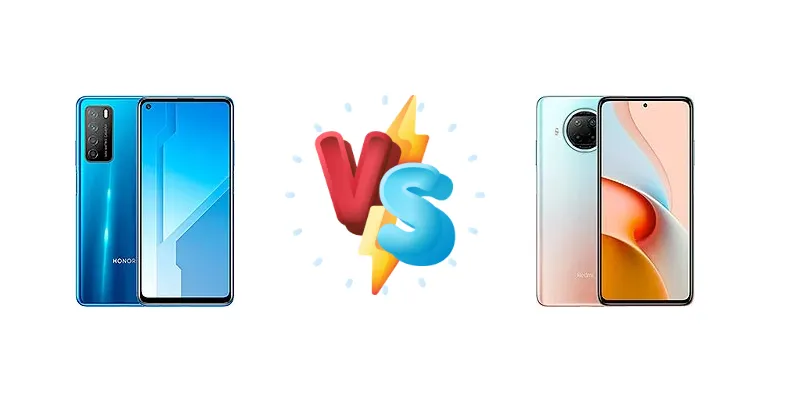
The Honor Play4 and Xiaomi Redmi Note 9 Pro 5G represent compelling options in the increasingly competitive mid-range 5G smartphone market. Both aim to deliver a smooth experience and 5G connectivity without breaking the bank, but they achieve this through different approaches to chipset selection and charging technology. This comparison dissects their key specifications to determine which device offers the best overall value.
🏆 Quick Verdict
For the average user prioritizing faster charging and a slightly more refined software experience, the Xiaomi Redmi Note 9 Pro 5G emerges as the winner. Its 33W charging significantly reduces downtime, and the Snapdragon 750G provides a solid, efficient performance profile. However, the Honor Play4 remains a strong contender for those seeking a potentially more raw performance edge.
| Network |
|---|
| 2G bands | GSM 850 / 900 / 1800 / 1900 | GSM 850 / 900 / 1800 / 1900 |
| 3G bands | HSDPA 850 / 900 / 1700(AWS) / 1900 / 2100 | HSDPA 850 / 900 / 1900 / 2100 |
| 4G bands | 1, 2, 3, 4, 5, 7, 8, 18, 19, 26, 34, 38, 39, 40, 41 | 1, 3, 5, 7, 8, 34, 38, 39, 40, 41 |
| 5G bands | 1, 38, 41, 77, 78, 79 SA/NSA | 1, 3, 41, 78, 79 SA/NSA/Sub6 |
| Speed | HSPA, LTE, 5G | HSPA, LTE, 5G |
| Technology | GSM / CDMA / HSPA / LTE / 5G | GSM / CDMA / HSPA / EVDO / LTE / 5G |
| | CDMA 800 & TD-SCDMA | CDMA2000 1xEV-DO |
| Launch |
|---|
| Announced | 2020, June 03. Released 2020, June 13 | 2020, November 26 |
| Status | Discontinued | Available. Released 2020, December 01 |
| Body |
|---|
| Build | - | Glass front (Gorilla Glass 5), glass back (Gorilla Glass 5) |
| Dimensions | 170 x 78.5 x 8.9 mm (6.69 x 3.09 x 0.35 in) | 165.4 x 76.8 x 9 mm (6.51 x 3.02 x 0.35 in) |
| SIM | Nano-SIM + Nano-SIM | Nano-SIM + Nano-SIM |
| Weight | 213 g (7.51 oz) | 215 g (7.58 oz) |
| | IP5X (dust), IPX4 (water) resistance | IP53, dust and splash resistant |
| Display |
|---|
| Protection | - | Corning Gorilla Glass 5 |
| Resolution | 1080 x 2400 pixels, 20:9 ratio (~386 ppi density) | 1080 x 2400 pixels, 20:9 ratio (~395 ppi density) |
| Size | 6.81 inches, 112.0 cm2 (~83.9% screen-to-body ratio) | 6.67 inches, 107.4 cm2 (~84.6% screen-to-body ratio) |
| Type | IPS LCD | IPS LCD, HDR10, 120Hz, 450 nits (typ) |
| Platform |
|---|
| CPU | Octa-core (4x2.0 GHz Cortex-A76 & 4x2.0 GHz Cortex-A55) | Octa-core (2x2.2 GHz Kryo 570 & 6x1.8 GHz Kryo 570) |
| Chipset | Mediatek Dimensity 800 (7 nm) | Qualcomm SM7225 Snapdragon 750G 5G (8 nm) |
| GPU | Mali-G57MP4 | Adreno 619 |
| OS | Android 10, Magic UI 3.1, no Google Play Services | Android 10, MIUI 12 |
| Memory |
|---|
| Card slot | microSDXC | microSDXC (uses shared SIM slot) |
| Internal | 128GB 8GB RAM | 128GB 6GB RAM, 128GB 8GB RAM, 256GB 8GB RAM |
| | - | UFS 2.2 |
| Main Camera |
|---|
| Features | Dual-LED flash, HDR, panorama | Dual-LED dual-tone flash, HDR, panorama |
| Quad | 64 MP, f/1.9, 26mm (wide), 1/1.72", 0.8µm, PDAF
8 MP, f/2.2, (ultrawide)
2 MP (macro)
Auxiliary lens | 108 MP, f/1.8, 26mm (wide), 1/1.52", 0.7µm, PDAF
8 MP, f/2.2, 118˚ (ultrawide), 1/4.0", 1.12µm
2 MP (macro)
Auxiliary lens |
| Video | 4K@30fps, 1080p@30fps, gyro-EIS | 4K@30fps, 1080p@30/60fps, gyro-EIS |
| Selfie camera |
|---|
| Features | - | HDR, panorama |
| Single | 16 MP | 16 MP, f/2.5, (wide), 1/3.06", 1.0µm |
| Video | 1080p@30fps | 1080p@30fps, gyro-EIS |
| Sound |
|---|
| 3.5mm jack | Yes | Yes |
| 35mm jack | Yes | Yes |
| Loudspeaker | Yes | Yes, with stereo speakers |
| | - | 24-bit/192kHz audio |
| Comms |
|---|
| Bluetooth | 5.1, A2DP, LE | 5.1, A2DP, LE |
| Infrared port | - | Yes |
| NFC | No | Yes |
| Positioning | GPS, GLONASS, BDS | GPS (L1+L5), GLONASS (G1), BDS (B1I+B2a), GALILEO (E1+E5a), QZSS (L1+L5) |
| Radio | FM radio | Unspecified |
| USB | USB Type-C 2.0, OTG | USB Type-C 2.0 |
| WLAN | Wi-Fi 802.11 a/b/g/n/ac, dual-band, Wi-Fi Direct | Wi-Fi 802.11 a/b/g/n/ac, dual-band, Wi-Fi Direct |
| Features |
|---|
| Sensors | Fingerprint (side-mounted), accelerometer, gyro, proximity, compass | Fingerprint (side-mounted), accelerometer, gyro, compass |
| | - | Virtual proximity sensing |
| Battery |
|---|
| Charging | 22.5W wired, 70% in 30 min | 33W wired, 100% in 58 min |
| Type | Li-Po 4300 mAh | Li-Po 4820 mAh |
| Misc |
|---|
| Colors | Black, Blue, Light Blue | Gray, Blue, Red/Mint |
| Models | TNNH-AN00 | M2007J17C |
| Price | About 250 EUR | About 370 EUR |
Honor Play4
- Potentially higher raw CPU performance with Dimensity 800
- Competitive 5G connectivity
- Likely a more affordable price point
- Slower 22.5W charging
- Less power-efficient chipset compared to Snapdragon 750G
- Potentially less refined software experience
Xiaomi Redmi Note 9 Pro 5G
- Faster 33W charging for quicker top-ups
- More power-efficient Snapdragon 750G chipset
- Potentially better software optimization and 5G modem integration
- Slightly lower theoretical CPU performance
- May be marginally more expensive
- Potentially less raw processing power for demanding tasks
Display Comparison
Neither device's display specifications are provided, so a direct comparison is limited. However, given their market positioning, both likely feature LCD panels with FHD+ resolution. The Redmi Note 9 Pro series historically prioritizes larger displays, potentially offering a more immersive viewing experience. Color accuracy and peak brightness will likely be similar, with both aiming for acceptable outdoor visibility. Without specific data, it's reasonable to assume the display experience will be comparable, with the Redmi potentially having a slight edge in size.
Camera Comparison
Without detailed camera specifications, a comprehensive comparison is impossible. However, both phones likely feature multi-camera setups with a primary sensor, ultrawide, and potentially a macro lens. The Redmi Note 9 Pro series has a history of emphasizing camera capabilities, potentially offering a more refined image processing pipeline and better low-light performance. Sensor size and aperture are critical factors, and without that data, it's difficult to determine a clear winner. The inclusion of Optical Image Stabilization (OIS) on either device would be a significant advantage, but this information is unavailable.
Performance
The core of the difference lies in the chipsets. The Honor Play4 utilizes the Mediatek Dimensity 800 (7nm), featuring an octa-core configuration with 4x2.0 GHz Cortex-A76 and 4x2.0 GHz Cortex-A55 cores. The Redmi Note 9 Pro 5G employs the Qualcomm SM7225 Snapdragon 750G 5G (8nm) with 2x2.2 GHz Kryo 570 and 6x1.8 GHz Kryo 570 cores. The Snapdragon 750G's 8nm process offers improved power efficiency compared to the Dimensity 800's 7nm node, potentially leading to better battery life and less thermal throttling during sustained workloads. While the Dimensity 800's Cortex-A76 cores offer a slight theoretical advantage in single-core performance, the Snapdragon 750G's optimized architecture and Adreno GPU provide a more balanced and efficient experience for gaming and everyday tasks. The Snapdragon 750G also benefits from Qualcomm's established 5G modem integration.
Battery Life
The Redmi Note 9 Pro 5G boasts a significant advantage in charging speed with its 33W wired charging, achieving a full charge in 58 minutes. The Honor Play4's 22.5W charging, while respectable, takes longer to replenish the battery. While battery capacity isn't specified, the Snapdragon 750G's superior power efficiency likely mitigates any capacity difference. The faster charging of the Redmi Note 9 Pro 5G translates to less downtime and a more convenient user experience, especially for users who frequently top up their phones throughout the day.
Buying Guide
Buy the Honor Play4 if you prioritize raw CPU performance for demanding tasks and potentially benefit from the Dimensity 800's processing power. Buy the Xiaomi Redmi Note 9 Pro 5G if you value faster charging speeds, a more efficient chipset, and a generally smoother user experience with potentially better software optimization. The Redmi Note 9 Pro 5G is ideal for users who frequently stream video, game casually, and need their phone to stay powered throughout the day.
Frequently Asked Questions
❓ Will the Snapdragon 750G in the Redmi Note 9 Pro 5G struggle with graphically intensive games like PUBG or Genshin Impact?
The Snapdragon 750G is a capable chipset for gaming, and while it won't deliver flagship-level performance, it can comfortably handle PUBG and Genshin Impact at medium to high settings. The Adreno GPU is well-optimized for mobile gaming, and the 8nm process helps prevent excessive throttling during extended gaming sessions.
❓ How much faster is the 33W charging on the Redmi Note 9 Pro 5G compared to the 22.5W charging on the Honor Play4 in real-world usage?
The Redmi Note 9 Pro 5G's 33W charging can fully charge the battery in approximately 58 minutes, while the Honor Play4 takes considerably longer. This translates to roughly a 30-40% faster charging experience, meaning you can get a significant charge in a shorter amount of time, which is particularly useful for users who are always on the go.
❓ Does the Dimensity 800 in the Honor Play4 offer a noticeable advantage in multi-tasking compared to the Snapdragon 750G?
The Dimensity 800's Cortex-A76 cores may provide a slight edge in multi-tasking scenarios involving CPU-intensive applications. However, the Snapdragon 750G's efficient architecture and optimized software integration often result in a smoother overall experience, even with a slightly lower theoretical CPU performance.