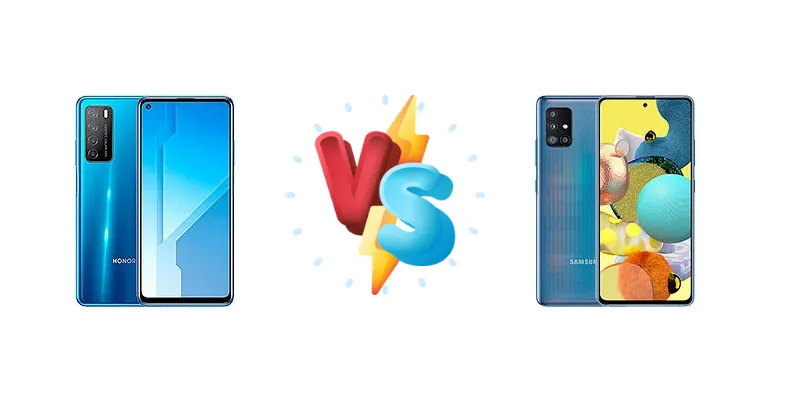
The Honor Play4 and Samsung Galaxy A51 5G UW represent compelling options in the increasingly crowded mid-range 5G smartphone market. Both aim to deliver 5G connectivity without a flagship price tag, but they achieve this through different approaches to chipset selection and feature prioritization. This comparison dissects the core differences to determine which device offers the best value for your money.
🏆 Quick Verdict
For the average user prioritizing quick top-ups and potentially slightly better sustained performance, the Honor Play4 is the stronger choice. Its 22.5W charging significantly outperforms the A51 5G UW’s 15W, and the Dimensity 800 offers competitive performance. However, Samsung’s brand recognition and software experience may appeal to some.
| Network |
|---|
| 2G bands | GSM 850 / 900 / 1800 / 1900 | GSM 850 / 900 / 1800 / 1900 |
| 3G bands | HSDPA 850 / 900 / 1700(AWS) / 1900 / 2100 | HSDPA 850 / 900 / 1900 / 2100 |
| 4G bands | 1, 2, 3, 4, 5, 7, 8, 18, 19, 26, 34, 38, 39, 40, 41 | 2, 4, 5, 13, 66 |
| 5G bands | 1, 38, 41, 77, 78, 79 SA/NSA | 260, 261 mmWave |
| Speed | HSPA, LTE, 5G | HSPA, LTE, 5G |
| Technology | GSM / CDMA / HSPA / LTE / 5G | GSM / HSPA / LTE / 5G |
| | CDMA 800 & TD-SCDMA | - |
| Launch |
|---|
| Announced | 2020, June 03. Released 2020, June 13 | 2020, August 14 |
| Status | Discontinued | Available. Released 2020, August 14 |
| Body |
|---|
| Build | - | Glass front (Gorilla Glass 3), plastic back, aluminum frame |
| Dimensions | 170 x 78.5 x 8.9 mm (6.69 x 3.09 x 0.35 in) | 158.8 x 73.4 x 8.6 mm (6.25 x 2.89 x 0.34 in) |
| SIM | Nano-SIM + Nano-SIM | Nano-SIM (pre-installed) |
| Weight | 213 g (7.51 oz) | 188.8 g (6.67 oz) |
| | IP5X (dust), IPX4 (water) resistance | - |
| Display |
|---|
| Protection | - | Corning Gorilla Glass 3 |
| Resolution | 1080 x 2400 pixels, 20:9 ratio (~386 ppi density) | 1080 x 2400 pixels, 20:9 ratio (~405 ppi density) |
| Size | 6.81 inches, 112.0 cm2 (~83.9% screen-to-body ratio) | 6.5 inches, 102.0 cm2 (~87.5% screen-to-body ratio) |
| Type | IPS LCD | Super AMOLED |
| Platform |
|---|
| CPU | Octa-core (4x2.0 GHz Cortex-A76 & 4x2.0 GHz Cortex-A55) | Octa-core (1x2.4 GHz Kryo 475 Prime & 1x2.2 GHz Kryo 475 Gold & 6x1.8 GHz Kryo 475 Silver) |
| Chipset | Mediatek Dimensity 800 (7 nm) | Qualcomm SM7250 Snapdragon 765G 5G (7 nm) |
| GPU | Mali-G57MP4 | Adreno 620 |
| OS | Android 10, Magic UI 3.1, no Google Play Services | Android 10, One UI 2 |
| Memory |
|---|
| Card slot | microSDXC | microSDXC (uses shared SIM slot) |
| Internal | 128GB 8GB RAM | 128GB 6GB RAM |
| | - | UFS 2.1 |
| Main Camera |
|---|
| Features | Dual-LED flash, HDR, panorama | LED flash, panorama, HDR |
| Quad | 64 MP, f/1.9, 26mm (wide), 1/1.72", 0.8µm, PDAF
8 MP, f/2.2, (ultrawide)
2 MP (macro)
Auxiliary lens | 48 MP, f/2.0, 26mm (wide), 1/2.0", 0.8µm, PDAF
12 MP, f/2.2, 123˚ (ultrawide)
5 MP (macro)
Auxiliary lens |
| Single | - | 5 MP, AF |
| Video | 4K@30fps, 1080p@30fps, gyro-EIS | 4K@30fps, 1080p@30/120fps; gyro-EIS |
| Selfie camera |
|---|
| Features | - | HDR |
| Single | 16 MP | 32 MP, f/2.2, 26mm (wide), 1/2.8", 0.8µm |
| Video | 1080p@30fps | 4K@30fps, 1080p@30fps |
| Sound |
|---|
| 3.5mm jack | Yes | Yes |
| 35mm jack | Yes | Yes |
| Loudspeaker | Yes | Yes |
| Comms |
|---|
| Bluetooth | 5.1, A2DP, LE | 5.0, A2DP, LE |
| NFC | No | Yes |
| Positioning | GPS, GLONASS, BDS | GPS, GLONASS, GALILEO, BDS |
| Radio | FM radio | FM radio, RDS, recording |
| USB | USB Type-C 2.0, OTG | USB Type-C 2.0, OTG |
| WLAN | Wi-Fi 802.11 a/b/g/n/ac, dual-band, Wi-Fi Direct | Wi-Fi 802.11 a/b/g/n/ac, dual-band, Wi-Fi Direct |
| Features |
|---|
| Sensors | Fingerprint (side-mounted), accelerometer, gyro, proximity, compass | Fingerprint (under display, optical), accelerometer, gyro, proximity, compass |
| | - | ANT+ |
| Battery |
|---|
| Charging | 22.5W wired, 70% in 30 min | 15W wired |
| Stand-by | - | Up to 672 h |
| Talk time | - | Up to 5 h |
| Type | Li-Po 4300 mAh | Li-Po 4500 mAh |
| Misc |
|---|
| Colors | Black, Blue, Light Blue | Prism Bricks Blue |
| Models | TNNH-AN00 | SM-A516V |
| Price | About 250 EUR | About 470 EUR |
| SAR | - | 0.70 W/kg (head) 1.25 W/kg (body) |
| SAR EU | - | 0.59 W/kg (head) 1.32 W/kg (body) |
Honor Play4
- Faster 22.5W charging
- Potentially better sustained performance with Dimensity 800
- More efficient chipset architecture
- Less established brand recognition
- Software experience may not appeal to all users
Samsung Galaxy A51 5G UW
- Samsung One UI software experience
- Strong brand reputation
- Potentially better image processing
- Slower 15W charging
- Snapdragon 765G may throttle under sustained load
Display Comparison
Neither device boasts a particularly standout display. While specific panel details (like peak brightness in nits or color gamut coverage) are unavailable, both likely utilize IPS LCD technology common in this price bracket. The focus here isn't on visual fidelity, but rather on functional usability. Bezels are expected to be moderate on both, and color accuracy will likely be tuned for vibrant, rather than strictly accurate, representation.
Camera Comparison
Without detailed sensor specifications, a direct camera comparison is challenging. However, the market positioning suggests both phones will prioritize versatility over outright image quality. The A51 5G UW likely benefits from Samsung’s established image processing algorithms, potentially delivering more pleasing results in auto mode. The Honor Play4 may offer a more neutral image profile. It's crucial to note that the inclusion of low-resolution auxiliary cameras (often 2MP macro or depth sensors) on both devices adds little practical value.
Performance
The core of the difference lies in the chipsets. The Honor Play4’s Mediatek Dimensity 800 (7nm) utilizes a Cortex-A76 based core cluster, offering strong single-core performance and efficient multi-core processing. The Samsung Galaxy A51 5G UW’s Qualcomm Snapdragon 765G (7nm) employs Kryo cores, with a prime core for peak tasks. While the Snapdragon 765G has a slightly higher clocked prime core (2.4GHz vs 2.0GHz), the Dimensity 800’s architecture is generally considered more efficient. This translates to potentially better sustained performance under load, as the Dimensity 800 is less prone to thermal throttling. Both devices likely feature adequate RAM for smooth multitasking, but the specific LPDDR version isn't specified.
Battery Life
The battery capacity isn't specified for either device, but both likely fall in the 4000-5000mAh range, typical for this class. However, the charging speed is a significant differentiator. The Honor Play4’s 22.5W wired charging allows for a 70% charge in just 30 minutes, a substantial advantage over the Samsung Galaxy A51 5G UW’s slower 15W charging. This faster charging capability makes the Play4 more convenient for users who need a quick power boost.
Buying Guide
Buy the Honor Play4 if you need faster charging speeds and prioritize a chipset known for efficient power management, making it ideal for users who frequently top up their phones throughout the day. Buy the Samsung Galaxy A51 5G UW if you prefer the Samsung One UI experience, value a more established brand reputation, and aren't as concerned about maximizing charging speed or squeezing every last bit of performance from your device.
Frequently Asked Questions
❓ Will the Dimensity 800 in the Honor Play4 handle demanding games like PUBG or Call of Duty Mobile?
The Mediatek Dimensity 800 is capable of running PUBG and Call of Duty Mobile at medium to high settings. While it won't match the performance of flagship chipsets, its efficient architecture should provide a stable gaming experience, though extended sessions may result in some thermal throttling. Expect playable frame rates, but don't anticipate consistently hitting maximum graphical settings.
❓ How much slower is the 15W charging on the Samsung Galaxy A51 5G UW compared to the Honor Play4's 22.5W?
The difference is substantial. The Honor Play4 can gain 70% charge in 30 minutes, while the A51 5G UW will take considerably longer – likely over an hour to reach the same charge level. This makes the Play4 significantly more convenient for users who need a quick top-up before leaving the house.
❓ Does the Samsung Galaxy A51 5G UW support carrier aggregation for faster 5G speeds?
The Snapdragon 765G in the A51 5G UW *does* support carrier aggregation, which is crucial for achieving faster and more reliable 5G speeds. However, the actual speeds experienced will depend on your carrier's network infrastructure and the specific bands supported.
❓ Is the software on the Honor Play4 heavily customized, and does it include a lot of bloatware?
Honor's software (Magic UI) is based on Android, but it does include a degree of customization. While it has improved in recent years, it may still contain some pre-installed apps (bloatware). The level of bloatware is generally less than some other Chinese manufacturers, but it's something to be aware of.