
Honor Play4 vs. Motorola Moto G Power (2021): A Detailed Performance and Battery Life Showdown
| Phones Images | |||||
|---|---|---|---|---|---|
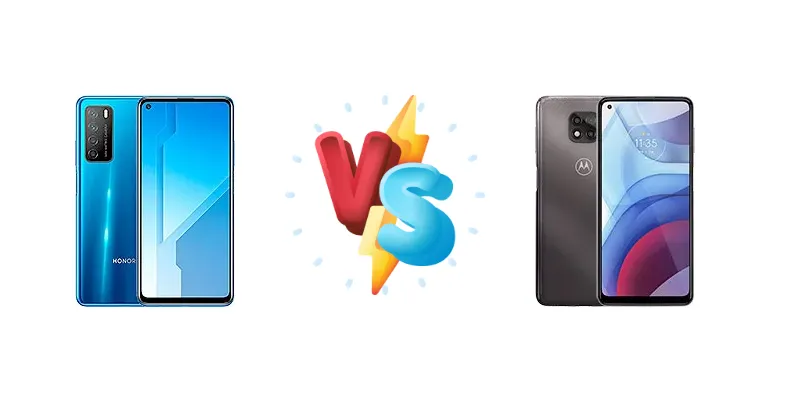
|
🏆 Quick Verdict
For users prioritizing performance and faster charging, the Honor Play4 is the clear winner. Its Dimensity 800 chipset delivers a significantly smoother experience, especially in demanding tasks. However, the Motorola Moto G Power (2021) remains a compelling option for those who value exceptional battery life and a lower upfront cost.
| PHONES | ||
|---|---|---|
| Phone Names | Honor Play4 | Motorola Moto G Power (2021) |
| Network | ||
|---|---|---|
| 2G bands | GSM 850 / 900 / 1800 / 1900 | GSM 850 / 900 / 1800 / 1900 |
| 3G bands | HSDPA 850 / 900 / 1700(AWS) / 1900 / 2100 | HSDPA 850 / 900 / 1700(AWS) / 1900 / 2100 |
| 4G bands | 1, 2, 3, 4, 5, 7, 8, 18, 19, 26, 34, 38, 39, 40, 41 | 1, 2, 3, 4, 5, 7, 8, 12, 13, 14, 17, 25, 26, 29, 30, 38, 41, 66, 71 |
| 5G bands | 1, 38, 41, 77, 78, 79 SA/NSA | - |
| Speed | HSPA, LTE, 5G | HSPA, LTE |
| Technology | GSM / CDMA / HSPA / LTE / 5G | GSM / CDMA / HSPA / EVDO / LTE |
| CDMA 800 & TD-SCDMA | CDMA2000 1xEV-DO | |
| Launch | ||
|---|---|---|
| Announced | 2020, June 03. Released 2020, June 13 | 2021, January 08 |
| Status | Discontinued | Available. Released 2021, January 14 |
| Body | ||
|---|---|---|
| Build | - | Glass front, plastic back, plastic frame |
| Dimensions | 170 x 78.5 x 8.9 mm (6.69 x 3.09 x 0.35 in) | 165.3 x 75.9 x 9.5 mm (6.51 x 2.99 x 0.37 in) |
| SIM | Nano-SIM + Nano-SIM | Nano-SIM |
| Weight | 213 g (7.51 oz) | 206.5 g (7.30 oz) |
| IP5X (dust), IPX4 (water) resistance | Water-repellent coating | |
| Display | ||
|---|---|---|
| Resolution | 1080 x 2400 pixels, 20:9 ratio (~386 ppi density) | 720 x 1600 pixels, 20:9 ratio (~266 ppi density) |
| Size | 6.81 inches, 112.0 cm2 (~83.9% screen-to-body ratio) | 6.6 inches, 105.2 cm2 (~83.8% screen-to-body ratio) |
| Type | IPS LCD | IPS LCD |
| Platform | ||
|---|---|---|
| CPU | Octa-core (4x2.0 GHz Cortex-A76 & 4x2.0 GHz Cortex-A55) | Octa-core (4x2.0 GHz Kryo 260 Gold & 4x1.8 GHz Kryo 260 Silver) |
| Chipset | Mediatek Dimensity 800 (7 nm) | Qualcomm SM6115 Snapdragon 662 (11 nm) |
| GPU | Mali-G57MP4 | Adreno 610 |
| OS | Android 10, Magic UI 3.1, no Google Play Services | Android 10 |
| Memory | ||
|---|---|---|
| Card slot | microSDXC | microSDXC (dedicated slot) |
| Internal | 128GB 8GB RAM | 32GB 3GB RAM, 64GB 4GB RAM |
| - | eMMC 5.1 | |
| Main Camera | ||
|---|---|---|
| Features | Dual-LED flash, HDR, panorama | LED flash, HDR, panorama |
| Quad | 64 MP, f/1.9, 26mm (wide), 1/1.72", 0.8µm, PDAF 8 MP, f/2.2, (ultrawide) 2 MP (macro) Auxiliary lens | - |
| Triple | - | 48 MP, f/1.7, (wide), 1/2.0", 0.8µm, PDAF 2 MP (macro) Auxiliary lens |
| Video | 4K@30fps, 1080p@30fps, gyro-EIS | 1080p@30/60fps, gyro-EIS |
| Selfie camera | ||
|---|---|---|
| Features | - | HDR |
| Single | 16 MP | 8 MP, f/2.0, 1.12µm |
| Video | 1080p@30fps | 1080p@30fps, gyro-EIS |
| Sound | ||
|---|---|---|
| 3.5mm jack | Yes | Yes |
| 35mm jack | Yes | Yes |
| Loudspeaker | Yes | Yes |
| Comms | ||
|---|---|---|
| Bluetooth | 5.1, A2DP, LE | 5.0, A2DP, LE |
| NFC | No | No |
| Positioning | GPS, GLONASS, BDS | GPS, GLONASS, GALILEO |
| Radio | FM radio | FM radio |
| USB | USB Type-C 2.0, OTG | USB Type-C 2.0 |
| WLAN | Wi-Fi 802.11 a/b/g/n/ac, dual-band, Wi-Fi Direct | Wi-Fi 802.11 a/b/g/n/ac, dual-band, Wi-Fi Direct |
| Features | ||
|---|---|---|
| Sensors | Fingerprint (side-mounted), accelerometer, gyro, proximity, compass | Fingerprint (side-mounted), accelerometer, gyro, proximity, compass, barometer |
| Battery | ||
|---|---|---|
| Charging | 22.5W wired, 70% in 30 min | 15W wired |
| Type | Li-Po 4300 mAh | Li-Po 5000 mAh |
| Misc | ||
|---|---|---|
| Colors | Black, Blue, Light Blue | Flash Gray, Polar Silver |
| Models | TNNH-AN00 | - |
| Price | About 250 EUR | About 60 EUR |
Honor Play4
- Significantly faster processor for gaming and multitasking
- Faster 22.5W charging
- More efficient chipset for potentially better battery life *during use* (despite smaller battery)
- Battery life may not match the Moto G Power's endurance
- Potentially higher price point
Motorola Moto G Power (2021)
- Exceptional battery life
- More affordable price
- Reliable performance for basic tasks
- Slower processor struggles with demanding apps
- Slow 15W charging
Display Comparison
Neither device boasts a particularly standout display. While specific display specs (resolution, panel type) are missing for the Honor Play4, the focus here is on the chipset difference. The Moto G Power (2021) likely features a standard 60Hz LCD panel, typical for its price bracket. The Play4’s chipset allows for smoother rendering of UI elements, which *feels* like a better display experience even if the raw specs are similar. The lack of high refresh rate support on either device means neither is ideal for fast-paced gaming visuals.
Camera Comparison
Without detailed camera specifications, a direct comparison is difficult. However, the chipset difference indirectly impacts camera performance. The Dimensity 800’s image signal processor (ISP) is more capable than the Snapdragon 662’s, allowing for faster image processing and potentially better low-light performance. It’s reasonable to assume the Play4 can handle more complex computational photography tasks. The Moto G Power likely relies more on software processing to compensate for its less powerful ISP. The presence of a dedicated ISP in the Dimensity 800 allows for faster autofocus and more accurate color reproduction.
Performance
The core difference lies in the chipsets. The Honor Play4’s Mediatek Dimensity 800 (7nm) is a substantial upgrade over the Motorola Moto G Power’s Qualcomm Snapdragon 662 (11nm). The Dimensity 800’s Cortex-A76 cores provide significantly more processing power than the Snapdragon 662’s Kryo 260 Gold cores. This translates to faster app loading times, smoother multitasking, and a more responsive user experience. The 7nm process node of the Dimensity 800 also contributes to better thermal efficiency, potentially reducing throttling during sustained workloads. While both CPUs have four cores clocked at 2.0 GHz, the architectural differences are key; the A76 is a more modern and efficient design. The Snapdragon 662 is adequate for basic tasks, but will struggle with graphically intensive games or demanding applications.
Battery Life
The Motorola Moto G Power (2021) is designed for longevity. While the exact battery capacity isn't specified, Motorola’s ‘Power’ line is renowned for its large batteries. The 15W charging, however, is relatively slow. The Honor Play4, with its 22.5W charging, can reach 70% charge in just 30 minutes, offering a significant convenience advantage. The Dimensity 800’s efficiency also contributes to better battery life, but the Moto G Power likely still holds a lead in overall endurance due to its larger battery capacity. The trade-off is speed versus stamina; the Play4 charges faster, but the G Power lasts longer on a single charge.
Buying Guide
Buy the Honor Play4 if you need a phone capable of handling demanding games and applications with ease, and if you appreciate faster charging speeds. This phone is ideal for users who frequently multitask or enjoy mobile gaming. Buy the Motorola Moto G Power (2021) if you prioritize all-day (and potentially multi-day) battery life above all else, and if you're on a tighter budget. It's the perfect choice for users who primarily use their phone for communication, browsing, and light media consumption.