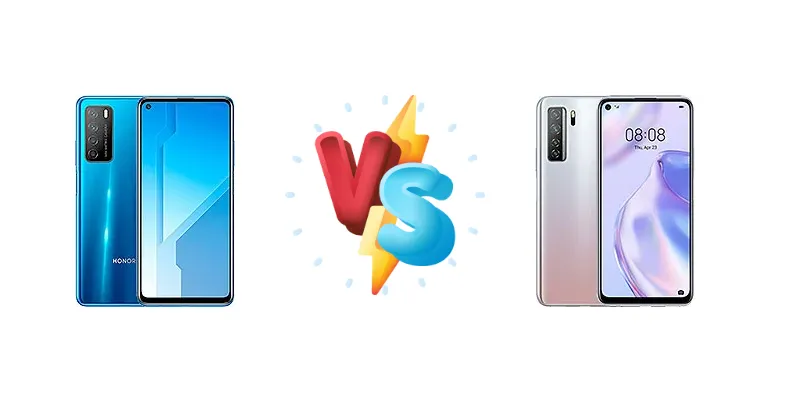
Both the Honor Play4 and Huawei nova 7 SE 5G Youth represent compelling options in the increasingly competitive mid-range 5G smartphone market. While both leverage Mediatek's Dimensity series, subtle yet significant differences in their chipsets and charging capabilities dictate which device caters to specific user priorities. This comparison dissects these nuances to determine the optimal choice.
🏆 Quick Verdict
For the average user prioritizing faster charging and a slightly more responsive CPU, the Huawei nova 7 SE 5G Youth emerges as the winner. Its 40W charging significantly reduces downtime, and the higher clocked Cortex-A76 cores offer a marginal performance boost. However, the Honor Play4 remains a strong contender for those on a tighter budget.
| Network |
|---|
| 2G bands | GSM 850 / 900 / 1800 / 1900 | GSM 850 / 900 / 1800 / 1900 |
| 3G bands | HSDPA 850 / 900 / 1700(AWS) / 1900 / 2100 | HSDPA 800 / 850 / 900 / 1700(AWS) / 1900 / 2100 |
| 4G bands | 1, 2, 3, 4, 5, 7, 8, 18, 19, 26, 34, 38, 39, 40, 41 | 1, 2, 3, 4, 5, 8, 18, 19, 26, 34, 38, 39, 40, 41 |
| 5G bands | 1, 38, 41, 77, 78, 79 SA/NSA | 1, 41, 77, 78 SA/NSA |
| Speed | HSPA, LTE, 5G | HSPA, LTE, 5G |
| Technology | GSM / CDMA / HSPA / LTE / 5G | GSM / CDMA / HSPA / LTE / 5G |
| | CDMA 800 & TD-SCDMA | CDMA 800 & TD-SCDMA |
| Launch |
|---|
| Announced | 2020, June 03. Released 2020, June 13 | 2020, October 16. Released 2020, October 16 |
| Status | Discontinued | Discontinued |
| Body |
|---|
| Dimensions | 170 x 78.5 x 8.9 mm (6.69 x 3.09 x 0.35 in) | 162.3 x 75 x 8.6 mm (6.39 x 2.95 x 0.34 in) |
| SIM | Nano-SIM + Nano-SIM | Nano-SIM + Nano-SIM |
| Weight | 213 g (7.51 oz) | 189 g (6.67 oz) |
| | IP5X (dust), IPX4 (water) resistance | - |
| Display |
|---|
| Resolution | 1080 x 2400 pixels, 20:9 ratio (~386 ppi density) | 1080 x 2400 pixels, 20:9 ratio (~405 ppi density) |
| Size | 6.81 inches, 112.0 cm2 (~83.9% screen-to-body ratio) | 6.5 inches, 102.0 cm2 (~83.8% screen-to-body ratio) |
| Type | IPS LCD | IPS LCD, HDR10 |
| Platform |
|---|
| CPU | Octa-core (4x2.0 GHz Cortex-A76 & 4x2.0 GHz Cortex-A55) | Octa-core (2x2.4 GHz Cortex-A76 & 6x2.0 GHz Cortex-A55) |
| Chipset | Mediatek Dimensity 800 (7 nm) | Mediatek Dimensity 800U (7 nm) |
| GPU | Mali-G57MP4 | Mali-G57 MC3 |
| OS | Android 10, Magic UI 3.1, no Google Play Services | Android 10, EMUI 10.1, no Google Play Services |
| Memory |
|---|
| Card slot | microSDXC | No |
| Internal | 128GB 8GB RAM | 128GB 8GB RAM |
| Main Camera |
|---|
| Features | Dual-LED flash, HDR, panorama | LED flash, Panorama, HDR |
| Quad | 64 MP, f/1.9, 26mm (wide), 1/1.72", 0.8µm, PDAF
8 MP, f/2.2, (ultrawide)
2 MP (macro)
Auxiliary lens | 64 MP, f/1.8, 26mm (wide), PDAF
8 MP, f/2.4, 17mm (ultrawide)
2 MP (macro)
Auxiliary lens |
| Video | 4K@30fps, 1080p@30fps, gyro-EIS | 4K@30fps, 1080p@30fps |
| Selfie camera |
|---|
| Features | - | HDR |
| Single | 16 MP | 16 MP, f/2.0, (wide) |
| Video | 1080p@30fps | 1080p@30fps |
| Sound |
|---|
| 3.5mm jack | Yes | Yes |
| 35mm jack | Yes | Yes |
| Loudspeaker | Yes | Yes |
| Comms |
|---|
| Bluetooth | 5.1, A2DP, LE | 5.1, A2DP, LE |
| NFC | No | No |
| Positioning | GPS, GLONASS, BDS | GPS, GLONASS, GALILEO, BDS, QZSS |
| Radio | FM radio | No |
| USB | USB Type-C 2.0, OTG | USB Type-C 2.0, OTG |
| WLAN | Wi-Fi 802.11 a/b/g/n/ac, dual-band, Wi-Fi Direct | Wi-Fi 802.11 a/b/g/n/ac, dual-band, Wi-Fi Direct |
| Features |
|---|
| Sensors | Fingerprint (side-mounted), accelerometer, gyro, proximity, compass | Fingerprint (side-mounted), accelerometer, proximity, compass |
| Battery |
|---|
| Charging | 22.5W wired, 70% in 30 min | 40W wired, 70% in 30 min
5W reverse wired |
| Type | Li-Po 4300 mAh | Li-Po 4000 mAh |
| Misc |
|---|
| Colors | Black, Blue, Light Blue | Crush Green, Space Silver, Midnight Black, Purple |
| Models | TNNH-AN00 | CND-AN00 |
| Price | About 250 EUR | About 290 EUR |
Honor Play4
- Potentially lower price point
- Reliable 5G connectivity
- Mediatek Dimensity 800 provides solid performance
- Slower charging speed (22.5W)
- Lower CPU clock speeds compared to the 800U
- Lacks reverse wireless charging
Huawei nova 7 SE 5G Youth
- Faster 40W wired charging
- Higher CPU clock speeds (Dimensity 800U)
- Includes 5W reverse wired charging
- Potentially higher price
- May experience slightly more thermal throttling under heavy load
- Image processing may be overly aggressive for some users
Display Comparison
Unfortunately, display specifications are not provided. However, given the market segment, both devices likely feature LCD panels with 60Hz refresh rates. The nova 7 SE, historically, tends to prioritize slightly more vibrant color profiles, while Honor often aims for greater accuracy. Bezels are expected to be comparable, typical of phones in this price range. Without specific data, it's difficult to declare a clear winner; the user experience will likely hinge on personal preference regarding color calibration.
Camera Comparison
Camera details are absent, but we can infer based on the market positioning. Both phones likely feature a multi-camera setup with a primary sensor, ultrawide, and potentially a depth sensor. The nova 7 SE, given Huawei’s camera expertise, likely benefits from more sophisticated image processing algorithms, potentially resulting in better dynamic range and low-light performance. The absence of optical image stabilization (OIS) is probable on both, relying instead on software stabilization. Any 2MP macro sensors are likely to be of limited utility, serving primarily as marketing features.
Performance
The core difference lies in the chipsets: the Honor Play4 utilizes the Mediatek Dimensity 800, while the nova 7 SE 5G Youth features the Dimensity 800U. Both are 7nm chips, but the 800U boasts higher CPU clock speeds – 2.4 GHz Cortex-A76 cores versus the Play4’s 2.0 GHz. This translates to a noticeable, though not dramatic, improvement in single-core performance, benefiting app launch times and general responsiveness. The GPU performance is likely similar, sufficient for medium-to-high graphics settings in most mobile games. Both phones benefit from 5G connectivity, but thermal management will be crucial; the 800U’s higher clocks could lead to slightly more heat generation under sustained load.
Battery Life
While battery capacities are unknown, the charging speeds are a key differentiator. The Honor Play4 supports 22.5W wired charging, achieving 70% charge in 30 minutes. The nova 7 SE 5G Youth doubles down with 40W wired charging, also reaching 70% in 30 minutes. This faster charging is a significant advantage for users who frequently need to top up their phones. Furthermore, the nova 7 SE 5G Youth adds 5W reverse wired charging, allowing it to act as a power bank for other devices – a feature absent on the Play4.
Buying Guide
Buy the Honor Play4 if you need a reliable 5G experience at the lowest possible price point and aren't overly concerned with the absolute fastest charging speeds. Buy the Huawei nova 7 SE 5G Youth if you prioritize quicker top-ups, appreciate a slightly more responsive user interface, and value the convenience of reverse wireless charging, even at a potentially higher cost.
Frequently Asked Questions
❓ Will the Dimensity 800U in the nova 7 SE 5G Youth noticeably improve gaming performance compared to the Play4?
While both chips are capable of handling most mobile games, the higher CPU clock speeds of the Dimensity 800U will provide a slight edge in titles that are CPU-bound. Expect marginally smoother frame rates and faster loading times, but don't anticipate a dramatic difference. The GPU performance is likely comparable.
❓ How much faster is the 40W charging on the nova 7 SE 5G Youth in real-world usage?
Both phones reach 70% charge in 30 minutes, but the 40W charging on the nova 7 SE 5G Youth will likely deliver a faster initial charge rate, getting you to around 50% quicker than the Play4's 22.5W. This is particularly beneficial for quick top-ups when you only have a short amount of time to charge.
❓ Does the Huawei nova 7 SE 5G Youth support 5G on all networks and bands?
5G support varies by region and carrier. It's crucial to verify compatibility with your specific carrier's 5G bands before purchasing. Both phones support 5G, but the specific bands supported may differ.
❓ Is the reverse charging feature on the nova 7 SE 5G Youth useful for everyday use?
The 5W reverse charging is primarily useful for topping up accessories like wireless earbuds or smartwatches in emergencies. It's not designed to quickly charge another smartphone, but it provides a convenient way to share power when needed.