
Honor Play4 vs Google Pixel 4a 5G: Which Mid-Range 5G Phone Reigns Supreme?
| Phones Images | |||||
|---|---|---|---|---|---|
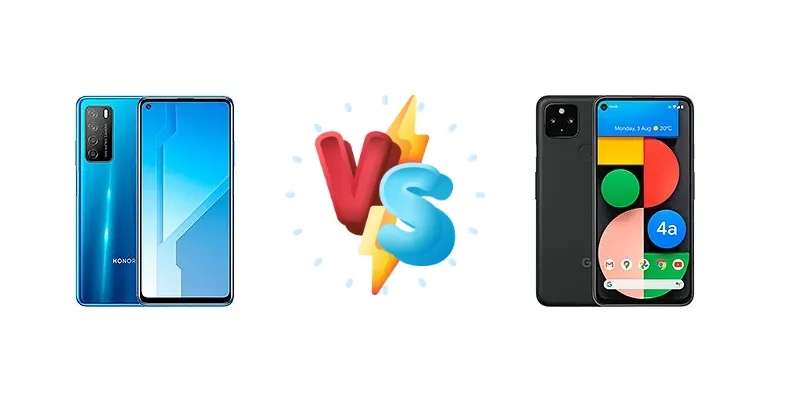
|
🏆 Quick Verdict
For the average user prioritizing a balanced experience with a strong emphasis on camera quality and software support, the Google Pixel 4a 5G emerges as the better choice. However, the Honor Play4 offers a compelling alternative for those prioritizing raw processing power and faster charging, particularly if software updates are less of a concern.
| PHONES | ||
|---|---|---|
| Phone Names | Honor Play4 | Google Pixel 4a 5G |
| Network | ||
|---|---|---|
| 2G bands | GSM 850 / 900 / 1800 / 1900 | GSM 850 / 900 / 1800 / 1900 |
| 3G bands | HSDPA 850 / 900 / 1700(AWS) / 1900 / 2100 | HSDPA 850 / 900 / 1700(AWS) / 1900 / 2100 |
| 4G bands | 1, 2, 3, 4, 5, 7, 8, 18, 19, 26, 34, 38, 39, 40, 41 | 1, 2, 3, 4, 5, 7, 8, 12, 13, 14, 17, 18, 19, 20, 25, 26, 28, 29, 30, 32, 38, 39, 40, 41, 42, 46, 48, 66, 71 |
| 5G bands | 1, 38, 41, 77, 78, 79 SA/NSA | 1, 2, 3, 5, 7, 8, 12, 28, 41, 66, 71, 77, 78 Sub6, mmWave (market dependant) |
| Speed | HSPA, LTE, 5G | HSPA, LTE, 5G |
| Technology | GSM / CDMA / HSPA / LTE / 5G | GSM / HSPA / LTE / 5G |
| CDMA 800 & TD-SCDMA | - | |
| Launch | ||
|---|---|---|
| Announced | 2020, June 03. Released 2020, June 13 | 2020, September 30 |
| Status | Discontinued | Available. Released 2020, November 05 |
| Body | ||
|---|---|---|
| Build | - | Glass front (Gorilla Glass 3), plastic back, plastic frame |
| Dimensions | 170 x 78.5 x 8.9 mm (6.69 x 3.09 x 0.35 in) | 153.9 x 74 x 8.2 mm (Sub-6) or 8.5 mm (Sub-6 and mmWave) |
| SIM | Nano-SIM + Nano-SIM | Nano-SIM + eSIM |
| Weight | 213 g (7.51 oz) | 168 g (5G Sub-6); 171 g ( 5G Sub-6 and mmWave) (5.93 oz) |
| IP5X (dust), IPX4 (water) resistance | - | |
| Display | ||
|---|---|---|
| Protection | - | Corning Gorilla Glass 3 |
| Resolution | 1080 x 2400 pixels, 20:9 ratio (~386 ppi density) | 1080 x 2340 pixels, 19.5:9 ratio (~413 ppi density) |
| Size | 6.81 inches, 112.0 cm2 (~83.9% screen-to-body ratio) | 6.2 inches, 95.7 cm2 (~84.1% screen-to-body ratio) |
| Type | IPS LCD | OLED, HDR |
| - | Always-on display | |
| Platform | ||
|---|---|---|
| CPU | Octa-core (4x2.0 GHz Cortex-A76 & 4x2.0 GHz Cortex-A55) | Octa-core (1x2.4 GHz Kryo 475 Prime & 1x2.2 GHz Kryo 475 Gold & 6x1.8 GHz Kryo 475 Silver) |
| Chipset | Mediatek Dimensity 800 (7 nm) | Qualcomm SM7250 Snapdragon 765G 5G (7 nm) |
| GPU | Mali-G57MP4 | Adreno 620 |
| OS | Android 10, Magic UI 3.1, no Google Play Services | Android 11, upgradable to Android 14 |
| Memory | ||
|---|---|---|
| Card slot | microSDXC | No |
| Internal | 128GB 8GB RAM | 128GB 6GB RAM |
| - | UFS 2.1 | |
| Main Camera | ||
|---|---|---|
| Dual | - | 12.2 MP, f/1.7, 27mm (wide), 1/2.55", 1.4µm, dual pixel PDAF, OIS 16 MP, f/2.2, 107˚ (ultrawide), 1.0µm |
| Features | Dual-LED flash, HDR, panorama | LED flash, Pixel Shift, Auto-HDR, panorama |
| Quad | 64 MP, f/1.9, 26mm (wide), 1/1.72", 0.8µm, PDAF 8 MP, f/2.2, (ultrawide) 2 MP (macro) Auxiliary lens | - |
| Video | 4K@30fps, 1080p@30fps, gyro-EIS | 4K@30/60fps, 1080p@30/60/120/240fps; gyro-EIS |
| Selfie camera | ||
|---|---|---|
| Features | - | HDR |
| Single | 16 MP | 8 MP, f/2.0, 24mm (wide), 1/4.0", 1.12µm |
| Video | 1080p@30fps | 1080p@30fps |
| Sound | ||
|---|---|---|
| 3.5mm jack | Yes | Yes |
| 35mm jack | Yes | Yes |
| Loudspeaker | Yes | Yes, with stereo speakers |
| Comms | ||
|---|---|---|
| Bluetooth | 5.1, A2DP, LE | 5.0, A2DP, LE, aptX HD |
| NFC | No | Yes |
| Positioning | GPS, GLONASS, BDS | GPS, GLONASS, GALILEO, QZSS, BDS |
| Radio | FM radio | No |
| USB | USB Type-C 2.0, OTG | USB Type-C 3.1 |
| WLAN | Wi-Fi 802.11 a/b/g/n/ac, dual-band, Wi-Fi Direct | Wi-Fi 802.11 a/b/g/n/ac, dual-band, Wi-Fi Direct |
| Features | ||
|---|---|---|
| Sensors | Fingerprint (side-mounted), accelerometer, gyro, proximity, compass | Fingerprint (rear-mounted), accelerometer, gyro, proximity, compass, barometer |
| Battery | ||
|---|---|---|
| Charging | 22.5W wired, 70% in 30 min | 18W wired, PD2.0 |
| Type | Li-Po 4300 mAh | Li-Po 3885 mAh |
| Misc | ||
|---|---|---|
| Colors | Black, Blue, Light Blue | Just Black, Clearly White |
| Models | TNNH-AN00 | GD1YQ, G025I, G025E, G025H, G6QU3 |
| Price | About 250 EUR | About 140 EUR |
Honor Play4
- Faster 22.5W charging
- Potentially stronger multi-core CPU performance
- Likely more affordable price point
- Honor's Magic UI may not appeal to all users
- Potentially less frequent software updates
- Camera performance likely lags behind the Pixel
Google Pixel 4a 5G
- Exceptional camera quality with Google's image processing
- Clean Android experience with guaranteed updates
- Strong 5G connectivity and Qualcomm optimization
- Slower 18W charging
- CPU performance slightly lower than the Dimensity 800
- Potentially higher price
Display Comparison
Neither device boasts a standout display. Both likely utilize IPS LCD panels, common in this price bracket. The key difference lies in processing power, not display tech. While specific display specs (resolution, brightness) are missing, the focus should be on the chipset's ability to drive the UI smoothly. The Pixel 4a 5G's 6.4-inch display offers a larger viewing area, potentially beneficial for media consumption, while the Play4's size is unspecified but likely more compact.
Camera Comparison
Google’s Pixel phones are renowned for their computational photography, and the 4a 5G is no exception. While sensor sizes are unknown, the Pixel’s image processing algorithms are likely to extract more detail and dynamic range from its sensor than the Honor Play4. The Honor Play4 likely relies more on hardware specifications, and without knowing the sensor size or aperture, it's difficult to assess its low-light performance. The Pixel 4a 5G’s strength lies in its software-driven image quality, consistently delivering excellent results in various conditions. We can expect the Pixel to excel in portrait mode and HDR photography.
Performance
The core of the difference lies in the chipsets. The Honor Play4’s Mediatek Dimensity 800 (7nm) features a Cortex-A76 based CPU, offering strong multi-core performance. Its octa-core configuration (4x2.0 GHz Cortex-A76 & 4x2.0 GHz Cortex-A55) is geared towards sustained workloads. Conversely, the Google Pixel 4a 5G’s Snapdragon 765G (7nm) employs a Kryo architecture with a prime core clocked at 2.4 GHz. While the Snapdragon 765G’s single-core performance is higher, the Dimensity 800’s architecture may provide better sustained performance in graphically intensive games. The Snapdragon 765G benefits from Qualcomm’s optimized software and GPU drivers, potentially leading to a smoother gaming experience despite the theoretical CPU advantage of the Dimensity 800.
Battery Life
Battery capacity is not specified for either device, making a direct comparison difficult. However, the charging speeds offer a clear distinction. The Honor Play4’s 22.5W wired charging, capable of reaching 70% in 30 minutes, is significantly faster than the Pixel 4a 5G’s 18W charging with PD2.0. This means the Play4 will spend less time tethered to a charger. The Pixel 4a 5G’s Power Delivery support offers wider compatibility with chargers, but the slower charging speed is a trade-off. Real-world battery life will depend heavily on usage patterns and battery capacity, but the Play4’s faster charging provides a tangible convenience advantage.
Buying Guide
Buy the Honor Play4 if you need a phone primarily for demanding tasks like gaming and multitasking, and value faster 22.5W charging. You're comfortable with Honor's Magic UI and potentially limited software update support. Buy the Google Pixel 4a 5G if you prioritize a clean Android experience, exceptional camera performance powered by Google's computational photography, and guaranteed software updates, even if it means slightly slower charging and a less powerful chipset on paper.