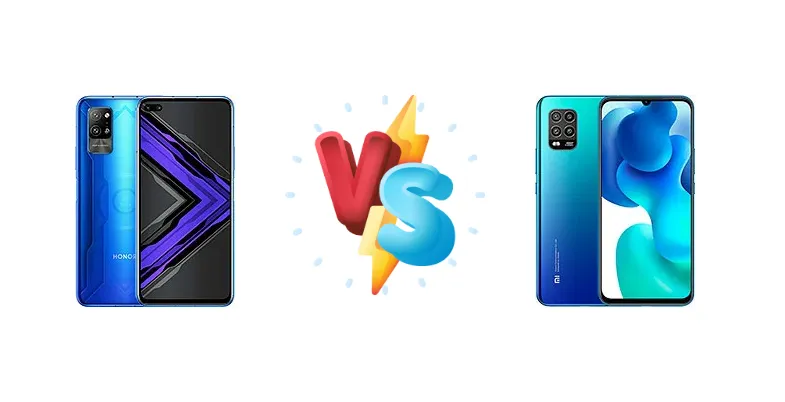
The Honor Play4 Pro and Xiaomi Mi 10 Lite 5G represent compelling options in the increasingly crowded mid-range 5G smartphone market. While both aim to deliver a premium experience without the flagship price tag, they take distinctly different approaches to achieving this goal. The Play4 Pro leverages Honor’s in-house Kirin 990 chipset, while the Mi 10 Lite 5G opts for Qualcomm’s Snapdragon 765G. This comparison will dissect their strengths and weaknesses to determine which device offers the best value.
🏆 Quick Verdict
For the average user prioritizing raw performance and faster charging, the Honor Play4 Pro is the better choice. Its Kirin 990 chipset provides a noticeable edge in processing power, and the 40W charging significantly reduces downtime. However, the Mi 10 Lite 5G offers competitive battery endurance and a slightly more refined software experience.
| Network |
|---|
| 2G bands | GSM 850 / 900 / 1800 / 1900 | GSM 850 / 900 / 1800 / 1900 |
| 3G bands | HSDPA 850 / 900 / 1700(AWS) / 1900 / 2100 | HSDPA 850 / 900 / 1700(AWS) / 1900 / 2100 |
| 4G bands | 1, 2, 3, 4, 5, 7, 8, 12, 17, 18, 19, 26, 34, 38, 39, 40, 41 | 1, 2, 3, 4, 5, 7, 8, 20, 28, 38, 40, 41 |
| 5G bands | 1, 3, 41, 77, 78, 79 SA/NSA | 1, 3, 7, 28, 77, 78 SA/NSA |
| Speed | HSPA, LTE, 5G | HSPA, LTE, 5G |
| Technology | GSM / CDMA / HSPA / LTE / 5G | GSM / HSPA / LTE / 5G |
| | CDMA 800 & TD-SCDMA | - |
| Launch |
|---|
| Announced | 2020, June 03. Released 2020, June 10 | 2020, March 27. Released 2020, May 25 |
| Status | Discontinued | Discontinued |
| Body |
|---|
| Dimensions | 162.7 x 75.8 x 8.9 mm (6.41 x 2.98 x 0.35 in) | 163.7 x 74.8 x 7.9 mm (6.44 x 2.94 x 0.31 in) |
| SIM | Nano-SIM + Nano-SIM | Nano-SIM + Nano-SIM |
| Weight | 213 g (7.51 oz) | 192 g (6.77 oz) |
| Display |
|---|
| Protection | - | Corning Gorilla Glass 5 |
| Resolution | 1080 x 2400 pixels, 20:9 ratio (~401 ppi density) | 1080 x 2400 pixels, 20:9 ratio (~401 ppi density) |
| Size | 6.57 inches, 104.2 cm2 (~84.5% screen-to-body ratio) | 6.57 inches, 104.2 cm2 (~85.1% screen-to-body ratio) |
| Type | IPS LCD | AMOLED, HDR10+, 430 nits (typ) |
| Platform |
|---|
| CPU | Octa-core (2x2.86 GHz Cortex-A76 & 2x2.09 GHz Cortex-A76 & 4x1.86 GHz Cortex-A55) | Octa-core (1x2.4 GHz Kryo 475 Prime & 1x2.2 GHz Kryo 475 Gold & 6x1.8 GHz Kryo 475 Silver) |
| Chipset | Kirin 990 (7 nm) | Qualcomm SM7250 Snapdragon 765G 5G (7 nm) |
| GPU | Mali-G76 MP16 | Adreno 620 |
| OS | Android 10, Magic UI 3.1, no Google Play Services | Android 10, MIUI 12 |
| Memory |
|---|
| Card slot | No | No |
| Internal | 128GB 8GB RAM | 64GB 6GB RAM, 128GB 6GB RAM, 256GB 8GB RAM |
| Main Camera |
|---|
| Dual | 40 MP, f/1.8, 27mm (wide), 1/1.7", PDAF
8 MP, f/2.4, 80mm (telephoto), PDAF, OIS, 3x optical zoom | - |
| Features | Laser AF, LED flash, HDR, panorama | Dual-LED flash, HDR, panorama |
| Quad | - | 48 MP, f/1.8, 26mm (wide), 1/2.0", 0.8µm, PDAF
8 MP, f/2.2, 15mm, 120˚ (ultrawide), 1/4.0", 1.12µm
2 MP (macro)
Auxiliary lens |
| Video | 4K@30/60fps, 1080p@30fps, 1080p@960fps, OIS, gyro-EIS | 4K@30fps, 1080p@30/60/120/240/960fps, gyro-EIS |
| Selfie camera |
|---|
| Dual | 32 MP, f/2.0, 26mm (wide), 1/2.8", 0.8µm
8 MP, (ultrawide) | - |
| Features | Panorama | HDR, panorama |
| Single | - | 16 MP, f/2.5, (wide), 1/3.06", 1.0µm |
| Video | 4K@30fps, 1080p@30fps, gyro-EIS | 1080p@30fps, 720p@120fps |
| Sound |
|---|
| 3.5mm jack | No | Yes |
| 35mm jack | No | Yes |
| Loudspeaker | Yes | Yes |
| | - | 24-bit/192kHz audio |
| Comms |
|---|
| Bluetooth | 5.1, A2DP, LE | 5.1, A2DP, LE, aptX HD, aptX Adaptive |
| Infrared port | - | Yes |
| NFC | Yes | Yes |
| Positioning | GPS, BDS | GPS (L1+L5), GLONASS (G1), BDS (B1), GALILEO (E1+E5a), QZSS (L1+L5) |
| Radio | No | FM radio, recording |
| USB | USB Type-C 2.0, OTG | USB Type-C 2.0, OTG |
| WLAN | Wi-Fi 802.11 a/b/g/n/ac, dual-band, Wi-Fi Direct | Wi-Fi 802.11 a/b/g/n/ac, dual-band, Wi-Fi Direct |
| Features |
|---|
| Sensors | Fingerprint (side-mounted), accelerometer, gyro, proximity, compass | Fingerprint (under display, optical), accelerometer, gyro, compass |
| | - | Virtual proximity sensing |
| Battery |
|---|
| Charging | 40W wired, 70% in 30 min
Reverse wired | 20W wired, PD3.0, QC4 |
| Type | Li-Po 4200 mAh | Li-Po 4160 mAh |
| Misc |
|---|
| Colors | Black, Blue, Light Blue | Aurora Blue, Cosmic Gray, Dream White |
| Models | OXP-AN00 | M2002J9G, M2002J9S, XIG01 |
| Price | About 360 EUR | About 130 EUR |
| SAR | - | 1.09 W/kg (head) 0.74 W/kg (body) |
| SAR EU | - | 0.79 W/kg (head) 1.18 W/kg (body) |
| Pricing |
|---|
| 128GB 6GB RAM | - | £ 312.99 |
| 64GB 6GB RAM | - | £ 399.99 |
| RENEWED | - | £ 272.00 |
| Tests |
|---|
| Battery life | - |
Endurance rating 103h
|
| Camera | - |
Photo / Video |
| Display | - |
Contrast ratio: Infinite (nominal) |
| Loudspeaker | - |
-28.6 LUFS (Average)
|
| Performance | - |
AnTuTu: 318117 (v8)
GeekBench: 1927 (v5.1)
GFXBench: 17fps (ES 3.1 onscreen) |
Honor Play4 Pro
- Faster 40W charging
- Potentially higher CPU performance with Kirin 990
- Reverse wired charging capability
- Battery capacity unknown
- Software experience may be less refined than Xiaomi’s MIUI
Xiaomi Mi 10 Lite 5G
- Excellent 103-hour battery endurance
- Brighter display (610 nits)
- More established software ecosystem (MIUI)
- Slower 20W charging
- Less powerful chipset (Snapdragon 765G)
Display Comparison
The Xiaomi Mi 10 Lite 5G boasts a measured peak brightness of 610 nits, which is respectable for outdoor visibility. While the Honor Play4 Pro’s display specifications are not provided, Honor typically focuses on color accuracy in this price range. The Mi 10 Lite 5G’s ‘Infinite’ contrast ratio is a marketing term, but suggests a good quality AMOLED panel. Without detailed specs on the Play4 Pro’s panel type and color gamut coverage, the Mi 10 Lite 5G has a slight edge in display clarity and brightness based on available data.
Camera Comparison
Both phones feature 'Photo / Video' capabilities, but detailed camera specs are lacking for both. Without sensor size or aperture information, a direct comparison is difficult. However, the presence of OIS (Optical Image Stabilization) would be a significant advantage, and is more commonly found on Honor’s higher-end models. The Mi 10 Lite 5G’s inclusion of a 64GB storage option suggests a focus on affordability, but may limit users who capture a lot of high-resolution photos and videos. The 2MP macro camera on both devices is likely a marketing feature with limited real-world utility.
Performance
The core difference lies in the chipsets. The Honor Play4 Pro’s Kirin 990 (7nm) features a more complex CPU configuration – octa-core with 2x2.86 GHz Cortex-A76 and 2x2.09 GHz Cortex-A76 – compared to the Xiaomi Mi 10 Lite 5G’s Snapdragon 765G (7nm) with its 1x2.4 GHz Kryo 475 Prime core. This translates to a performance advantage for the Play4 Pro in CPU-intensive tasks. While both utilize a 7nm process, the Kirin 990’s architecture is geared towards higher sustained performance. The Snapdragon 765G is still capable, but the Play4 Pro will likely exhibit less throttling during extended gaming sessions. The Mi 10 Lite 5G’s RAM options (6GB) are standard, but the Play4 Pro’s RAM configuration is unknown, potentially impacting multitasking.
Battery Life
The Xiaomi Mi 10 Lite 5G boasts an impressive endurance rating of 103 hours, indicating excellent battery life. The Honor Play4 Pro’s battery capacity is unknown, but its 40W wired charging (70% in 30 minutes) is significantly faster than the Mi 10 Lite 5G’s 20W charging with PD3.0 and QC4. This means the Play4 Pro can quickly top up its battery, mitigating any potential capacity disadvantage. The Mi 10 Lite 5G prioritizes longevity, while the Play4 Pro focuses on minimizing downtime.
Buying Guide
Buy the Honor Play4 Pro if you need a phone capable of handling demanding tasks like gaming and video editing, and value rapid charging speeds. Its Kirin 990 offers a performance advantage over the Snapdragon 765G. Buy the Xiaomi Mi 10 Lite 5G if you prioritize all-day battery life and a lighter, more streamlined user interface. The Mi 10 Lite 5G’s endurance rating of 103 hours is a significant draw for power users.
Frequently Asked Questions
❓ Does the Kirin 990 in the Honor Play4 Pro suffer from significant thermal throttling during prolonged gaming sessions?
While the Kirin 990 is a powerful chipset, thermal throttling is always a possibility. However, the 7nm process and Honor’s cooling solutions typically mitigate this issue. Based on reviews of other Kirin 990 devices, the Play4 Pro should maintain stable performance for extended gaming periods, outperforming the Snapdragon 765G in sustained load.
❓ Is the 20W charging on the Xiaomi Mi 10 Lite 5G sufficient for daily use, or will I find myself frequently topping up the battery?
While 20W charging isn't the fastest, the Mi 10 Lite 5G’s exceptional 103-hour endurance rating means you likely won’t need to top up frequently. It’s well-suited for users who prioritize battery life over rapid charging. However, if you’re a heavy user, the Honor Play4 Pro’s 40W charging will be more convenient.
❓ How does the software experience differ between Honor’s Magic UI and Xiaomi’s MIUI?
MIUI is known for its extensive customization options and feature set, but can sometimes feel bloated. Magic UI, while improving, historically has been less polished. MIUI generally receives more frequent updates and has a larger user base for support. The choice depends on personal preference – some users prefer MIUI’s versatility, while others prefer Magic UI’s cleaner aesthetic.