
Honor Play4 Pro vs Huawei P40 lite 5G: Which Kirin-Powered Phone Reigns Supreme?
| Phones Images | |||||
|---|---|---|---|---|---|
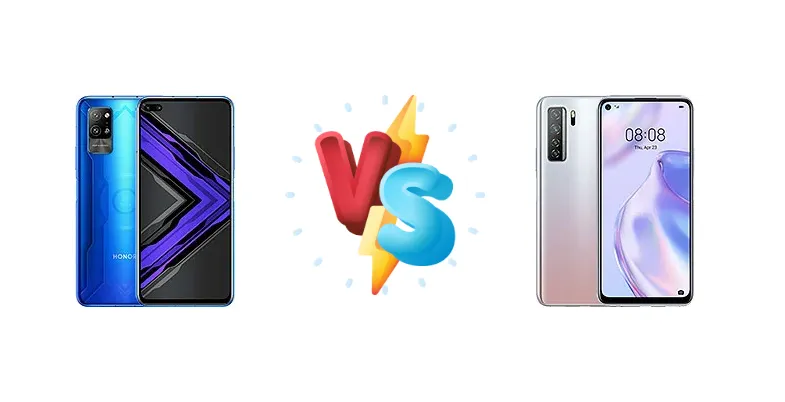
|
🏆 Quick Verdict
For users prioritizing raw performance and sustained gaming, the Honor Play4 Pro is the clear winner thanks to its Kirin 990 chipset. While the P40 lite 5G offers a very similar charging experience and 5G connectivity, it can't match the Play4 Pro's processing power. The Play4 Pro is the better choice for demanding users.
| PHONES | ||
|---|---|---|
| Phone Names | Honor Play4 Pro | Huawei P40 lite 5G |
| Network | ||
|---|---|---|
| 2G bands | GSM 850 / 900 / 1800 / 1900 | GSM 850 / 900 / 1800 / 1900 |
| 3G bands | HSDPA 850 / 900 / 1700(AWS) / 1900 / 2100 | HSDPA 800 / 850 / 900 / 1700(AWS) / 1900 / 2100 |
| 4G bands | 1, 2, 3, 4, 5, 7, 8, 12, 17, 18, 19, 26, 34, 38, 39, 40, 41 | 1, 2, 3, 4, 5, 6, 7, 8, 12, 17, 18, 19, 20, 26, 28, 34, 38, 39, 40, 41, 66 |
| 5G bands | 1, 3, 41, 77, 78, 79 SA/NSA | 1, 3, 28, 38, 41, 77, 78, 79 SA/NSA |
| Speed | HSPA, LTE, 5G | HSPA, LTE, 5G |
| Technology | GSM / CDMA / HSPA / LTE / 5G | GSM / HSPA / LTE / 5G |
| CDMA 800 & TD-SCDMA | - | |
| Launch | ||
|---|---|---|
| Announced | 2020, June 03. Released 2020, June 10 | 2020, May 15. Released 2020, May 28 |
| Status | Discontinued | Discontinued |
| Body | ||
|---|---|---|
| Dimensions | 162.7 x 75.8 x 8.9 mm (6.41 x 2.98 x 0.35 in) | 162.3 x 75 x 8.6 mm (6.39 x 2.95 x 0.34 in) |
| SIM | Nano-SIM + Nano-SIM | Nano-SIM + Nano-SIM |
| Weight | 213 g (7.51 oz) | 189 g (6.67 oz) |
| Display | ||
|---|---|---|
| Resolution | 1080 x 2400 pixels, 20:9 ratio (~401 ppi density) | 1080 x 2400 pixels, 20:9 ratio (~405 ppi density) |
| Size | 6.57 inches, 104.2 cm2 (~84.5% screen-to-body ratio) | 6.5 inches, 102.0 cm2 (~83.8% screen-to-body ratio) |
| Type | IPS LCD | IPS LCD, HDR10 |
| Platform | ||
|---|---|---|
| CPU | Octa-core (2x2.86 GHz Cortex-A76 & 2x2.09 GHz Cortex-A76 & 4x1.86 GHz Cortex-A55) | Octa-core (1x2.36 GHz Cortex-A76 & 3x2.22 GHz Cortex-A76 & 4x1.84 GHz Cortex-A55) |
| Chipset | Kirin 990 (7 nm) | Kirin 820 5G (7 nm) |
| GPU | Mali-G76 MP16 | Mali-G57 (6-core) |
| OS | Android 10, Magic UI 3.1, no Google Play Services | Android 10, EMUI 10.1, no Google Play Services |
| Memory | ||
|---|---|---|
| Card slot | No | Nano Memory (uses shared SIM slot) |
| Internal | 128GB 8GB RAM | 128GB 6GB RAM, 128GB 8GB RAM |
| Main Camera | ||
|---|---|---|
| Dual | 40 MP, f/1.8, 27mm (wide), 1/1.7", PDAF 8 MP, f/2.4, 80mm (telephoto), PDAF, OIS, 3x optical zoom | - |
| Features | Laser AF, LED flash, HDR, panorama | LED flash, Panorama, HDR |
| Quad | - | 64 MP, f/1.8, 26mm (wide), PDAF 8 MP, f/2.4, 17mm (ultrawide) 2 MP (macro) Auxiliary lens |
| Video | 4K@30/60fps, 1080p@30fps, 1080p@960fps, OIS, gyro-EIS | 4K@30fps, 1080p@30fps |
| Selfie camera | ||
|---|---|---|
| Dual | 32 MP, f/2.0, 26mm (wide), 1/2.8", 0.8µm 8 MP, (ultrawide) | - |
| Features | Panorama | HDR |
| Single | - | 16 MP, f/2.0, (wide) |
| Video | 4K@30fps, 1080p@30fps, gyro-EIS | 1080p@30fps |
| Sound | ||
|---|---|---|
| 3.5mm jack | No | Yes |
| 35mm jack | No | Yes |
| Loudspeaker | Yes | Yes |
| Comms | ||
|---|---|---|
| Bluetooth | 5.1, A2DP, LE | 5.1, A2DP, LE |
| NFC | Yes | Yes |
| Positioning | GPS, BDS | GPS, GLONASS, GALILEO, BDS |
| Radio | No | No |
| USB | USB Type-C 2.0, OTG | USB Type-C 2.0, OTG |
| WLAN | Wi-Fi 802.11 a/b/g/n/ac, dual-band, Wi-Fi Direct | Wi-Fi 802.11 a/b/g/n/ac, dual-band, Wi-Fi Direct |
| Features | ||
|---|---|---|
| Sensors | Fingerprint (side-mounted), accelerometer, gyro, proximity, compass | Fingerprint (side-mounted), accelerometer, gyro, proximity, compass |
| Battery | ||
|---|---|---|
| Charging | 40W wired, 70% in 30 min Reverse wired | 40W wired, 70% in 30 min 5W reverse wired |
| Type | Li-Po 4200 mAh | Li-Po 4000 mAh |
| Misc | ||
|---|---|---|
| Colors | Black, Blue, Light Blue | Crush Green, Space Silver, Midnight Black |
| Models | OXP-AN00 | CDY-NX9A |
| Price | About 360 EUR | About 190 EUR |
Honor Play4 Pro
- More powerful Kirin 990 chipset
- Superior GPU performance for gaming
- Reverse wired charging capability
- Potentially better image processing
- May experience more thermal throttling under sustained load
- Potentially higher power consumption
Huawei P40 lite 5G
- Slightly more modern design (potentially)
- Competitive 40W fast charging
- Solid performance for everyday tasks
- 5G connectivity
- Less powerful Kirin 820 chipset
- No reverse wired charging
- Inferior GPU performance
Display Comparison
Unfortunately, detailed display specifications are unavailable. However, given the market positioning, we can infer both devices likely utilize IPS LCD panels. The key differentiator will be color calibration and peak brightness. The P40 lite 5G, being a newer model, *may* benefit from slightly improved panel technology, but without concrete data, this remains speculative. Bezels are likely comparable, targeting a modern, edge-to-edge aesthetic.
Camera Comparison
Without detailed sensor information, a direct camera comparison is difficult. However, the Kirin 990’s more powerful ISP (Image Signal Processor) in the Play4 Pro likely translates to better image processing, particularly in low-light conditions. The P40 lite 5G may compensate with software optimizations, but the hardware advantage leans towards the Play4 Pro. We can assume both phones feature a multi-camera setup, but the Play4 Pro’s ISP will likely handle dynamic range and noise reduction more effectively. The presence of OIS (Optical Image Stabilization) would be a significant advantage for either device, but this information is currently unavailable.
Performance
The core difference lies in the chipsets. The Honor Play4 Pro’s Kirin 990, built on a 7nm process, features a more complex CPU configuration: two high-performance Cortex-A76 cores clocked at 2.86 GHz, two more Cortex-A76 cores at 2.09 GHz, and four efficiency-focused Cortex-A55 cores at 1.86 GHz. The P40 lite 5G’s Kirin 820 5G also uses a 7nm process, but its CPU is configured with one Cortex-A76 core at 2.36 GHz, three Cortex-A76 cores at 2.22 GHz, and four Cortex-A55 cores at 1.84 GHz. This suggests the Kirin 990 offers a significant advantage in multi-core performance and sustained clock speeds, benefiting demanding tasks like video editing and gaming. The Kirin 990 also boasts a more powerful Mali-G76 MP16 GPU compared to the Kirin 820’s Mali-G56 MP4, further solidifying the Play4 Pro’s gaming prowess. Both devices likely utilize LPDDR4X RAM, but the Play4 Pro’s superior chipset will be the limiting factor, not RAM speed.
Battery Life
Both devices feature 40W wired charging, achieving 70% charge in 30 minutes. This is a significant advantage for both, offering rapid top-ups. The Play4 Pro offers reverse wired charging, a feature absent in the P40 lite 5G, allowing it to charge other devices. While battery capacity isn’t specified, the Kirin 990’s greater power consumption may necessitate a slightly larger battery in the Play4 Pro to achieve comparable battery life. The similar charging speeds largely negate any potential battery capacity differences for the average user.
Buying Guide
Buy the Honor Play4 Pro if you need a phone capable of handling demanding games and applications, and value the extra processing headroom offered by the Kirin 990. Buy the Huawei P40 lite 5G if you prioritize a slightly more streamlined user experience and are content with solid, but not exceptional, performance for everyday tasks and casual gaming.